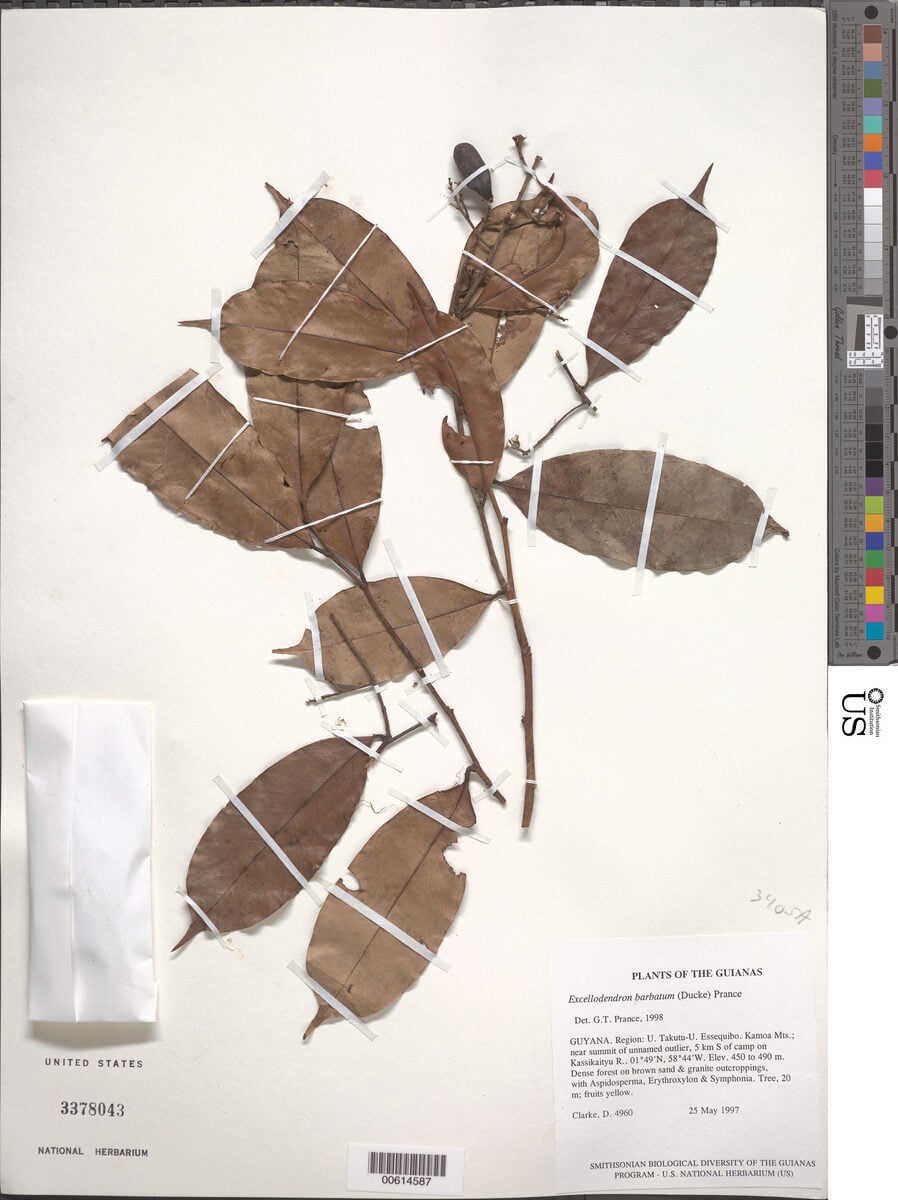
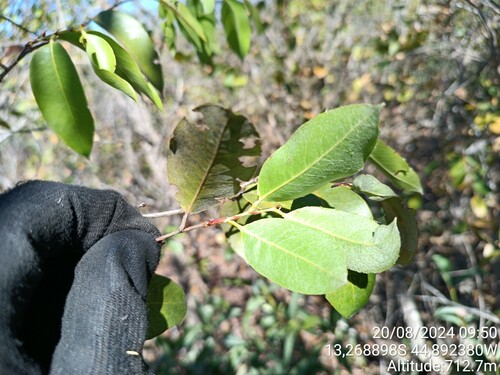
Parinari excelsa
Sabine
Rough skinned plum, Guinea plum
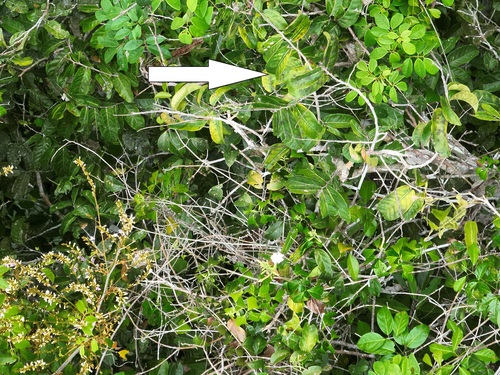
iNaturalist· cc-by-nc
(c) Nigel Pitman, some rights reserved (CC BY-NC), uploaded by Nigel Pitman
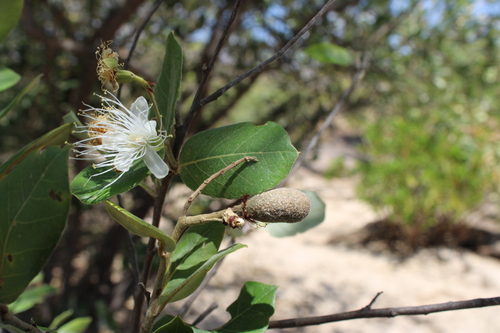
iNaturalist· cc-by-nc
(c) Carel Jongkind, some rights reserved (CC BY-NC), uploaded by Carel Jongkind
iNaturalist· cc-by-nc-sa
(c) TanzaniaPlantCollaboration, some rights reserved (CC BY-NC-SA)
Summary
Source: WikipediaParinari excelsa, the Guinea plum, is a species of large, evergreen tree in the family Chrysobalanaceae. It has a very wide distribution in tropical Africa and the Americas. This species grows to 50 m (160 ft) tall while the trunk is up to 1.5 m (5 ft) in diameter.
Description
A large evergreen tree. It grows to 50 m high. The trunk is 1.5 m across. It has buttresses. The branches have a cottony covering. The leaves are alternate and simple. They are 5-10 cm long by 2.5-5 cm wide. The flowers are pink and white. They have a sweet smell. Fruit are oval and 6 cm long by 4 cm wide. They are red-brown and have a warty surface. This is hard and woody. There are 1-2 seeds per stone.
Edible Uses
The unripe fruit are eaten after extended preparation, while ripe fruit can be consumed fresh, dried and boiled with peanut sauce, or fermented. The kernel is roasted and mixed into other foods, and the bark is roasted to flavor palm wine.
Traditional Uses
The unripe fruit are eaten after long preparation. The ripe fruit can be eaten or cut up and dried and boiled with peanut sauce. They are also fermented. The kernel is roasted and then mixed with other foods. The bark is roasted and used to flavour palm wine.
Medicinal Uses
A decoction of the bark is used in the treatment of anaemia and is used as a tonic by pregnant women. Either alone, or combined with other medicinal plants, it is taken in decoction as a treatment against diarrhoea, stomach ache and other stomach-disorders. Combined with earth from the fungus-nursery in a termite nest, it is taken as a treatment for hookworm, and is also used in a treatment of insanity. Used externally, it is pounded, macerated and chewed then applied as a cicatrizant to fresh wounds, especially in circumcision. Analysis of material from the Congo showed a trace of flavones in the stem-bark, and an abundance in the roots, plus plenty of tannin in both, but no other active principal. A root-macerate is taken internally as a treatment for migraine and stomach-pains, and for female sterility. Externally, it is used as a haemostatic and cicatrizant. Root-decoctions are prepared for washes, baths, massages and fumigations in tiredness, fevers and chest-pains and rheumatism. Steam from a boiling decoction of leafy twigs is considered to soothe gingivitis, stomatitis and toothache. An infusion of the fruit is taken as a drink in the treatment of diarrhoea and dysentery.
Distribution
A tropical plant. It grows in tropical Africa. It grows in forest and along river banks. It can be in savannah or palm groves. It grows from the lowlands to 1,000 m altitude in West Africa. In East Africa it grows to 2,400 m altitude.
Where It Grows
Africa, Amazon, Angola, Benin, Bolivia, Brazil, Burkina Faso, Burundi, Cameroon, Central Africa, Central African Republic, CAR, Central America, Colombia, Congo DR, Costa Rica, Côte d'Ivoire, East Africa, French Guiana, Gabon, Gambia, Ghana, Guianas, Guinea, Guinée, Guinea-Bissau, Guyana, Honduras, Ivory Coast, Liberia, Malawi, Mozambique, Nigeria, Rwanda, Senegal, Sierra Leone, South America, Suriname, Tanzania, Togo, Uganda, Venezuela, West Africa, Zambia,
Cultivation
Trees are grown from seed.
Other Uses
Both the wood-ash and the bark-ash contain tannin. The endocarp is filled with a loose cottony wool surrounding the kernel. This is used as a fire-tinder. The seed shell and pulp of the fruit yield a dye. A drying oil can be obtained from the seed. The sapwood is creamy-white and not clearly demarcated from the brown heartwood. The wood is hard, heavy, very strong and tough. It sinks when fresh. It is a timber of secondary importance and logging is now not commonly carried out, though it has been traded as sugué from Ivory Coast for shipment to Europe as a substitute for oak. The timber is difficult to work. It is so full of silica that saws blunt rapidly. It is best sawn whilst still green and with special saws. Yet it finds use locally and has potential. It is cut into planks and timbers and made into furniture. If exposed to weathering it is not durable and may be attacked by borers, though if protected it is good for house-timbers. If pressure-treated with preservative, it is excellent for railway sleepers. It is used for cabinet making, joinery, construction, furniture, tool handles and domestic utensils. The wood is also used for firewood and yields a good charcoal. The tree is used for shade in coffee and cinchona plantations.
Production
In Tanzania fruit are collected from August to March. In Sierra Leone fruit are between June and December.
Other Information
Fruit are sold in markets. The fruit are especially eaten by children. It is considered an important fruit tree.
Notes
There are about 50 Parinari species. They grow in the tropics.
Nutrition
| Part | Moisture | kJ | kcal | Protein | Vit A | Vit C | Iron | Zinc |
|---|---|---|---|---|---|---|---|---|
| Fruit | 66.8 | 489 | 117 | 1.3 | — | — | 1.7 | — |
Synonyms
Also Known As
Aiamoradan, Am-bis, Asila akoung, Atchaguesse, Bal-le, Banga, Bionai, Bitchalam, Bokohoton, Bu fujay, Bussol, Bu wel, Cura, Curanaco, Esagko, Foungouti, Grey plum, Guari, Ijakere, Inyi, Jaraguacaba, Kankenom, Kein, Koa, Koin, Kola, Kpar, Kure, Kwalo, Lut, Machende a nguluwe, Makara-yek, Mampara, Mampata, Mampatace, Mampatas, Mampataz, Mampato, Mantchoul, Mbula, Meile, Merecurillo, Mgama, Mganda, Minquela, Minquelma, Mkanjula, Msaula, Mubura, Mulanga, Mulatana, Mupundu wa muhulu, Muula, Naudi, N'djano, N'tchalame, Ndawa, Ndawei, Nguluwe, Nheg-cuneme, Pile, Quein, Roffin-plom, Rosenkwarie, Suge, Uchirana, Uchi de tambagui, Uguene, Ukenom, Undiano, Wokere besoerie
References (48)
- Aniama, S. O., et al, 2016, Ethnobotanical documentaton of some plants among Igala people of Kogi State (Nigeria). The International Journal Of Engineering And Science (IJES). 5(4) pp 33-42
- Atato, A., et al, 2010, Diversity of Edible Wild Fruit Tree Species of Togo. Global Science Books.
- Awodoyin, R.O., Olubode, O.S., Ogbu, J.U., Balogun, R.B., Nwawuisi, J.U. and Orji, K.O., 2015, Indigenous Fruit Trees of Tropical Africa: Status, Opportunity for Development and Biodiversity Management. Agricultural Sciences, 6, 31-41
- Bojang, L., 1999, Non-wood Forest Products in The Gambia. EC-FAO Partnership Programme.
- Burkill, H. M., 1985, The useful plants of west tropical Africa, Vol. 1. Kew.
Show all 48 references Hide references
- Burkill, I.H., 1966, A Dictionary of the Economic Products of the Malay Peninsula. Ministry of Agriculture and Cooperatives, Kuala Lumpur, Malaysia. Vol 2 (I-Z) p 1694 (As Parinarium excelsum)
- Djihounouck, Y., et al, 2018, Diversité Et Importance Socio-Economique Des Espèces Fruitières Sauvages Comestibles En Zone Kasa (Sud-Ouest Du Sénégal). European Scientific Journal December 2018 edition Vol.14, No.36 ISSN: 1857 – 7881
- Djihounouck, Y., et al, 2021, Ethnobotanical Uses of Non-cultivated Edible Fruit Species in the Department of Oussouye (South Senegal). Journal of Food Research; Vol. 10, No. 4 p 20
- FAO. 1983, Food and fruit-bearing forest species 1: Examples from Eastern Africa. FAO Food and Forestry Paper 44/1 p 87
- FERRY et al., (As Parinarium excelsum)
- Food Composition Tables for use in Africa FAO http://www.fao.org/infoods/directory No. 1003
- Fowler, D. G., 2007, Zambian Plants: Their Vernacular Names and Uses. Kew. p 18
- Fox, F. W. & Young, M. E. N., 1982, Food from the Veld. Delta Books. p 155
- Gallois, S., et al, 2020, Methodological priorities in assessing wild edible plant knowledge and use – a case study among the Baka in Cameroon.
- Grandtner, M. M. & Chevrette, J., 2013, Dictionary of Trees, Volume 2: South America: Nomenclature, Taxonomy and Ecology. Academic Press p 481
- Gueye, M., et al, 2014, Wild Fruits Traditionally Gathered by the Malinke Ethnic Group in the Edge of Niokolo Koba Park (Senegal). American Journal of Plant Sciences 5, 1306-1317
- Hawthorne, W.& Marshall, C., 2013, Nimba Western Area Iron Ore Concentrator Mining Project Environmental and Social Impact Assessment. AcelorMittel Liberia. p 498
- Hedrick, U.P., 1919, (Ed.), Sturtevant's edible plants of the world. p 464 (As Parinarium excelsum)
- Heywood, V.H., Brummitt, R.K., Culham, A., and Seberg, O. 2007, Flowering Plant Families of the World. Royal Botanical Gardens, Kew. p 99
- Hwang, L. C., et al, 2020, Traditional Botanical Uses of Non-Timber Forest Products (NTFP) in Seven Counties in Liberia. ACS Symposium Series; American Chemical Society: Washington, DC, 2020.
- Jardin, C., 1970, List of Foods Used In Africa, FAO Nutrition Information Document Series No 2.p 35, 152
- Jusu, A. & Cuni-Sanchez, A., 2017, Priority indigenous fruit trees in the African rainforest zone: insights from Sierra Leone. Genet Resour Crop Evol (2017) 64:745–760
- Kermath, B. M., et al, 2014, Food Plants in the Americas: A survey of the domesticated, cultivated and wild plants used for Human food in North, Central and South America and the Caribbean. On line draft. p 606
- Latham, P & Mbuta, A., 2017, Useful Plants of Central Province, Democratic Republic of Congo. Volume 2. Salvation Army p 86
- Le Houerou, H. N., (Ed.), 1980, Browse in Africa. The current state of knowledge. International Livestock Centre for Africa, Ethiopia. p 162
- Lovett, J. C. et al, Field Guide to the Moist Forest Trees of Tanzania. p 38
- Malaisse, F., 1997, Se nourrir en floret claire africaine. Approche ecologique et nutritionnelle. CTA., p 65
- Mangambu Mokoso Jean De Dieu, et al, 2015, Etudes ethnobotanique et ethnolinguistique des ressources forestieres ligneuses utilisees par la population du coulour Ecologique du Parc National de Kahuzi-biega (R. D. Congo). European Journal of Scientific Research May 2015.
- Mpasiwakomu, R. A., 2017, The Diversity and Utilization of Wild Edible and Medicinal Plant Species found in Uvinza Miombo Woodlands, Tanzania. M. Sc. thesis University of Tanzania.
- Msola, D. K., 2007, The role of Wild Foods in Household Income and Food Security in Mufundi District, Tanzania. Morogoro, Tanzania. p 44
- Msuya, T. S., et al, 2010, Availability, Preference and Consumption of Indigenous Foods in the Eastern Arc Mountains, Tanzania, Ecology of Food and Nutrition, 49:3, 208-227
- N'Diaye, M., et al.,2003, Principle fruits of gathering consumed and marketed in Guinea. Fruits, Vol. 58: 99-116
- Oteng-Amoako, A. A. (Ed.), 2006, 100 Tropical African Timber Trees from Ghana. Forestry Research Institute of Ghana. p 202
- Peters, C. R., O'Brien, E. M., and Drummond, R.B., 1992, Edible Wild plants of Sub-saharan Africa. Kew. p 83
- Prance, G. T., 1972, Chrysobalanaceae in Flora Neotropica Vol. 9 Hafner. p 185
- Roa, J. A. G. & Boada, D. S. G., 2018, Fundación para el Fortalecimiento de la Fruticultura y Plantas Alimenticias no Convencionales en Colombia.
- Ruffo, C. K., Birnie, A. & Tengnas, B., 2002, Edible Wild Plants of Tanzania. RELMA p 512
- Savill, P. S. & Fox, J. E. D., Trees of Sierra Leone. p 217
- Trans. Roy. Hort. Soc. London 5:451. 1824
- Unwin, A. H., 1920, West African Forests and Forestry. Fisher Unwin Ltd. pdf on Internet p 54
- Vivien, J. & Faure, J.J., 1985, Abres des forets dense d'Afrique Centrale. Agence de Cooperation Culturelle et Technique. Paris. p 168
- Vivien, J., & Faure, J.J., 1996, Fruitiers Sauvages d'Afrique. Especes du Cameroun. CTA p 119
- von Katja Rembold, 2011, Conservation status of the vascular plants in East African rain forests. Dissertation Universitat Koblenz-Landau p 176
- White, F., Dowsett-Lemaire, F. and Chapman, J. D., 2001, Evergreen Forest Flora of Malawi. Kew. p 193
- Wickens, G.E., 1995, Edible Nuts. FAO Non-wood forest products. FAO, Rome. p 115
- Williamson, J., 2005, Useful Plants of Malawi. 3rd. Edition. Mdadzi Book Trust. p 187
- World Checklist of Useful Plant Species 2020. Royal Botanic Gardens, Kew
- www.colecionandofrutas.org