Couepia longipendula
Pilger
Pendula nut, Drooping couepia
wikimedia· cc-by
Forest & Kim Starr (via Wikimedia Commons)
Summary
Source: WikipediaThe tropical rainforest tree Couepia longipendula is known by the common names egg nut, castanha de galinha, and pendula nut. It is found in the Amazon. Its nuts are used as a food source in rural South America, especially in Brazil. The nuts are useful for their oil.
Description
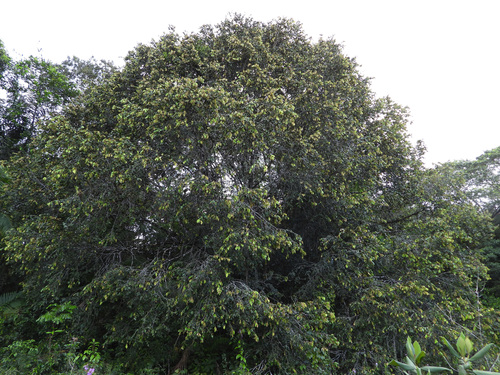
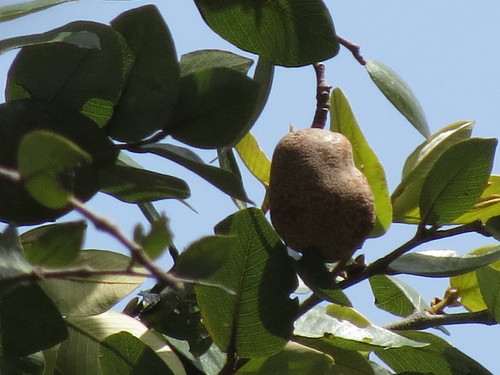
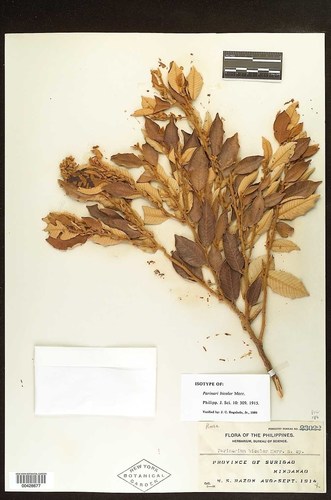
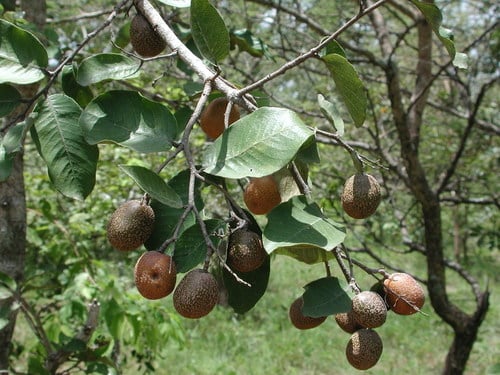
An evergreen tree. It grows 4-30 m high. The trunk is erect and 10-40 cm across. The crown is dense. The leaves are simple and leathery. They are 8-18 cm long and bright green and shiny on the upper surface. The nut has a very hard shell. The flowers are in hanging groups on the end of very long stalks. The stalks can be 1 m long. The flowers are showy and pink and have both sexes. The fruit have long fruit stalks. The fruit are oval and have a thick fibrous skin. They contain one seed or nut. The fruit are 6-7 cm long and 3-4 cm wide. Probably now Acioa longipendula (PIlg.) Sothers & Prance
Edible Uses
The seeds or nuts are eaten fresh, roasted, or toasted. The oil-rich kernels have an excellent flavor and are used in cooking. The nuts are sold in local markets and are popular locally.
Traditional Uses
The seed or nut is eaten fresh, roasted or toasted. The kernels are rich in oil. They have an excellent flavour. The oil is used in cooking.
This uses section is brief — help expand it
Medicinal Uses
The bark and pericarp extracts are used in local medicine.
Distribution
A tropical plant. It grows naturally in dryland tropical forest in the central Amazon in Brazil. It grows between 50-400 m above sea level.
Where It Grows
Amazon, Brazil*, Colombia, Guiana, Peru, South America,
Cultivation
Plants are grown from seed. The seeds are collected from ripe fruit and the fibrous covering removed. Seed should be planted fresh. In cultivation it is a low spreading tree.
Propagation
Seeds germinate within weeks of falling from the tree onto moist ground. Viability is rapidly lost and seeds do not store easily. Sow the seeds in individual containers in a semi-shaded position. Germination rates are usually low, and the seed can be slow to sprout.
Other Uses
The oil from the seed is used for soap-making. A rough fibre is obtained from the bark. The wood is medium-textured, irregular-grained, very heavy, hard, very strong and difficult to work. A very durable wood, it is very resistant to wood-eating organisms. It is used for general construction, carpentry, roofing tiles, railway sleepers, posts etc.
Production
The nut is 75-80% oil.
Other Information
The nuts are sold in local markets. They are popular locally. It is cultivated for the kernels.
Notes
There are 71 Couepia species. They are all in tropical America.
Also Known As
Ayuirai, Castanha-de-galinha, Casranha de galinha, Castanha pendula, Cenizo, Eggnut, Huevo de danta
References (18)
- FAO, 1995, Edible Nuts. Non Wood Forest Products 5. (As Couepia longipendula)
- Grandtner, M. M. & Chevrette, J., 2013, Dictionary of Trees, Volume 2: South America: Nomenclature, Taxonomy and Ecology. Academic Press p 166 (As Couepia longipendula)
- Hermandez Bermejo, J.E., and Leon, J. (Eds.), 1994, Neglected Crops. 1492 from a different perspective. FAO Plant Production and Protection Series No 26. FAO, Rome. p15 (As Couepia longipendula)
- INFOODSUpdatedFGU-list.xls (As Couepia longipendula)
- Kermath, B. M., et al, 2014, Food Plants in the Americas: A survey of the domesticated, cultivated and wild plants used for Human food in North, Central and South America and the Caribbean. On line draft. p 270 (As Couepia longipendula)
Show all 18 references Hide references
- Kiple, K.F. & Ornelas, K.C., (eds), 2000, The Cambridge World History of Food. CUP p 1770 (As Couepia longipendula)
- Lorenzi, H., Bacher, L., Lacerda, M. & Sartori, S., 2006, Brazilian Fruits & Cultivated Exotics. Sao Paulo, Instituto Plantarum de Estuados da Flora Ltda. p 121 (As Couepia longipendula)
- Lorenzi, H., 2009, Brazilian Trees. A Guide to the Identification and Cultivation of Brazilian Native Trees. Instituto Plantarum de Estuados da Flora Ltda. Vol. 3 p 78 (As Couepia longipendula)
- Martin, F. W., et al, 1987, Perennial Edible Fruits of the Tropics. USDA Handbook 642 p 91 (As Couepia longipendula)
- Notizbl. Koenigl. Bot. Gart. Berlin 6:41. 1914 (As Couepia longipendula)
- Paz, F. S., et al, 2021, Edible Fruit Plant Species in the Amazon Forest Rely Mostly on Bees and Beetles as Pollinators. Journal of Economic Entomology, XX(XX), 2021, 1–13 (As Couepia longipendula)
- Prance, G. T., 1972, Chrysobalanaceae in Flora Neotropica Vol. 9 Hafner. p 187 (As Couepia longipendula)
- Reis, S. V. and Lipp, F. L., 1982, New Plant Sources for Drugs and Foods from the New York Botanical Garden herbarium. Harvard. p 107 (As Couepia longipendula)
- Roa, J. A. G. & Boada, D. S. G., 2018, Fundación para el Fortalecimiento de la Fruticultura y Plantas Alimenticias no Convencionales en Colombia.
- Smith, N., Mori, S.A., et al, 2004, Flowering Plants of the Neotropics. Princeton. p 102 (As Couepia longipendula)
- Sothers, C. & Prance, G. T., et al, 2016, Taxonomic novelties in Neotropical Chrysobalanaceae: towards a monophyletic Couepia. Phytotaxa 172 (3) © 2014 Magnolia Press
- Wickens, G.E., 1995, Edible Nuts. FAO Non-wood forest products. FAO, Rome. p 62, 115 (As Couepia longipendula)
- www.tradewindsfruit.com