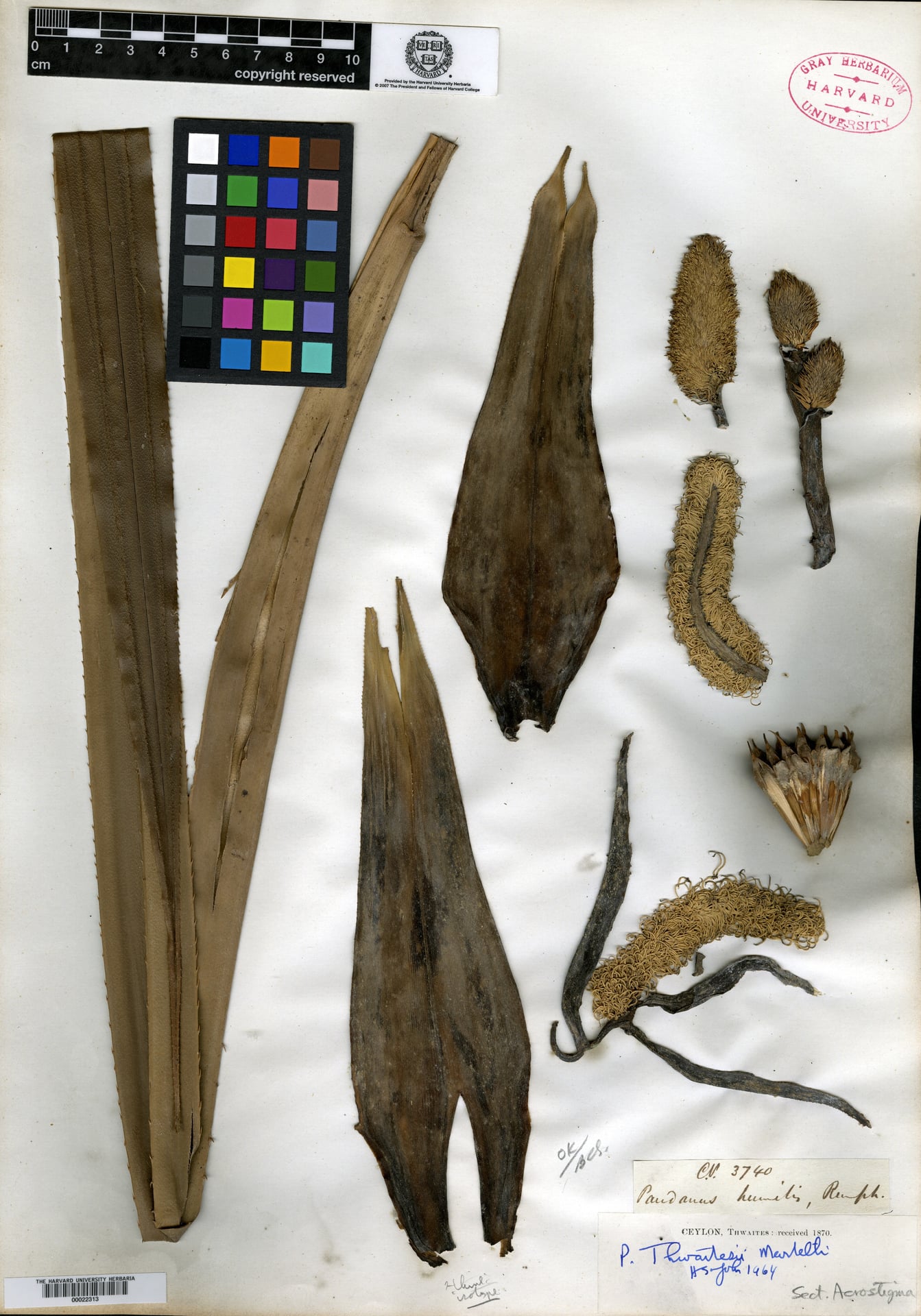
Pandanus antaresensis
St John
gbif· cc0
President and Fellows of Harvard College
gbif· cc0
President and Fellows of Harvard College
gbif· cc0
President and Fellows of Harvard College
Description
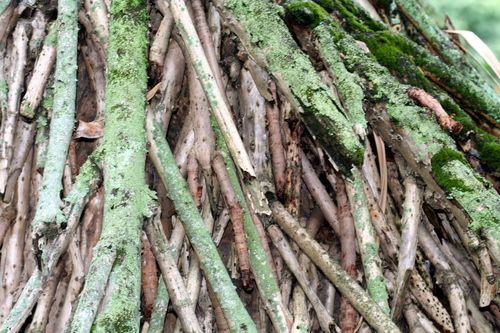
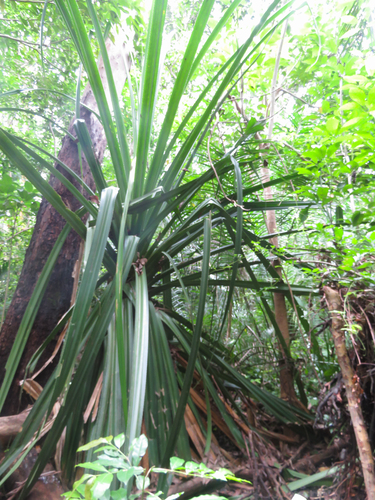
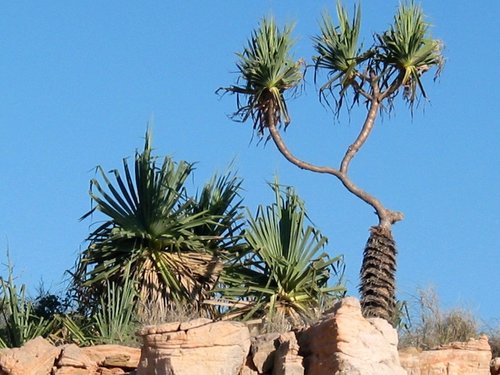
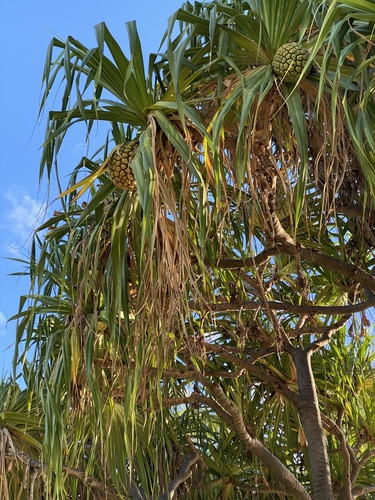
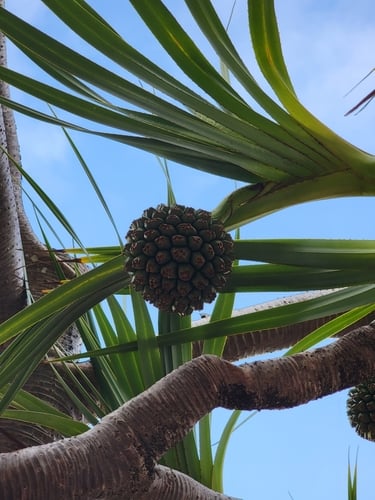
A branched screwpine with crowns normally at the same height. Fruit are large clusters made up of groups of 5 nuts. The kernels are small and hard to extract. When ripe the fruit turn red and the nuts drop individually.
Edible Uses
On New Guinea karuka is cultivated crop, and has been used as a major food source since nearly 31,000 years ago in the Pleistocene. In PNG nearly 2 million people (almost half the rural population) live in regions where karuka is commonly eaten. There is high demand for it in the New Guinea Highlands: Entire households (including pigs, who are sometimes fed the fruits) will move from the valleys to higher elevations at harvest time, often for several weeks. Each household will average 12 to 176 trees. Trade in karuka is small-scale and not commercial. Local marketplaces typically will have 12 to 50 fruits for sale. With some coordination between state agencies and private sector, karuka could have export market access. The crop has a medium potential for large-scale sustainable commercialization in the region, but care must be taken in the sensitive local environments to expanded agriculture. Diets of tree owners could also be negatively influenced by rapid commercialization. The endosperm, a white kernel, is eaten raw, roasted, smoked, or mumued. Nuts that are not immediately eaten are typically sun-dried for storage. The karuka kernels have a sweet, coconut taste, or savory and like walnuts. Smoked or cooked karuka is either stored in the rafters or sold at local marketplaces. The uncooked clusters can also be stored for months buried in waterlogged earth, which possibly ferments it. It is a regional staple food and one of the few plants in the area with a high protein content. The spongy core of the multiple fruit cluster can also be cooked and eaten after the nuts are removed. The high fat content means the nuts can be processed into an edible yellow oil. Karuka oil contains 52.39% oleic acid, 44.90% palmitic acid, and 0.19% stearic acid. The oil is a good source of Vitamin E (α-tocopherol 5.03 mg/100 g). The colour of the oil is from the carotenoids, which are at a concentration of 2.75 μg/g. The antioxidant activity for the oil is fairly low, and it is higher in saturated than unsaturated fats. Some subjective reports indicate that children are healthier after karuka season, but there may also be increased incidence of tropical ulcers and pig-bel (caused by Clostridium perfringens). But the connections, if any, are unclear. Trunks and buttress roots are used for building. The sheets of bark are used for house walls. The leaves are used for bush shelters and raincapes. The leaves were the preferred building material for housing in Papua New Guinea before colonial contact. The durable white spathe leaves on male inflorescences are used by the Wola people to wrap pearl shells. Karuka can be cultivated by cutting a mature branch and replanting it (vegetative propagation). Suckers can also be replanted. Nurseries also plant seeds directly. New nuts will grow when a tree is at least five or six years old, and can keep producing for up to fifty years. The tree can tolerate temperatures down to 3 °C (37 °F) for extended periods and 0 °C (32 °F) for short periods. The USDA hardiness is 10–12, and is hardy to zone 10 in the UK system. In Upper Karint near Pingirip, karukas are planted as boundary lines between garden plots.
Traditional Uses
The kernels are eaten.
This uses section is brief — help expand it
Distribution
A tropical plant. It grows in the highlands from about 1600 to 2500 m altitude. It can be down to 850 m above sea level.
Where It Grows
Asia, Indonesia, Pacific, Papua New Guinea, PNG, SE Asia, West Papua,
Cultivation
Plants are often self sown but are also planted from seed.
Propagation
Seed - can be slow to generate.
Other Uses
The leaves are used for thatching.
Production
Nuts are usually harvested after they fall. Production is not distinctly seasonal. The outside fibres are burnt off then the shell splits.
Other Information
Although the trees are fairly common in Papua New Guinea, the nuts are not highly prized because they are hard to extract.
Notes
There are about 600 Pandanus species. They grow in the tropics.
Also Known As
Aendashor, Kupili, Mataeng, Mayabuw, Paym, Pem, Pembras
References (8)
- Bourke, M., 1995, Edible Indigenous Nuts in Papua New Guinea. In South Pacific Indigenous Nuts. ACIAR Proceedings No 69, Canberra. p 46
- Bourke, R. M., Altitudinal limits of 230 economic crop species in Papua New Guinea. Terra australis 32.
- French, B.R., 1986, Food Plants of Papua New Guinea, A Compendium. Asia Pacific Science Foundation p 161
- Hyndman, D. C., 1984, Ethnobotany of Wopkaimin Pandanus: Significant Papua New Guinea Plant Resource. Economic Botany 38(3) pp. 287-303
- Milliken, W., 2000, Ethnobotany of the Yali of West Papua. Royal Botanical Garden, Edinburgh. p 10 (near Baliem)
Show all 8 references Hide references
- Sillitoe, P. 1995, An Ethnobotanical Account of the Plant Resources of the Wola Region, Southern Highlands Province, Papua New Guinea. J. Ethnobiol. 15(2): 201-235
- Walter, A. & Sam C., 2002, Fruits of Oceania. ACIAR Monograph No. 85. Canberra. p 281
- World Checklist of Useful Plant Species 2020. Royal Botanic Gardens, Kew