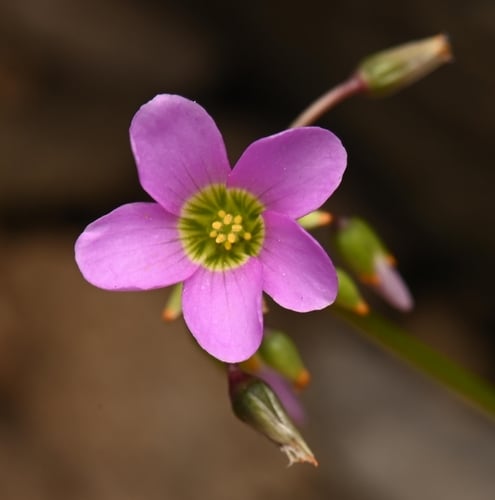
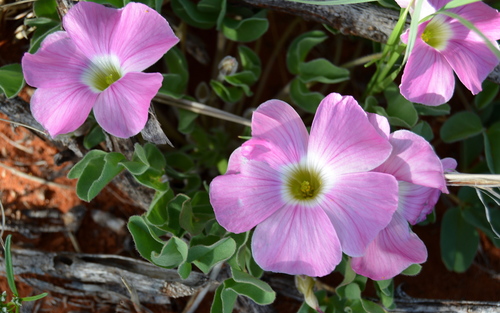
Oxalis debilis var. corymbosa
Kunth, (A. DC.) Lourteig
Pink shamrock, Lilac oxalis
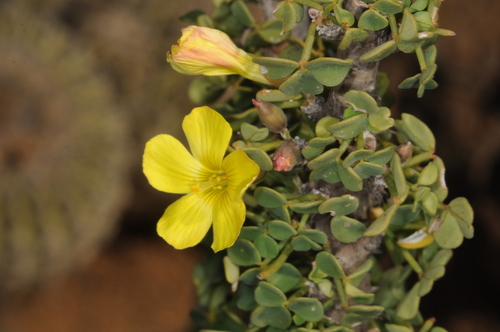
iNaturalist· cc0
no rights reserved, uploaded by 葉子
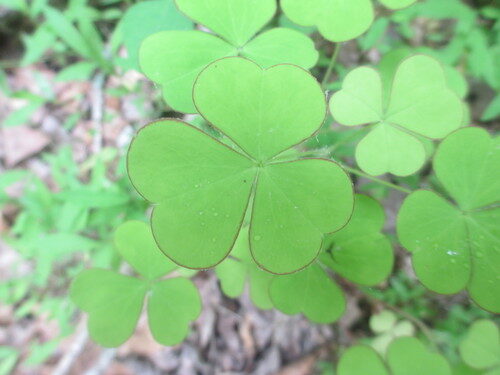
iNaturalist· cc-by-nc
(c) Stella Lung, some rights reserved (CC BY-NC), uploaded by Stella Lung
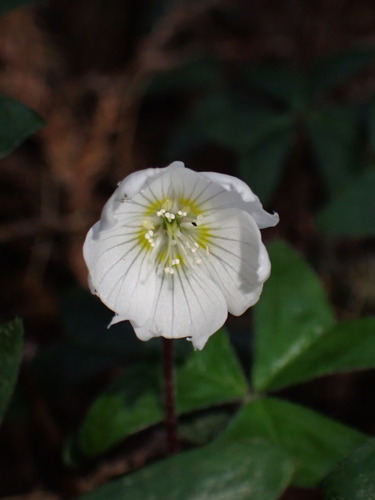
iNaturalist· cc-by
(c) Alison Northup, some rights reserved (CC BY), uploaded by Alison Northup
Summary
Source: WikipediaOxalis debilis, the large-flowered pink-sorrel or pink woodsorrel, is a perennial plant and herb in the family Oxalidaceae. Its original distribution is South America but it has become a cosmopolitan species, occurring in all continents except Antarctica. It can be found in both temperate and tropical areas. The flowers, leaves and roots are edible. The plant contains oxalic acid, which can cause calcium deficiency if eaten in larger amounts, but typical quantities of the plant would likely not be enough to cause this effect.
Description
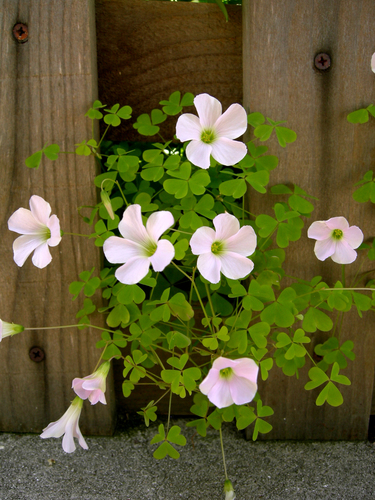
A small herb. It grows 25 cm high. It has bulbils 3-6 mm long. These are amongst the scales on the bulb. The leaves are compound and in rings. The leaf stalks are 7-25 cm long. The leaflets are 2-4 cm long. The flowers are purplish-pink. They occur in groups of 8-15 in the axils of leaves.
Edible Uses
The flowers, leaves and roots are edible. There is concern that the plant should only be consumed in small amounts because it contains oxalic acid, which can cause calcium deficiency if eaten in larger amounts. Studies show that this is an exaggerated fear.
Traditional Uses
The taproot or bulb can be eaten raw. They are also used for pickles. The leaves are used to sour food. They are a substitute for tamarind. The harvested leaves can be stored for 3 days. Caution: The leaves should only be eaten in small amounts due to oxalates.
Distribution
A tropical plant. It grows as a weed in lawns. It can grow in forest. In tropical Queensland it grows from sea level to 400 m altitude. In Java in Indonesia it grows between 450-1,450 m above sea level. In Argentina it grows below 1,000 m above sea level. It is usually in sunny locations.
Where It Grows
Africa, Argentina, Asia, Australia, Brazil, Central America*, China, Dominican Republic, East Africa, Guyana, Haiti, Hawaii, Himalayas, India, Korea, Mexico*, Mozambique, North America, Northeastern India, Pacific, Paraguay, Puerto Rico, Southern Africa, South America*, Uruguay, USA, West Indies,
Cultivation
Plants are grown from small bulbs.
Other Information
It is only eaten in small amounts,
Notes
There are about 500 Oxalis species.
Synonyms
Also Known As
Amrul, Bor tenggeshi, Copper Hammer Plant, Gider singri mekhai, Khatmitthi, 'Ipi pehu, Peria-puliyarai, Pink wood-sorrel, Piyag miu, Bor tengesi, Sanyecu, Tenga, Tenga se tenga, Three-leaved vinegar, Tinpatia, Tongchuicao
References (30)
- Alimenticias - FloraSBS(As Oxalis corymbosa)
- Ambasta, S.P. (Ed.), 2000, The Useful Plants of India. CSIR India. p 418 (As Oxalis martiana)
- Ann. Missouri Bot. Gard. 67:840. 1980
- Bandyopadhyay, S. et al, 2009, Wild edible plants of Koch Bihar district, West Bengal. Natural Products Radiance 8(1) 64-72 (As Oxalis corymbosa)
- Baro, D., Baruah, S. and Borthukar, S. K. 2015, Documentation on wild vegetables of Baksa district, BTAD (Assam). Scholars Research Library. Archives of Applied Science Research, 2015, 7 (9):19-2
Show all 30 references Hide references
- Benvenuti, S. & Mazzoncini, M., 2021, The Biodiversity of Edible Flowers: Discovering New Tastes and New Health Benefits. Frontiers in Plant Science Article 569499. (As Oxalis corymbosa)
- Burkill, I.H., 1966, A Dictionary of the Economic Products of the Malay Peninsula. Ministry of Agriculture and Cooperatives, Kuala Lumpur, Malaysia. Vol 2 (I-Z) p 1644
- Cooper, W. and Cooper, W., 2004, Fruits of the Australian Tropical Rainforest. Nokomis Editions, Victoria, Australia. p 381
- Cribb, A.B. & J.W., 1976, Wild Food in Australia, Fontana. p 125, 152
- Dutta, U., 2012, Wild Vegetables collected by the local communities from the Churang reserve of BTD, Assam. International Journal of Science and Advanced Technology. Vol. 2(4) p 122
- Exell, A.W. et al, (Ed), 1963, Flora Zambesiaca Vol 2 Part 1 Crown Agents, London. p 155
- Heyne, K., 1927, p 851
- Hussey, B.M.J., Keighery, G.J., Cousens, R.D., Dodd, J., Lloyd, S.G., 1997, Western Weeds. A guide to the weeds of Western Australia. Plant Protection Society of Western Australia. p 190
- Kermath, B. M., et al, 2014, Food Plants in the Americas: A survey of the domesticated, cultivated and wild plants used for Human food in North, Central and South America and the Caribbean. On line draft. p 597
- Lazarides, M. & Hince, B., 1993, Handbook of Economic Plants of Australia, CSIRO. p 178
- Lim, T. K., 2015, Edible Medicinal and Non Medicinal Plants. Volume 9, Modified Stems, Roots, Bulbs. Springer p 61
- Low, T., 1991, Wild Herbs of Australia and New Zealand. Angus & Robertson. p 73
- Marandi, R. R. & Britto, S. J., 2015, Medicinal Properties of Edible Weeds of Crop Fields and Wild plants Eaten by Oraon Tribals of Latehar District, Jharkhand. International Journal of Life Science and Pharma Research. Vo. 5. (2) April 2015
- Murtem, G. & Chaudhrey, P., 2016, An ethnobotanical note on wild edible plants of Upper Eastern Himalaya, India. Brazilian Journal of Biological Sciences, 2016, v. 3, no. 5, p. 63-81.
- Ochse, J. J. et al, 1931, Vegetables of the Dutch East Indies. Asher reprint. p 550 (As Oxalis corymbosa)
- Paczkowska, G . & Chapman, A.R., 2000, The Western Australian Flora. A Descriptive Calatogue. Western Australian Herbarium. p 415
- Patiri, B. & Borah, A., 2007, Wild Edible Plants of Assam. Geethaki Publishers. p 19
- Pegu, R., et al, 2013, Ethnobotanical study of Wild Edible Plants in Poba Reserved Forest, Assam, India. Research Journal of Agriculture and Forestry Sciences 1(3):1-10
- Plants for a Future database, The Field, Penpol, Lostwithiel, Cornwall, PL22 0NG, UK. http://www.scs.leeds.ac.uk/pfaf/
- Plants of Haiti Smithsonian Institute http://botany.si.edu/antilles/West Indies
- Singh, H.B., Arora R.K.,1978, Wild edible Plants of India. Indian Council of Agricultural Research, New Delhi. p14, 32 (As Oxalis martiana)
- Staples, G.W. and Herbst, D.R., 2005, A tropical Garden Flora. Bishop Museum Press, Honolulu, Hawaii. p 448
- Taram, M., et al, 2018, Wild Food Plant Resources of Komkar Adi Tribe of Upper Siang District in Arunachal Pradesh, India. Bulletin of Arunachal Forest Research, Vol. 33(2), 27-35 (As Oxalis corymbosa)
- Terra, G.J.A., 1973, Tropical Vegetables. Communication 54e Royal Tropical Institute, Amsterdam, p 64
- Valder, P., 1999, The Garden Plants of China. Florilegium. p 377