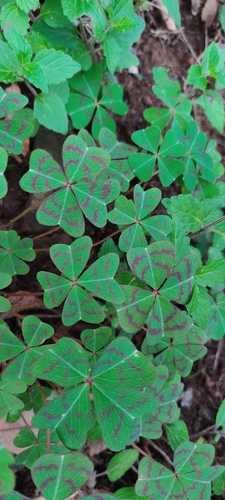
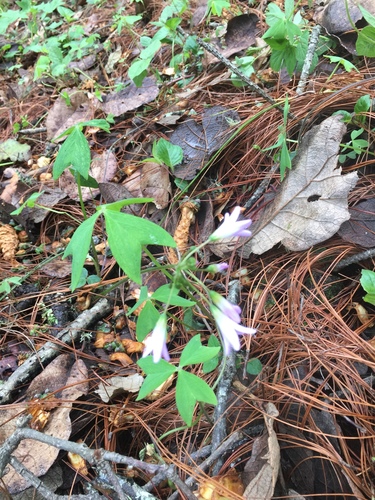
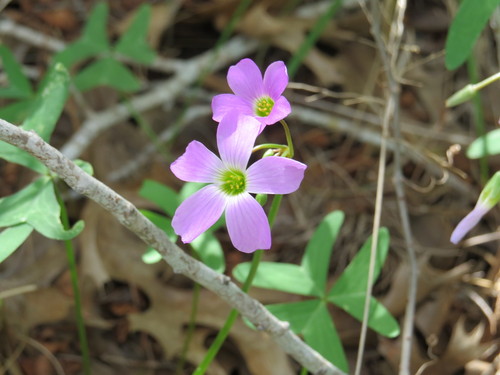
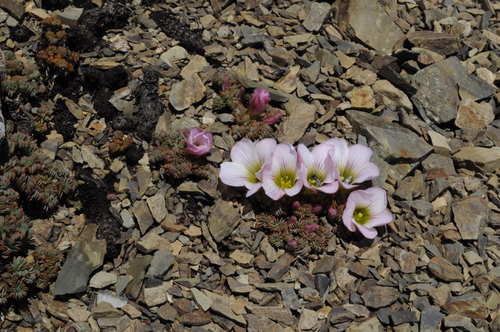
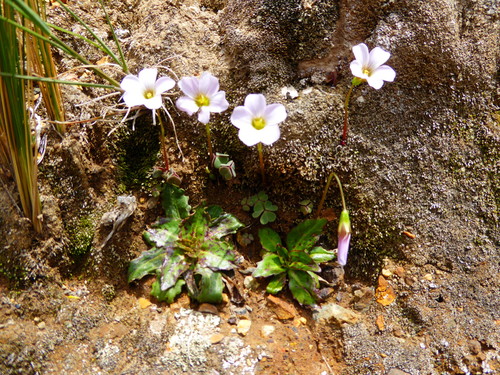
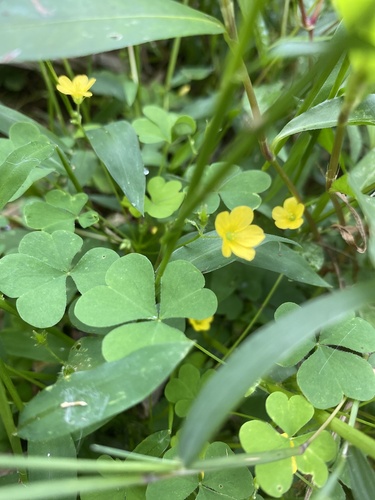
Oxalis cernua
Thunb.
iNaturalist· cc-by
(c) Amelia Tauber, some rights reserved (CC BY)
iNaturalist· cc-by-nc
(c) Karen, some rights reserved (CC BY-NC)
iNaturalist· cc-by-nc
(c) Thomas Friedrich, some rights reserved (CC BY-NC)
Description
A Mediterranean climate herb in the Oxalidaceae family with edible leaves and bulbils.
This description is brief — help expand it
Edible Uses
The leaves and bulbils are eaten.
Medicinal Uses
The plant is palatable and in modest quantities is reasonably harmless to humans and livestock. In South Africa it is a traditional ingredient in dishes such as waterblommetjiebredie ('water flower stew'). The plant has been used in various ways as a source of oxalic acid, as food, and in folk medicine. The raw bulbs have been used to deal with tapeworm and possibly other worms. The plant has been used as a diuretic, possibly hazardously. The lateral underground runners, which tend to be fleshy, have been eaten raw or boiled and served with milk. The golden petals can be used to produce a yellow dye.
Known Hazards
The leaves or roots are used in some parts of the world as a food, although the high levels of calcium oxalate in the plant may bear some risks. Such risks can be reduced if the plant parts are boiled first. Oxalic acid is toxic in large quantities, a concern in regions such as southern Australia where Oxalis pes-caprae grows invasively in enormous quantities and in high densities. Various sources suggest that oxalis ingestion causes calcium oxalate kidney stones, but clinical experience and physiological considerations make it unlikely that any realistic intake of Oxalis would affect human liability to kidney stones. Accordingly, some Australian references to the hazards of oxalis to livestock tend to be dismissive of this risk. However, in spite of its comparatively benign nature, where it has become dominant in pastures, as sometimes happens outside South Africa, Oxalis pes-caprae certainly can cause dramatic stock losses. For example, when hungry stock, such as sheep released just after being shorn, are let out to graze in a lush growth of Oxalis pes-caprae, they may gorge on the plant, with fatal results, as has been found in South Australia at least. Such stock fatalities patently have little logical connection with the presence or absence of oxalate kidney stones. For one thing, the fatal effects on sheep are far too rapid to result from the growth of bulk kidney stones. The plant has been found to be nutritious, but too acidic to be good fodder, largely being left untouched by grazing stock. When stock do consume large quantities, the effects typically involve death in several weeks with symptoms suggesting chronic oxalate poisoning, including tetany, or sudden death with extensive renal damage. Such damage suggests the twofold effect of calcium immobilisation (the tetany) and the formation of Calcium Oxalate Monohydrate raphides in the kidney tissue. The histotoxic effects of the raphides in kidney have by now been investigated. Oxalis poisoning of stock is not a serious forage concern in South African pastures, unless exceptionally favoured by overgrazing.
Distribution
It is a Mediterranean climate plant.
Where It Grows
Africa, Algeria, Libya, Mediterranean, North Africa, South Africa, Southern Africa,
Notes
There are about 500 Oxalis species.
References (4)
- Diss. Oxal. 14. 1781
- Hedrick, U.P., 1919, (Ed.), Sturtevant's edible plants of the world. p 456
- Jardin, C., 1970, List of Foods Used In Africa, FAO Nutrition Information Document Series No 2.p 92
- Terra, G. J. A., 1973, Tropical Vegetables. Communication 54e Royal Tropical Institute, Amsterdam, p 64