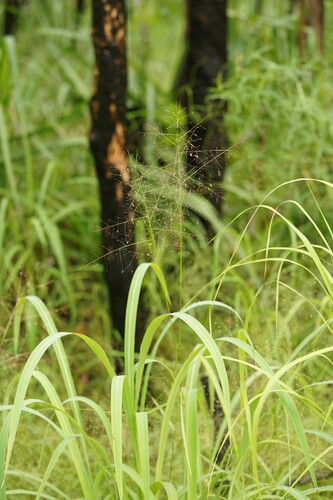
Oryza glaberrima subsp. stapfii
Steud.; (Roshew)Chev.
African rice
iNaturalist· cc-by-nc
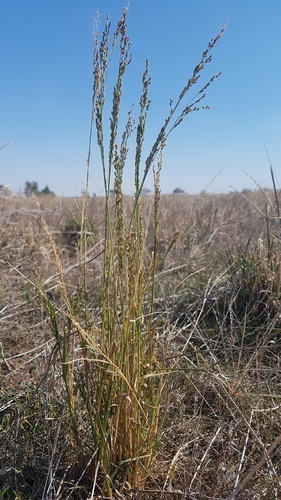
(c) Cole Tiemann, some rights reserved (CC BY-NC), uploaded by Cole Tiemann
iNaturalist· cc-by-nc
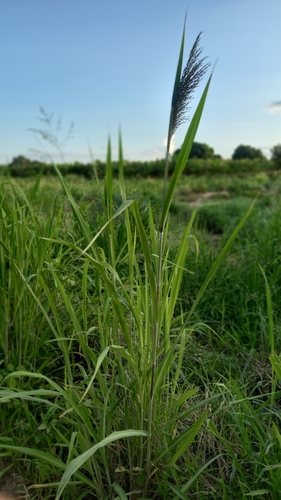
(c) Russ Hedley, some rights reserved (CC BY-NC)
Summary
Source: WikipediaOryza glaberrima, commonly known as African rice, is one of the two domesticated rice species. The species was first domesticated and grown in West Africa around 3,000 years ago. In agriculture, it makes up an estimated 20% of rice grown commercially in West Africa, having largely been replaced by higher-yielding O. sativa (Asian rice). The number of O. glaberrima varieties grown is declining. Crossbreeding between African and Asian rice is difficult, but there exist some crosses. In comparison to O. sativa (Asian rice), African rice is hardy, pest-resistant, low-labour, and suited to a larger variety of African conditions. It is described as filling, with a distinct nutty flavour. It is also grown for cultural reasons.
Description
A tropical grass in the Poaceae family and a subspecies of African rice.
This description is brief — help expand it
Medicinal Uses
Multiple varieties of African rice are often grown so that the harvest is staggered. In this way, the harvest can be eaten fresh. Freshly harvested rice is moist, and can be puffed in fire, and eaten. Fried rice has a brownish color when fried; this is because of the husk which is green in color and turns brown when heated. African rice can be prepared in much the same way as Asian rice, but has a distinct nutty flavor, for which it is favored in West Africa. African rice grains are often reddish in colour; some varieties are strongly aromatic, other, like Carolina Gold, are not at all aromatic. African rice is also used in local traditional medicine.
Distribution
A tropical plant.
Where It Grows
Africa, West Africa,
Notes
There are about 20 Oryza species.
References (1)
- Jardin, C., 1970, List of Foods Used In Africa, FAO Nutrition Information Document Series No 2.p 4 (As Oryza glaberimma ssp. stapfii)