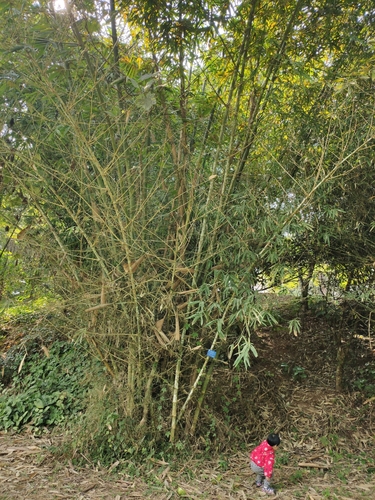
Saccharum spontaneum
L.
Wild pitpit, Wild sugarcane, Thatch grass
iNaturalist· cc0
no rights reserved, uploaded by 葉子
iNaturalist· cc0
no rights reserved, uploaded by 葉子
iNaturalist· cc-by-nc
(c) suchihfen, some rights reserved (CC BY-NC)
Summary
Source: WikipediaSaccharum spontaneum (wild sugarcane, kans grass) is a grass native throughout much of tropical and subtropical Asia, northern Australia, and eastern and northern Africa. It is a perennial grass, growing up to three meters in height, with spreading rhizomatous roots. The plant has hybridized with Saccharum officinarum, a domesticated sugarcane. The hybridization has produced Saccharum barberi and Saccharum sinense.
Description
A strong clumpy perennial grass. It has rhizomes or underground stems. The stalks are upright, hard and slightly thickened at the nodes. They can be 4 m high. The leaves are long (150 cm) and narrow (4 cm) with fine teeth on the edge. The leaves are flat. The flowers at the tip are like feathers.
Edible Uses
The very young flower shoots are eaten raw or cooked, and can be used in chutney. The peeled rhizome is sweet and is chewed. The seeds are eaten, particularly in Uganda. Ash from the burnt plant is used as a salt substitute.
Traditional Uses
The very young flower shoots are eaten raw or cooked. They are also used in chutney. The peeled rhizome is sweet and is chewed. Ash from the burnt plant is used as a salt substitute. The seeds are eaten in Uganda.
Distribution
A tropical plant. It grows in the lowlands from sea level up to at least 1650 m. It is often common in areas with a strongly seasonal rainfall and in grassland areas. It grows in areas with a rainfall above 1,500 mm. It can grow in arid places.
Where It Grows
Afghanistan, Africa, Algeria, Asia, Australia, Bangladesh, Bhutan, Burkina Faso, Cambodia, Cameroon, Central Africa, Central America, Central Asia, Chad, China, Congo, Cuba, Cyprus, East Africa, East Timor, Egypt, Ethiopia, Europe, FSM, Ghana, Himalayas, India, Indochina, Indonesia, Iran, Japan, Kazakhstan, Kenya, Korea, Kosrae, Laos, Libya, Malawi, Malaysia, Mariana Islands, Mauritius, Mediterranean, Micronesia, Middle East, Morocco, Myanmar, Nepal, Nigeria, North Africa, Northeastern India, Oman, Pacific, Pakistan, Palau, Panama, Papua New Guinea, PNG, Philippines, Pohnpei, Portugal, Saudi Arabia, SE Asia, Seychelles, Sierra Leone, Singapore, Sri Lanka, Sudan, Syria, Taiwan, Tajikistan, Tanzania, Tibet, Thailand, Timor-Leste, Tunisia, Turkmenistan, Uganda, Vietnam, West Africa, West Indies, Yemen,
Cultivation
Plants are mostly grown by dividing up the old clump.
Other Uses
The plant is a source of material for thatching. Plants are used for hedging or screening.
Other Information
It is cultivated.
Synonyms
Also Known As
Abookin kibiyaa, Kadukabbu, Kaing, Kans, Kas, Kasa, Kashia danda, Keshur, Khagori, Kyan-sein-gale, Lao, Maqesha, Mojora, Oi-nu, Piko-pimur, Pira tobu, Tebu hitam, Teppi, Thekke-gyi
References (29)
- Ambasta, S.P. (Ed.), 2000, The Useful Plants of India. CSIR India. p 537
- Azam, F. M. S., et al, 2014, Are Famine Food Plants Also Ethnomedicinal Plants? An Ethnomedicinal Appraisal of Famine Food Plants of Two Districts of Bangladesh. Evidence-Based Complementary and Alternative Medicine Volume 2014, Article ID 741712, 28 pages
- Balemie, K., & Kebebew, F., 2006, Ethnobotanical study of wild edible plants in Derashe and Kucha Districts, South Ethiopia. Journal of Ethnobiology and Ethnomedicine. 2:53
- Burkill, H. M., 1985, The useful plants of west tropical Africa, Vol. 2. Kew.
- Cowie, I, 2006, A Survey of Flora and vegetation of the proposed Jaco-Tutuala-Lore National Park. Timor-Lests (East Timor) www.territorystories.nt/gov.au p 52
Show all 29 references Hide references
- Facciola, S., 1998, Cornucopia 2: a Source Book of Edible Plants. Kampong Publications, p 179
- Flora of Pakistan. www.eFloras.org
- French, B.R., 1986, Food Plants of Papua New Guinea, A Compendium. Asia Pacific Science Foundation p 381
- Grubben, G. J. H. and Denton, O. A. (eds), 2004, Plant Resources of Tropical Africa 2. Vegetables. PROTA, Wageningen, Netherlands. p 564
- Japanese International Research Centre for Agricultural Science www.jircas.affrc.go.jp/project/value_addition/Vegetables
- Kermath, B. M., et al, 2014, Food Plants in the Americas: A survey of the domesticated, cultivated and wild plants used for Human food in North, Central and South America and the Caribbean. On line draft. p 773
- Lim, T. K., 2015, Edible Medicinal and Non Medicinal Plants. Volume 9, Modified Stems, Roots, Bulbs. Springer p 74
- Lulekal, E., et al, 2011, Wild edible plants in Ethiopia: a review on their potential to combat food insecurity. Afrika Focus - Vol. 24, No 2. pp 71-121
- Mant. pl. 2:183. 1771
- Miguel, E., et al, 1989, A checklist of the cultivated plants of Cuba. Kulturpflanze 37. 1989, 211-357
- Murtem, G. & Chaudhrey, P., 2016, An ethnobotanical note on wild edible plants of Upper Eastern Himalaya, India. Brazilian Journal of Biological Sciences, 2016, v. 3, no. 5, p. 63-81
- Ochse, J.J. et al, 1931, Vegetables of the Dutch East Indies. Asher reprint. p 338
- Patiri, B. & Borah, A., 2007, Wild Edible Plants of Assam. Geethaki Publishers. p 161
- Pawera, L., et al, 2020, Wild Food Plants and Trends in Their Use: From Knowledge and Perceptions to Drivers of Change in West Sumatra, Indonesia, Foods. 2020, 9, 1240
- Prashanth Kumar, G.M. and Shiddamallayya, N., 2015, Ethnobotanical Study of Less Known Wild Edible Plants of Hakki Pikki Tribes of Angadihalli, Hassan District, Karnataka. Journal or Medicinal Plants Studies 3(5):80-85
- Priyadi, H., et al, Five hundred plant species in Gunung Halimun Salak National Park West Java. A checklist including Sundanese names, distribution and use. CIFOR, FFPRI, SLU p 75
- Purseglove, J.W., 1972, Tropical Crops. Monocotyledons. Longmans p 214
- Royal Botanic Gardens, Kew (1999). Survey of Economic Plants for Arid and Semi-Arid Lands (SEPASAL) database. Published on the Internet; http://www.rbgkew.org.uk/ceb/sepasal/internet [Accessed 4th June 2011]
- Sarma, H., et al, 2010, Updated Estimates of Wild Edible and Threatened Plants of Assam: A Meta-analysis. International Journal of Botany 6(4): 414-423
- Simmonds, N.W., 1979, Sugarcane, in Simmonds N.W.,(ed), Crop Plant Evolution. Longmans. London. p 104
- Taram, M., et al, 2018, Wild Food Plant Resources of Komkar Adi Tribe of Upper Siang District in Arunachal Pradesh, India. Bulletin of Arunachal Forest Research, Vol. 33(2), 27-35
- Terra, G.J.A., 1973, Tropical Vegetables. Communication 54e Royal Tropical Institute, Amsterdam, p 70
- World Checklist of Useful Plant Species 2020. Royal Botanic Gardens, Kew
- Zeven, A. C. & de West, J. M. J., 1982, Dictionary of cultivated plants and their regions of diversity. Wageningen. p 55, 75