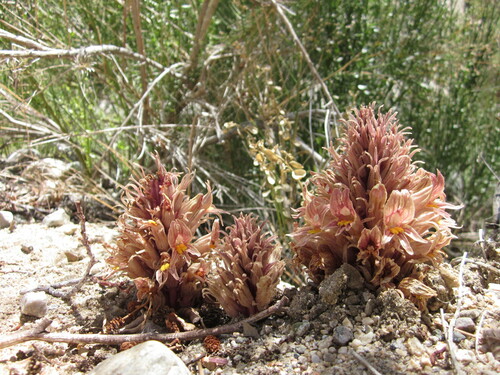
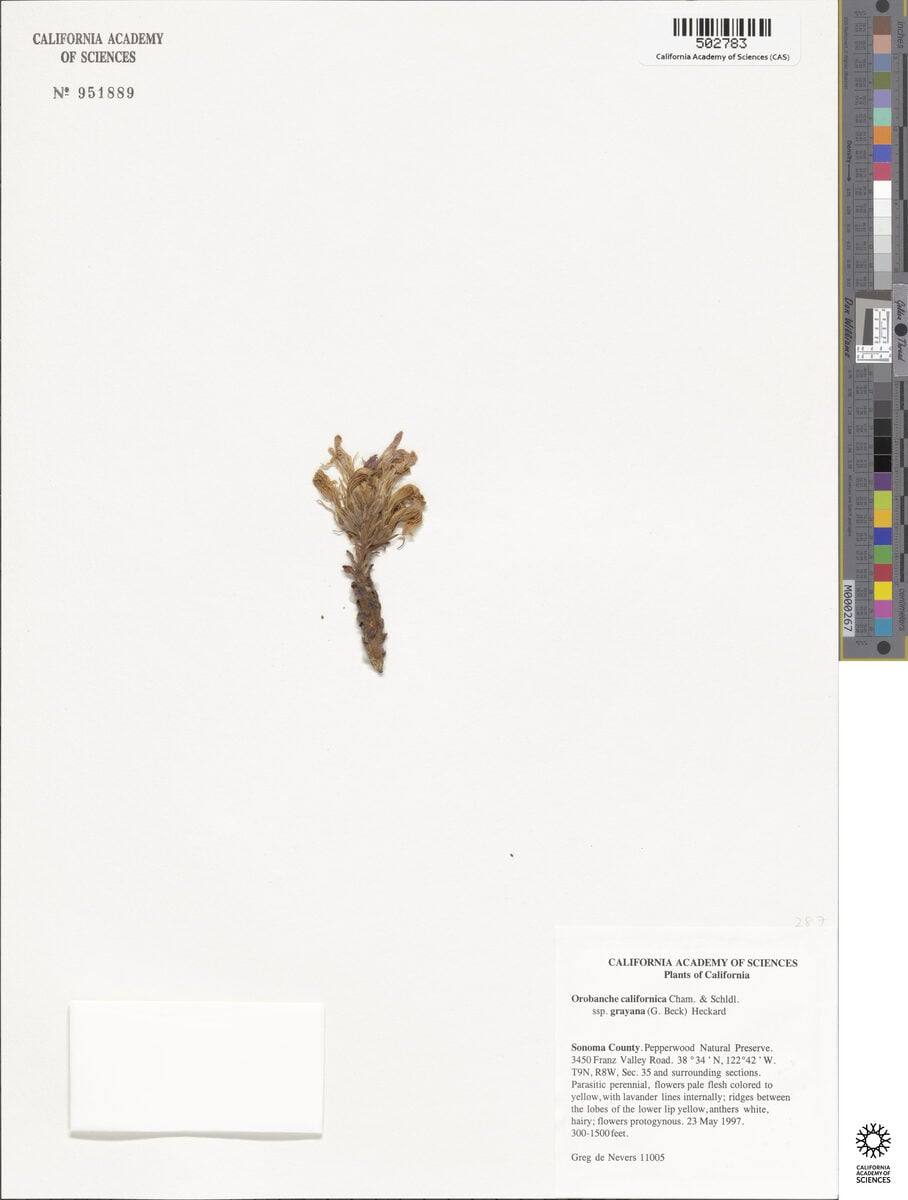
Orobanche uniflora
L.
One flowered Cancer root
iNaturalist· cc-by
(c) Tom Norton, some rights reserved (CC BY)
iNaturalist· cc-by
(c) Tom Norton, some rights reserved (CC BY)
iNaturalist· cc-by
(c) Tom Norton, some rights reserved (CC BY)
Summary
Source: WikipediaOrobanche uniflora, commonly known as one-flowered broomrape, one-flowered cancer root, ghost pipe or naked broomrape, is an annual parasitic herbaceous plant. It is native to much of North America, where it is a parasitic plant, tapping nutrients from many other species of plants, including those in the families Asteraceae and Saxifragaceae and in the genus Sedum. The name "orobanche" can be translated to "vetch-strangler" and "uniflora" can be translated to "single-flower".
Description
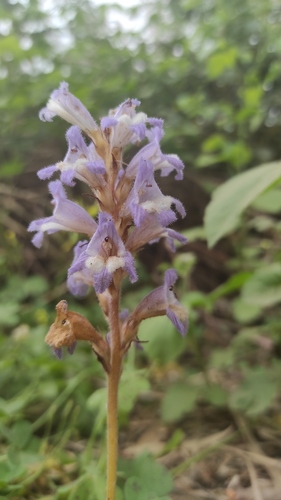
It is a parasitic plant. It feeds off the roots of other plants especially Sedum species. It grows 3.5 cm long. The main stem is under the ground. The flowers are purple to white. The fruit is a capsule with 2 sections and many seeds.
Edible Uses
The whole plant is edible, raw or cooked.
Medicinal Uses
The plant is both laxative and sedative.
Distribution
It is a temperate plant. It mostly grows in forests.
Where It Grows
Canada, North America, USA,
Cultivation
We have very little information on this species and do not know if it will be hardy in Britain, though judging by its native range it should succeed outdoors in many parts of this country. It requires a well-drained soil and should succeed in sun or shade. A fully parasitic plant lacking in chlorophyll, it is entirely dependant upon its host plant for obtaining nutrient. It is mainly parasitic on Sedum species and members of the families Compositae and Saxifragaceae in the wild. A polymorphic species.
Propagation
No specific information is available for this species, but sowing seed in a greenhouse in a pot containing a host plant is suggested. Seed is probably best sown as soon as ripe where possible. It may also be feasible to sow seed in situ around a host plant.
Other Uses
None known.
Notes
There are about 140 Orobanche species.
References (1)
- Plants for a Future database, The Field, Penpol, Lostwithiel, Cornwall, PL22 0NG, UK. http://www.scs.leeds.ac.uk/pfaf/