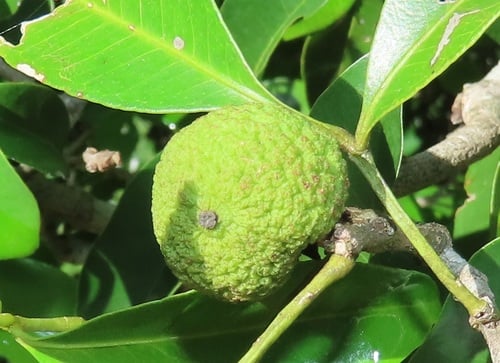
Orixa japonica
Thunberg
Stinking goat, Japanese changshan, White pepper
iNaturalist· cc-by-nc
(c) 李博恒, some rights reserved (CC BY-NC), uploaded by 李博恒
iNaturalist· cc-by-sa
(c) harum.koh, some rights reserved (CC BY-SA), uploaded by harum.koh
iNaturalist· cc-by-nc
(c) adonis_wei, some rights reserved (CC BY-NC), uploaded by adonis_wei
Summary
Source: WikipediaOrixa japonica, commonly called East Asian orixa or Japanese orixa, is a deciduous shrub growing to 3 metres (10 ft) with an equal spread. Native to China, Japan and South Korea, it is found on forested, sunny slopes at elevations from 500 to 1300 m. A recent scientific study found this plant to contain previously unknown alkaloids that may be effective against Plasmodium falciparum, one of the protozoan species that cause human malaria. This plant has an unusual and distinctive leaf pattern. Starting from the oldest leaf, the pattern of angles of subsequent leaves is 180 degrees, 90 degrees, 180 degrees, and 270 degrees. The pattern then repeats.
Description
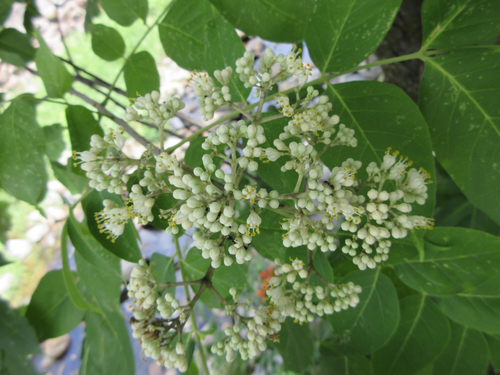
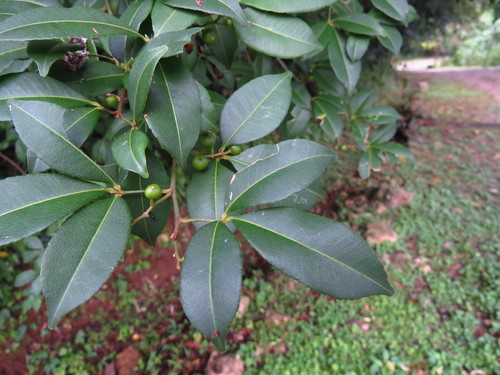
A deciduous shrub. It grows 2.4 m tall and is wide spreading. It can spread 3.5 m wide. The leaves are dark green and alternate. The leaves are 12 cm long. The leaves have an aroma. The leaves turn pale yellow in autumn. The flowers are small and have 4 petals. They are cup shaped and green. Male and female flowers are separate but on the same plant. Female flowers are borne singly and male flowers are in small groups. The fruit are brown and have 4 lobes. They are 18 mm across.
Edible Uses
Young leaves are cooked. They are aromatic with a pleasant, spicy odour.
Traditional Uses
The leaves are eaten cooked.
This uses section is brief — help expand it
Medicinal Uses
The plant is febrifuge.
Distribution
It is a temperate plant. It grows naturally in the mountainous regions of China, Korea and Japan. It is fully frost hardy. It needs a well drained fertile soil. It needs an open sunny position. It will tolerate dry conditions. It grows in the shade of broad-leaved deciduous forests between 750-1,300 m altitude in China. It suits hardiness zones 5-9. In Sichuan and Yunnan.
Where It Grows
Asia, Australia, China, Japan, Korea,
Cultivation
Succeeds in any fertile soil in sun or part shade. Survives in fairly dry shady conditions. The leaves have a foetid smell. They are distinctly and pleasantly aromatic according to another report whilst another says that they release an orange-like pungency when pressed. Plants are hardy to about -15°c. Dioecious, male and female plants must be grown if seed is required.
Propagation
Sow seed outdoors in spring, or in a cold frame if seed is scarce. Prick seedlings into individual pots once large enough to handle and grow on under glass through their first winter. Plant out into permanent positions in late spring or early summer after the last expected frosts. Take half-ripe wood cuttings, 5–8cm with a heel, in July or August in a frame — a fair percentage will root successfully. Root cuttings of 3cm length taken in December in a greenhouse give a high success rate. Self-layered branches can also be removed and transplanted at any point during the dormant season.
Other Uses
The plant can be grown as a hedge, forming a dense, light green barrier within five years.
Notes
There is only one Orixa species.
Synonyms
Also Known As
Ko-kusagi
References (5)
- Cundall, P., (ed.), 2004, Gardening Australia: flora: the gardener's bible. ABC Books. p 957
- Etherington, K., & Imwold, D., (Eds), 2001, Botanica's Trees & Shrubs. The illustrated A-Z of over 8500 trees and shrubs. Random House, Australia. p 502
- Hu, Shiu-ying, 2005, Food Plants of China. The Chinese University Press. p 502
- Martin, F. W., et al, 1987, Perennial Edible Fruits of the Tropics. USDA Handbook 642 p 76
- Plants for a Future database, The Field, Penpol, Lostwithiel, Cornwall, PL22 0NG, UK. http://www.scs.leeds.ac.uk/pfaf/