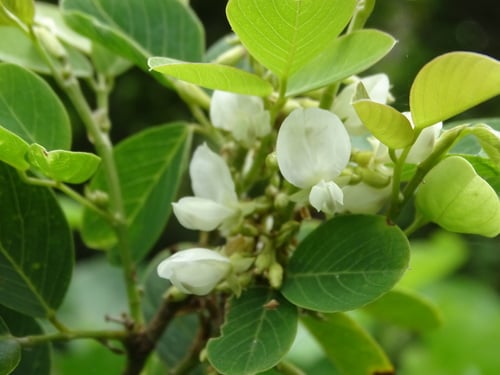
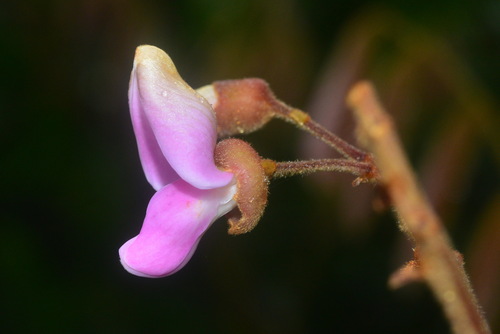
Vachellia haematoxylon
(Willd.) Seigler & Ebinger
Grey camel thorn
iNaturalist· cc-by-sa
(c) Tony Rebelo, some rights reserved (CC BY-SA), uploaded by Tony Rebelo
iNaturalist· cc-by-sa
(c) Tony Rebelo, some rights reserved (CC BY-SA), uploaded by Tony Rebelo
iNaturalist· cc-by-sa
(c) Tony Rebelo, some rights reserved (CC BY-SA), uploaded by Tony Rebelo
Summary
Source: WikipediaVachellia haematoxylon (gray camel thorn, giraffe thorn, Afrikaans: vaalkameeldoring, Afrikaans: basterkameeldoring, Afrikaans: basterkameel, Sotho: Mokholo) is a protected tree native to central and southeast Namibia, southwest Botswana and the Northern Cape of South Africa.
Description
A shrub or small tree. It grows to 6 m high. The bark is grey-brown. The leaves are compound. They have 15-27 pairs if leaflets each with very small leaflets along them. These are so fine they look like teeth. The leaves are densely covered with fine grey hairs. The flowers are in yellow balls. The fruit are long slender pods. These are up to 14 cm long by 1.3 cm wide. They are curved and densely grey and velvety. They are slightly constricted between the seeds.
Edible Uses
The resin or gum from the tree is edible, as is the pod wall of the fruit.
Traditional Uses
The resin or gum from the tree is edible. The pod wall of the fruit is edible.
This uses section is brief — help expand it
Distribution
It is a subtropical plant. It grows in desert and semidesert regions. It occurs on deep red sandy soil. It can grow in arid places.
Where It Grows
Africa, Botswana, Namibia, South Africa, Southern Africa,
Cultivation
It is not easy to cultivate.
Notes
There are about 1,350 Acacia species. Over 1,000 occur in Australia. Also as Mimosaceae.
Synonyms
References (8)
- Enum. pl. 2:1056. 1809 (As Acacia haematoxylon)
- Mannheimer, C. A. & Curtis. B.A. (eds), 2009, Le Roux and Muller's Field Guide to the Trees and Shrubs of Namibia. Windhoek: Macmillan Education Namibia. p 96 (As Acacia haematoxylon)
- Palgrave, K.C., 1996, Trees of Southern Africa. Struik Publishers. p 240 (As Acacia haematoxylon)
- Palmer, E and Pitman, N., 1972, Trees of Southern Africa. Vol. 2. A.A. Balkema, Cape Town p 775 (As Acacia haematoxylon)
- Peters, C. R., O'Brien, E. M., and Drummond, R.B., 1992, Edible Wild plants of Sub-saharan Africa. Kew. p 126 (As Acacia haematoxylon)
Show all 8 references Hide references
- Ruiters-Welcome, A. K., 2019, Food plants of southern Africa. Ph.D. thesis. Univ. of Johannesburg p 62
- van Wyk, Ben-Erik, 2019, The diversity and multiple uses of southern African legumes. Australian Systematic Botany, 2019, 32, 519–546
- Welcome, A. K. & Van Wyk, B.-E., 2019, An inventory and analysis of the food plants of southern Africa. South African Journal of Botany 122 (2019) 136–179