Prosopis ruscifolia
Griseb.
Algarobo, Pau-de-espinho
iNaturalist· cc-by-nc
(c) Andrea Talone Rìo, some rights reserved (CC BY-NC)
iNaturalist· cc-by-nc
(c) Andrea Talone Rìo, some rights reserved (CC BY-NC)
iNaturalist· cc-by-nc
(c) Andrea Talone Rìo, some rights reserved (CC BY-NC)
Description
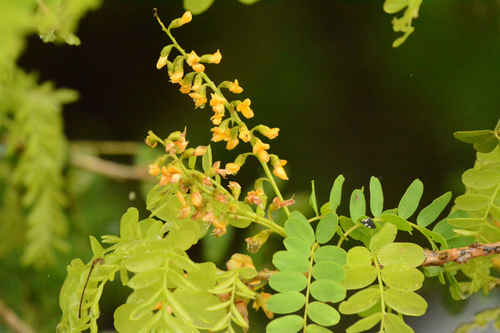
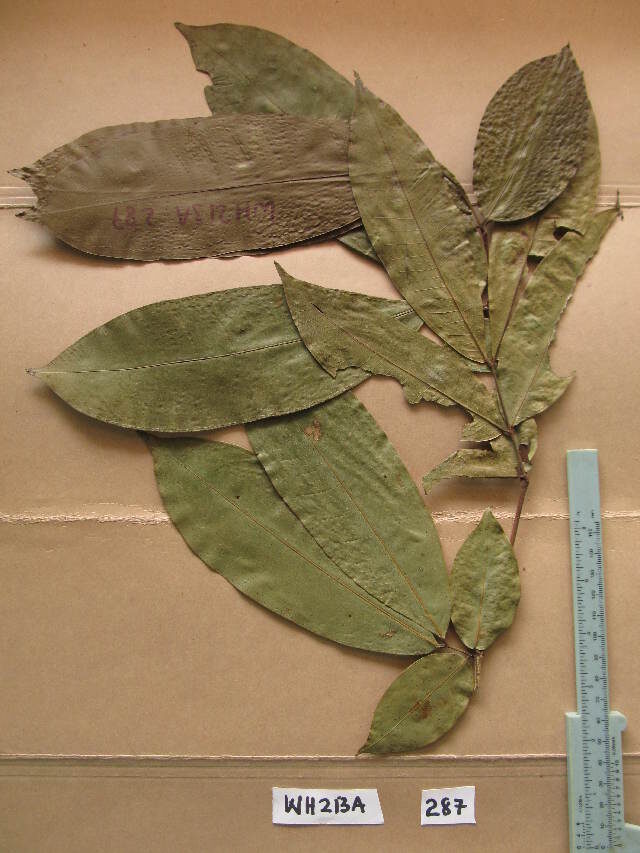
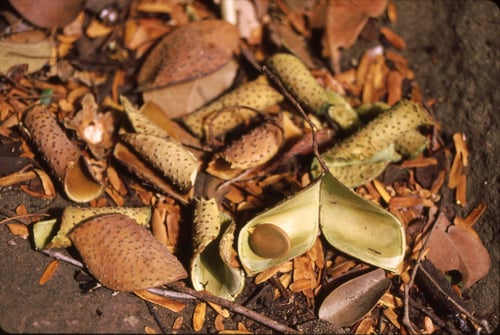
A tree. It grows 6-16 m tall. The crown is round. It has thorns 3-15 cm long. The trunk is upright and 30-45 cm across. The bark is thick and has cracks along the length. The leaves are compound and twice divided. The leaflets are opposite and has no leaf stalks. There are 2-5 pairs. The fruit is a curved pod. It is 15-30 cm long. There are yellowish purple marks on the ripe pod. There are 10-24 hard seeds.
Edible Uses
Pods - cooked or used as a meal. The report does not make it clear if the immature seeds or mature seeds are eaten. If it is used as a meal, the suggestion is that the mature seeds are dried and ground into a powder.
Traditional Uses
The pods are cooked and eaten or used as a dry meal. The pods are boiled and crushed and the juice eaten.
This uses section is brief — help expand it
Medicinal Uses
The leaves are said to have medicinal properties. The leaves are astringent and bitter. An infusion is used as a wash to treat diseases of the eyes.
Distribution
A subtropical plant. In Argentina it grows from sea level to 1,000 m above sea level.
Where It Grows
Argentina, Bolivia, Brazil, Paraguay, South America*, Uruguay,
Cultivation
Plants are grown from seed. The seed are removed from the ripe pod. They have a hard seed coat that needs to be broken. Fresh seed are planted and germinate in 1-2 weeks.
Propagation
Seed - it has a hard seedcoat and may benefit from scarification before sowing to speed up germination. This can usually be done by pouring a small amount of nearly boiling water on the seeds (being careful not to cook them!) and then soaking them for 12 - 24 hours in warm water. By this time they should have imbibed moisture and swollen - if they have not, then carefully make a nick in the seedcoat (being careful not to damage the embryo) and soak for a further 12 hours before sowing. Sow the seed in a sunny position in a nursery seedbed. A germination rate of above 50% can be expected, with the seed sprouting within 7 - 14 days.
Other Uses
The heartwood is reddish-yellow. The wood is thick-textured, straight-grained, heavy, hard, elastic, with good mechanical properties and moderately durable. It is only used locally, for applications such as furniture, door and window frames, cooperage, poles, railway ties etc. The fully grown tree yields a good timber of similar quality to that obtained from Prosopis alba and Prosopis nigra. It is used for flooring, barrels, carpentry etc. The wood is used for fuel and to make charcoal. A natural pioneer species within its native range, rapidly invading pasture land and other open areas. Considered a weed by cattle ranchers, it is fast-growing, fixes atmospheric nitrogen and can be used as a pioneer to establish native woodland or a woodland garden.
Notes
Also as Mimosaceae.
Nutrition
| Part | Moisture | kJ | kcal | Protein | Vit A | Vit C | Iron | Zinc |
|---|---|---|---|---|---|---|---|---|
| Fruit | — | 79 | 12.7 | — | — | 4.6 | 3.9 | — |
Also Known As
Algarrobo colorado, Algarrobo de hoja grande, Ibope moroti, Libope, Mata pasto, Morote, Olkha, Quilin, Quilino, Teyt, Vinal, Visnal
References (8)
- Abh. Koenigl. Ges. Wiss. Goettingen 19:82; Pl. lorentz. 34. 1874
- Bortolotto, I. M., et al, 2018, Lista preliminar das plantas alimenticias nativas de Mato Grosso do Sul, Brasil. Iheringia, Serie Botanica, Porto Alegre, 73 (supl.):101-116
- Bortholotto, I. M. et al, 2021, Food Composition Data: Edible Plants of Patanal. p306 In Jacob. U.P (Eds) Local Food Plants of Brazil. Ethnobiology.
- Grandtner, M. M. & Chevrette, J., 2013, Dictionary of Trees, Volume 2: South America: Nomenclature, Taxonomy and Ecology. Academic Press p 535
- Lorenzi, H., 2002, Brazilian Trees. A Guide to the Identification and Cultivation of Brazilian Native Trees. Vol. 02 Nova Odessa, SP, Instituto Plantarum p 200
Show all 8 references Hide references
- Malezas Comestibles del Cono Sur, INTA, 2009, Buernos Aires
- Polini, G., et al, Useful and edible plants of Paraguay Region of Chaco. p 90
- Scarpa, G. F., 2009, Wild food plants used by the indigenous peoples of South American Gran Chaco: A general synopsis and intercultural comparison. Journal of Applied Botany and Food Quality 83:90-101