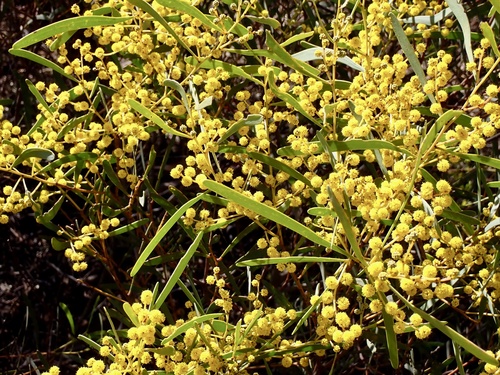
Acacia greggii
A. Gray
Catclaw acacia
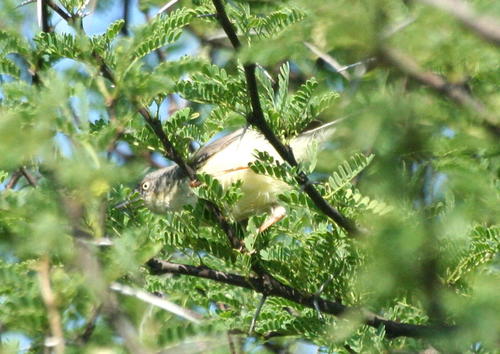
iNaturalist· cc-by-nc
(c) W. Terry Hunefeld, some rights reserved (CC BY-NC)
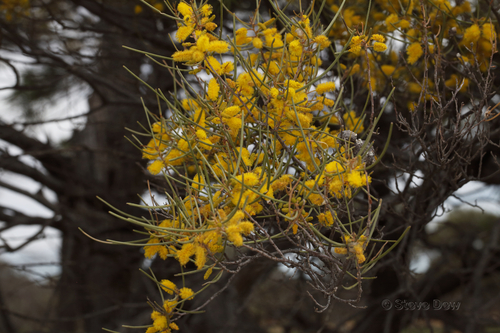
iNaturalist· cc-by-nc
(c) W. Terry Hunefeld, some rights reserved (CC BY-NC)
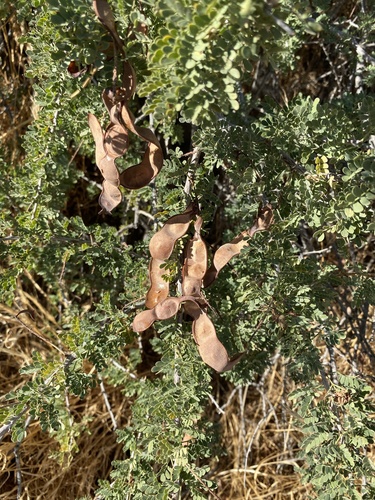
iNaturalist· cc-by-nc
(c) dalemeister, some rights reserved (CC BY-NC)
Description
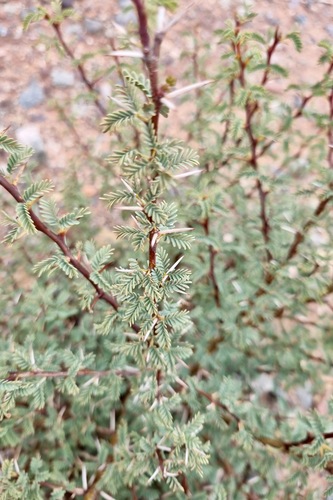
A shrub or small tree. It grows 5 m tall. There are prickles along the stem. The leaves are twice divided and there are 8-18 pairs of pinnae. There are up to 50 pairs of pinnules on each pinnae. The flowers are yellow. They are in large clusters at the ends of branches. The pods are flattened.
Edible Uses
The pods are eaten raw, boiled, or pounded into meal for porridge and cakes; dried pods are used as flour. The dried seeds, which contain 33% protein, are eaten like beans.
Traditional Uses
The pods are eaten raw. They are also boiled or pounded into a meal for porridge or cakes. The dried pods are used for flour. The dried seeds are eaten like beans.
Distribution
It is a subtropical plant. It does well in hot conditions and is very drought tolerant once established. It grows below 1,500 m above sea level. It grows in areas with an annual rainfall between 250-300 mm. It can grow in arid places.
Where It Grows
Africa, Egypt, Iran, Iraq, Mexico*, Middle East, North Africa, North America, USA,
Cultivation
Plants can be grown from seeds. The seeds are best soaked in acid to break the hard seed coat. It can be used as a hedge. It can be grown from semi-ripe cuttings.
Notes
There are about 1,350 Acacia species. Over 1,000 occur in Australia. This one is native to North America. Also as Mimosaceae. The seeds are 33 % protein.
Synonyms
Also Known As
Cat's paw, Devilsclaw, Gregg Catclaw, Texas mimosa
References (11)
- Beckstrom-Sternberg, Stephen M., and James A. Duke. "The Foodplant Database." http://probe.nalusda.gov:8300/cgi-bin/browse/foodplantdb.(ACEDB version 4.0 - data version July 1994)
- Bircher, A. G. & Bircher, W. H., 2000, Encyclopedia of Fruit Trees and Edible Flowering Plants in Egypt and the Subtropics. AUC Press. p 4
- Facciola, S., 1998, Cornucopia 2: a Source Book of Edible Plants. Kampong Publications, p 151
- Grandtner, M. M., 2008, World Dictionary of Trees. Wood and Forest Science Department. Laval University, Quebec, Qc Canada. (Internet database http://www.WDT.QC.ca)
- Kiple, K.F. & Ornelas, K.C., (eds), 2000, The Cambridge World History of Food. CUP p 1713
Show all 11 references Hide references
- Little, E.L., 1980, National Audubon Society Field Guide to North American Trees. Alfred A. Knopf. p 514
- Pl. wright. 1:65. 1852 (Smithsonian Contr. Knowl. 3, Art. 5)
- Royal Botanic Gardens, Kew (1999). Survey of Economic Plants for Arid and Semi-Arid Lands (SEPASAL) database. Published on the Internet; http://www.rbgkew.org.uk/ceb/sepasal/internet [Accessed 26th April 2011]
- Tozer, F., 2007, The Uses of Wild Plants. Green Man Publishing. p 13
- Usher, G., 1974, A Dictionary of Plants Used by Man. Constable. p 13
- Young, J., (Ed.), 2001, Botanica's Pocket Trees and Shrubs. Random House. p 47