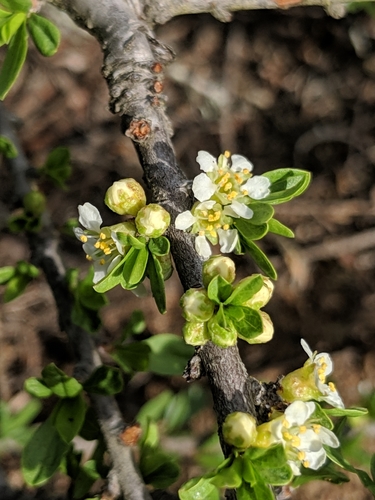
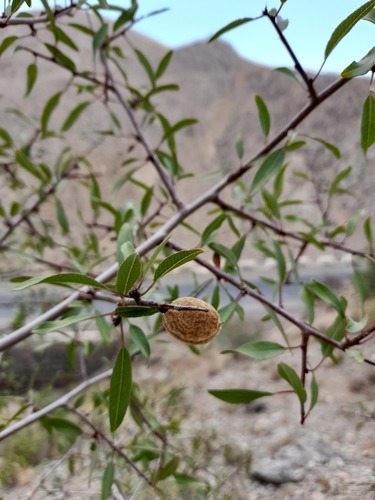
Amelanchier wiegandii
Nielson
Inland Service-berry
gbif· cc0
President and Fellows of Harvard College
Description
A shrub in the Rosaceae family growing to about 5 m tall, found in temperate regions.
This description is brief — help expand it
Edible Uses
The fruit can be eaten raw or cooked. It is rich in iron and copper.
Traditional Uses
Fruit are eaten raw or cooked.
This uses section is brief — help expand it
Medicinal Uses
None known.
Distribution
It is a temperate plant.
Where It Grows
Canada, North America,
Propagation
Seed is best harvested green, when fully formed but before the seed coat has hardened, then sown immediately in pots outdoors or in a cold frame. Stored seed obtained early in autumn can be given 4 weeks of warm stratification before being left out over winter, and should germinate in spring. Otherwise germination can be very slow, potentially taking 18 months or more. When seedlings are large enough to handle, prick them out into individual pots and grow on in a sheltered outdoor position, planting out once they reach 20cm or more. Where seed is plentiful, sow thinly in an outdoor seedbed and grow on for two years before moving to permanent positions during winter. Layering in spring takes around 18 months. Suckers can be divided in late winter, but they need to have been growing for 2 years beforehand to have developed roots. Once rooted, they can be planted directly into permanent positions.
Other Uses
None known.
Notes
There are about 25-30 Amelanchier species.
Synonyms
References (2)
- Amer. Midl. Naturalist 22:180. 1939
- Plants for a Future database, The Field, Penpol, Lostwithiel, Cornwall, PL22 0NG, UK. http://www.scs.leeds.ac.uk/pfaf/.