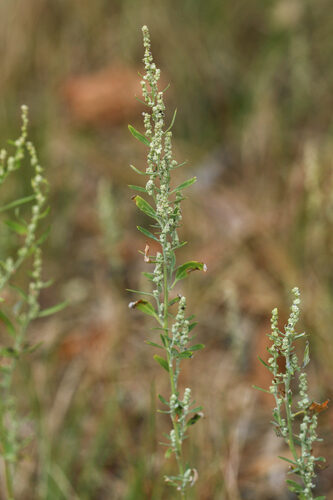
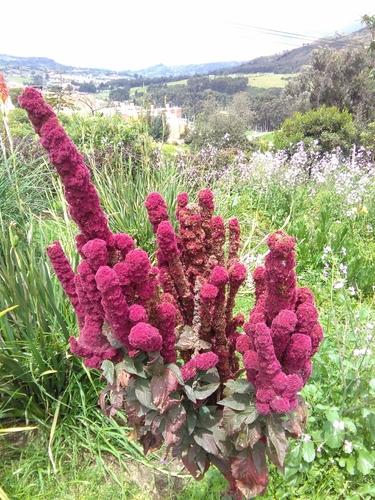
Amaranthus graecizans subsp. silvestris
(Vill.) Brenan
gbif· cc-by-sa
Josep Gesti
gbif· cc-by-sa
Josep Gesti
gbif· cc-by-nc
Katerina Kashirina
Summary
Source: WikipediaAmaranthus graecizans, the Mediterranean amaranth or short-tepalled pigweed, is an annual species in the botanical family Amaranthaceae. It is native to Africa, southern Europe, East Asia to India and Central Asia. It is naturalized in North America. More general common names include tumbleweed and pigweed.
Description
A herb.
This description is brief — help expand it
Edible Uses
The edible leaves are used as a vegetable throughout Africa and the Middle East. It can be eaten raw, but was more often cooked, or added to sauces and stews. A common way to cook Amaranthus graecizans was to cook it in buttermilk, or to squeeze fresh lime-juice over it. The seeds are starchy and can also be eaten Leaves, stems and seeds may be eaten raw and cooked, the leaves have a high nutritional value. When grown on nitrogen-rich soils they are known to concentrate nitrates in the leaves, especially noticeable on land where nitrate fertilizer is used.
Distribution
It is a temperate plant.
Where It Grows
Asia, Australia, Pakistan, Tasmania,
Notes
There are about 60 Amaranthus species. Villars changed Tournefort's "sylvestris" to "silvestris"
References (3)
- Cat. jard. pl. Strasbourg 111. 1807
- Ishtiaq, S., et al, 2014, Phytochemical and in vitro antioxidant evaluation of different fractions of Amaranthus graecizans subsp. silvestris (Vill.) Brenan. Asian Pacific Journal of Tropical Medicine. 7(suppl. 1):5342-5347
- Terra, G.J.A., 1973, Tropical Vegetables. Communication 54e Royal Tropical Institute, Amsterdam, p 23 (As Amaranthus sylvestris)