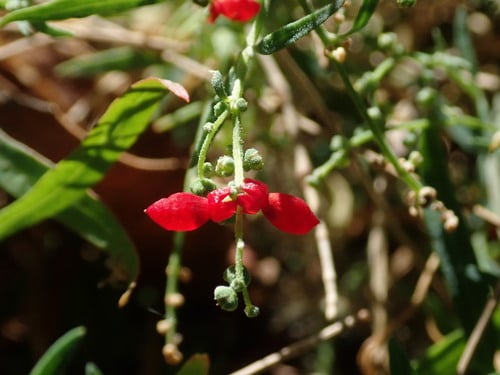
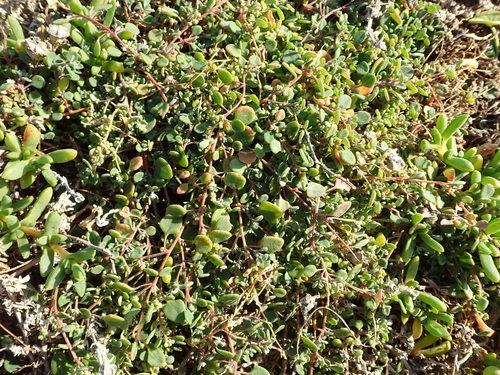
Amaranthus hybridus subsp. quitensis
(H. B. Kunth) Costea & Carretero
South American Amaranth, Ataco, Sangorache
gbif· cc-by-nc
ale_e
gbif· cc-by-nc
ale_e
gbif· cc-by-nc
ale_e
Summary
Source: WikipediaAmaranthus hybridus, commonly called green amaranth, slim amaranth, smooth amaranth, smooth pigweed, or red amaranth, is a species of annual flowering plant. It is a weedy species found now over much of North America and introduced into Europe and Eurasia.
Description
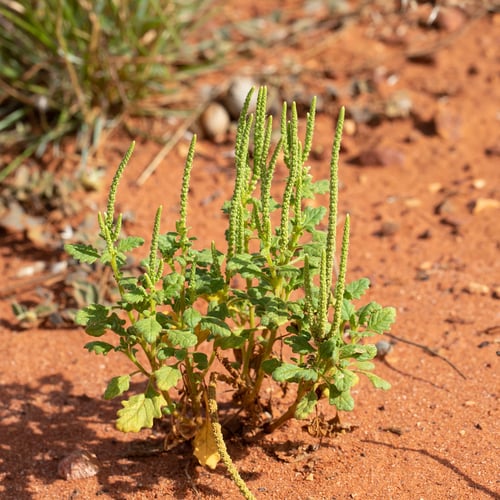
An annual plant which grows to 1 m high.
This description is brief — help expand it
Edible Uses
The seeds and cooked leaves are edible. The plant was used for food and medicine by several Native American groups and in traditional African medicine. It is among the species consumed as Quelite quintonil in Mexican food markets. It has weak antimicrobial activity, but contains promising anti-cancer phytochemicals.
Traditional Uses
The leaves are edible cooked. The seeds are ground into flour and cooked. The red flower provides colouring for foods. CAUTION: This plant can accumulate nitrates if grown with high nitrogen inorganic fertilisers and these are poisonous.
Distribution
A tropical plant.
Where It Grows
Australia, Andes, Argentina, Ecuador, South America,
Cultivation
It can be grown from seed or cuttings.
Notes
There are about 60 Amaranthus species.
Nutrition
| Part | Moisture | kJ | kcal | Protein | Vit A | Vit C | Iron | Zinc |
|---|---|---|---|---|---|---|---|---|
| Leaves | 81 | 249 | 60 | 4.1 | — | 25.7 | — | — |
| Seeds | — | — | — | — | — | — | — | — |
Synonyms
Also Known As
Yuyo colorado
References (9)
- Facciola, S., 1998, Cornucopia 2: a Source Book of Edible Plants. Kampong Publications, p 8
- Joyal, E., 1987, Ethnobotanical Field Notes from Ecuador: Camp, Prieto, Jorgensen, and Giler. Economic Botany 41(2): 163-189
- Lazarides, M. & Hince, B., 1993, Handbook of Economic Plants of Australia, CSIRO. p 17
- Luquez de Mucciarelli, S., et al, 1990, Chemical composition and nutritive value of Amaranthus quintensis. (In Spanish). Arch. Latinoam Nutr. Mar: 40(1):69-74
- Malezas Comestibles del Cono Sur, INTA, 2009, Buernos Aires (As Amaranthus quitensis)
Show all 9 references Hide references
- Plants for a Future database, The Field, Penpol, Lostwithiel, Cornwall, PL22 0NG, UK. http://www.scs.leeds.ac.uk/pfaf/
- Rozycki, V. R., et al, 1997, Nutrient content in vegetables species from the Argentine Chaco. (In Spanish), Arch. Latinoam Nutr. Sep. 47(3):265-70
- Ulian, T., et al, 2020, Unlocking plant resources to support food security and promote sustainable agriculture. Plants, People, Planet. 2020;2:421–445.
- F. W. H. A. von Humboldt et al., Nov. gen. sp. 2:156[folio]; 2:194[quarto]. 1818