Alpinia galanga
(L.) Wild.
Greater galangal
iNaturalist· cc-by
(c) Jacy Chen, some rights reserved (CC BY), uploaded by Jacy Chen
iNaturalist· cc-by-nc
(c) PK Yeung, some rights reserved (CC BY-NC), uploaded by PK Yeung
iNaturalist· cc-by-nc
(c) wangfh, some rights reserved (CC BY-NC)
Summary
Source: WikipediaAlpinia galanga, a plant in the ginger family, bears a rhizome used largely as an herb in Unani medicine and as a spice in Southeast Asian cookery. It is one of four plants known as "galangal". Its common names include greater galangal, lengkuas, and blue ginger.
Description
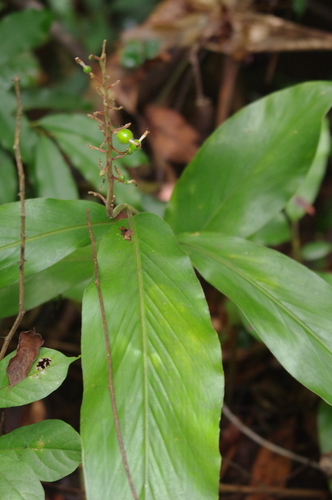
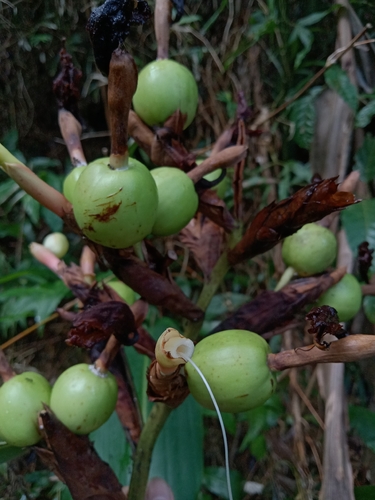
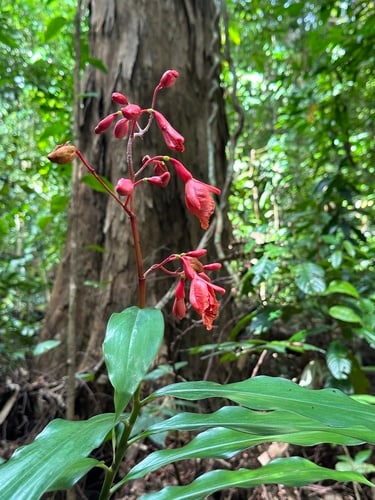
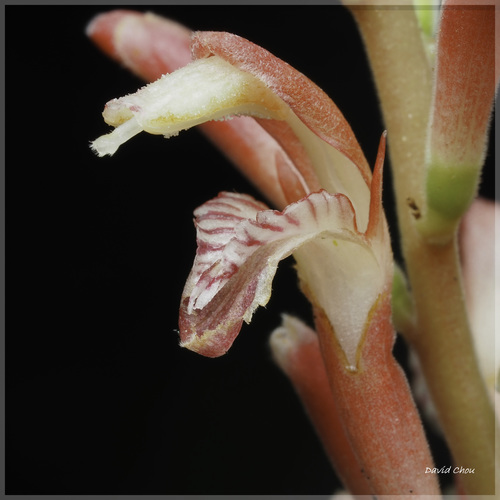
A herb which grows year after year. It grows to 1.6 m high and spreads to 1 m across. The rootstock creeps under the ground. This is round like a cylinder and branches. This thick rhizome can be 10-12 cm long by 3 cm wide. It grows as a dense clump. The outside of the root is reddish brown and inside is white. The stems lie along the ground. The leaves are long and narrow and sword shaped. The leaf blade is 25-35 cm long by 6-10 cm wide. They taper to the tip. They have a sweet scent. The flower spike is at the end of the shoot. It is hairy and 15-30 cm long. The flower bracts are oval and 2-8 mm long. The flowers are white. They occur in clusters at the ends of stalks. Each bracts surrounds 4-5 flowers. The flowers are 1.5 cm long and white with purple lines. The fruit is a round capsule. It is 1 cm across. It is orange-red.
Edible Uses
The rhizome is a common ingredient in Thai curries and soups such as tom kha kai, where it is used fresh in chunks or cut into thin slices, mashed and mixed into curry paste. It is also traditionally fermented with honey to produce the wine known as byais among the Mansaka people of the Philippines.
Traditional Uses
The root is used for flavouring curries. They are often sliced then removed before serving the dish. They can be pounded to a paste then added to dishes. They are also pickled. The young shoots and leaves are also eaten. Flower buds and flowers can also be cooked and eaten. They are also pickled. The red fruit are edible.
Medicinal Uses
Under the names 'chewing John', 'little John to chew', and 'court case root', it is used in African American folk medicine and hoodoo folk magic. In Unani medicine 'A.Galanga' is called as 'Khulanjan' and its actions and uses have been mentioned in many unani classical literatures like Al qanun fittib The Canon of Medicine, maghzanul mufradath etc. It is considered as Muqawwi qalb (cardiac tonic), mufarreh, munaffise balgam, muqawwi meda, muqawwi bah etc. Its used in Asthma, cough, sore throat and other illnesses. Famous unani drug preparations with Khulanjan as an ingredient include Habb e Jadwar, Jawarish Jalinus, Jawarish Ood shirin etc. Ayurveda considers A. galanga (Sanskrit:-rasna) as a Vata Shamana drug. Known as பேரரத்தை (perarathai) in Tamil, this form of ginger is used with licorice root, called in Tamil athi-mathuram (Glycyrrhiza glabra) as folk medicine for colds and sore throats.
Distribution
A tropical plant. It does best in rich moist soils. It prefers a protected shady position. It is drought and frost tender. The soil needs to be well-drained. It can be grown in sheltered sites in cooler climates but needs a heated glasshouse in cold places. In China it grows in grasslands between 100-1300 m altitude in S China. It suits hardiness zones 9-12. In XTBG Yunnan.
Where It Grows
Asia, Australia, Bangladesh, Cambodia, China, East Timor, Fiji, Guianas, Hawaii, India*, Indochina, Indonesia*, Laos, Malaysia, Myanmar, Northeastern India, Pacific, Philippines, SE Asia, Singapore, Sri Lanka, Suriname, Taiwan, Thailand, Timor-Leste, USA, Vietnam,
Cultivation
It is grown by dividing the rootstock. A piece about 5-10 cm long with at least 2 undamaged buds is used. Rhizomes are planted just below the surface and 60 cm apart.
Propagation
Seed - best sown as soon as ripe. Sow in containers and keep at around 20c. Division of the rootstock as new growth begins. Very easy. Shoots from pieces of galanga rhizome emerge about 1 week after planting; within 4 weeks 2 - 3 leaves have developed.
Other Uses
The plant is the source of an essential oil, called Essence d'Amali.
Production
Young rhizomes have more flavour than older ones. Plants are often harvested 3 months after planting.
Other Information
It is a cultivated food plant. They are sold in markets. It is a commercially cultivated vegetable. The fruit are available in Chinese stores in Australia.
Notes
There are about 200-230 Alpinia species. They are mostly tropical and subtropical. It is antimutagenic. It possibly has anti-cancer properties.
Nutrition
| Part | Moisture | kJ | kcal | Protein | Vit A | Vit C | Iron | Zinc |
|---|---|---|---|---|---|---|---|---|
| Rhizome | 85.9 | 220 | 51 | 1 | — | — | 2.1 | 0.7 |
| Leaves | — | — | 0.5 | — | — | — | — | — |
| Seed | — | — | — | — | — | — | — | — |
| Flowers | — | — | — | — | — | — | — | — |
| Fruit | — | — | — | — | — | — | — | — |
Synonyms
Also Known As
Ampar, Ampar haldi, Araththa, Dumbarasme, Gao liang kiang, Gieng, Ha, Hong dou kou, Java galangal, Jiang miao, Kanghoo, Kanghu, Kha, Kha baan, Khoa, Kol-inji, Kulanjan, Kulanjain, Kulinjan, Kunsa-gamon, Ladja, Lam kieu, Langkuas galangal, Laos, Lengkuas, Mi pi duo pu, Pa-de-gaw-gyi, Pedda-dumparashtram, Pera-rattai, Peraratta, Phrikan-gnek, Ramrhou, Rieng, Romdeng, Rumdaeng prey, Siamese ginger, Tara, Tharai
References (77)
- Ambasta S.P. (Ed.), 2000, The Useful Plants of India. CSIR India. p 30
- Anderson, E. F., 1993, Plants and people of the Golden Triangle. Dioscorides Press. p 202
- Arora, R. K., 2014, Diversity in Underutilized Plant Species - An Asia-Pacific Perspective. Bioversity International. p 99
- Benvenuti, S. & Mazzoncini, M., 2021, The Biodiversity of Edible Flowers: Discovering New Tastes and New Health Benefits. Frontiers in Plant Science Article 569499.
- Bircher, A. G. & Bircher, W. H., 2000, Encyclopedia of Fruit Trees and Edible Flowering Plants in Egypt and the Subtropics. AUC Press. p 21 (Also as Alpinia pyramidata)
Show all 77 references Hide references
- Bodkin, F., 1991, Encyclopedia Botanica. Cornstalk publishing, p 71
- Bremness, L., 1994, Herbs. Collins Eyewitness Handbooks. Harper Collins. p 144
- Brown, D., 2002, The Royal Horticultural Society encyclopedia of Herbs and their uses. DK Books. p 116
- Brown, W.H., 1920, Wild Food Plants of the Philippines. Bureau of Forestry Bulletin No. 21 Manila. p 37 (As Alpinia pyramidata)
- Burkill, I.H., 1966, A Dictionary of the Economic Products of the Malay Peninsula. Ministry of Agriculture and Cooperatives, Kuala Lumpur, Malaysia. Vol 2 (I-Z) p 1325 (As Languas galanga)
- Burnie, G & Fenton-Smith, J., 1999, A Grower's Guide to Herbs. Murdoch Books. p 35
- Cao, Y., et al, 2020, Ethnobotanical study on wild edible plants used by three trans-boundary ethnic groups in Jiangcheng County, Pu’er, Southwest China. Journal of Ethnobiology and Ethnomedicine (2020) 16:66
- Cengel, D. J. & Dany. C., (Eds), 2016, Integrating Forest Biodiversity Resource Management and Sustainable Community Livelihood Development in the Preah Vihear Protected Forest. International Tropical Timber Organization p 110
- Chin, H. F., 1999, Malaysian Vegetables in Colour. Tropical Press. p 83 (As Languas galanga)
- Cundall, P., (ed.), 2004, Gardening Australia: flora: the gardener's bible. ABC Books. p 139
- Deka, N. & Devi, N., 2015, Wild edible aquatic and marshland angiosperms of Baka district, BTC area, Assam, India. Asian J. Plant Sci. Res. 5(1):32-48
- Dobriyal, M. J. R. & Dobriyal, R., 2014, Non Wood Forest Produce an Option for Ethnic Food and Nutritional Security in India. Int. J. of Usuf. Mngt. 15(1):17-37
- Eiadthong, W., et al, 2010, Management of the Emerald Triangle Protected Forests Complex. Botanical Consultant Technical Report. p 22
- Facciola, S., 1998, Cornucopia 2: a Source Book of Edible Plants. Kampong Publications, p 247
- Foo, J.T.S.(ed), 1996, A Guide to Common Vegetables. Singapore Science Foundation. p 150 (As Languas galanga)
- Food Composition Tables for use in East Asia FAO http://www.fao.org/infoods/directory No. 515
- Hedrick, U.P., 1919, (Ed.), Sturtevant's edible plants of the world. p 45
- Hemphill, I, 2002, Spice Notes Macmillan. p 186
- Heyne, K., 1927, p 480
- Heywood, V.H., Brummitt, R.K., Culham, A., and Seberg, O., 2007, Flowering Plant Families of the World. Royal Botanical Gardens, Kew. p 409
- Hutton, W., 1997, Tropical Herbs and Spices of Indonesia. Periplus. p 33
- Jacquat, C., 1990, Plants from the Markets of Thailand. D.K. Book House p 118 (As Languas galanga)
- Jain et al, 2011, Dietary Use and Conservation Concern of Edible Wetland Plants at Indo-Burma Hotspot: A Case Study from Northeast India. Journal of Ethnobiology and Ethnomedicine 7:29 p 6
- Japanese International Research Centre for Agricultural Science www.jircas.affrc.go.jp/project/value_addition/Vegetables
- Jiwajinda, S., et al, 2002, Suppressive Effects of Edible Thai Plants on Superoxide and Nitric Oxide Generation. Asian Pacific Journal of Cancer Prevention, Vol 3, 2002 (As Languas galanga)
- Johnson, N., 2002, Environmental Change in northern Thailand: Impact on Wild Edible Plant Availability. Ecology of Food and Nutrition, 41: 5, 373-399
- Kar, A., & Borthakur, S. K., 2008, Wild vegetables of Karbi - Anglong district, Assam, Natural Product Radiance, Vol. 7(5), pp 448-460
- Kays, S. J., and Dias, J. C. S., 1995, Common Names of Commercially Cultivated Vegetables of the World in 15 languages. Economic Botany, Vol. 49, No. 2, pp. 115-152
- Kiple, K.F. & Ornelas, K.C., (eds), 2000, The Cambridge World History of Food. CUP p 433, 1776
- Larsen, K., Ibrahim, H., Khaw, S.H., & Saw, L.G., 1999, Gingers of Peninsula Malaysia and Singapore. Natural History Publications (Borneo). p 9, 66,
- Lembaga Biologi Nasional, 1977, Ubi-Ubian, Balai Pustaka, Jakarta. p 56 (As Languas galanga)
- Lim, T. K., 2015, Edible Medicinal and Non Medicinal Plants. Volume 9, Modified Stems, Roots, Bulbs. Springer p 50 (As Languas galanga)
- Lim, T. K., 2016, Edible Medicinal and Non-Medicinal Plants: Volume 12 Modified Stems, Roots p 8 (As Languas galanga)
- Lim, T. K., 2015, Edible Medicinal and Non Medicinal Plants. Volume 9, Modified Stems, Roots, Bulbs. Springer p 7
- Liu, Yi-tao, & Long, Chun-Lin, 2002, Studies on Edible Flowers Consumed by Ethnic Groups in Yunnan. Acta Botanica Yunnanica. 24(1):41-56
- Llamas, K.A., 2003, Tropical Flowering Plants. Timber Press. p 362
- Macmillan, H.F. (Revised Barlow, H.S., et al), 1991, Tropical Planting and Gardening. Sixth edition. Malayan Nature Society. Kuala Lumpur. p 380
- Martin, F.W. & Ruberte, R.M., 1979, Edible Leaves of the Tropics. Antillian College Press, Mayaguez, Puerto Rico. p 225
- Meitei, L. R., et al, 2022, An ethnobotanical study on the wild edible plants used by forest dwellers in Yangoupokpi Lokchao Wildlife Sanctuary, Manipur, India. Ethnobotany Research and Application 23:15
- Morton,
- Murakami, A. et al, 2014, Screening for the In Vitro Anti-tumor-promoting Activities of Edible Plants from Malaysia. Bioscience, Biotechnology, and Biochemistry, 64:1, 9-16.
- Norrington, L., & Campbell, C., 2001, Tropical Food Gardens. Bloomings Books. p 79
- Observ. bot. 2. 1791
- Ochse, J. J. et al, 1931, Vegetables of the Dutch East Indies. Asher reprint. p 730
- Ong, H.C. et al, 2012, Traditional knowledge and usage of edible plants among the Temuan villagers, Malaysia. Indian Journal of Traditional Knowledge. 11(1) pp 161-165
- Owen, S., 1993, Indonesian Food and Cookery, INDIRA reprints. p 71 (As Languas galanga)
- Peter, K. V. (Ed.), 2004, Handbook of Herbs and Spices Vol. 2 Woodhead Publishing and CRC Press. p
- Phon, P., 2000, Plants used in Cambodia. © Pauline Dy Phon, Phnom Penh, Cambodia. p 26
- Polinag, M. A., 2003, Food from the Wilderness. Department of Environment and Natural Resources. Laguna. (As Alpinia pyramidata)
- Purseglove, J.W., 1972, Tropical Crops. Monocotyledons. Longmans p 520 (As Languas galanga)
- Recher, P, 2001, Fruit Spirit Botanical Gardens Plant Index. www.nrg.com.au/~recher/ seedlist.html p 3
- Seidemann J., 2005, World Spice Plants. Economic Usage, Botany, Taxonomy. Springer. p 29
- Siemonsma, J. S. & Kasem Piluek, eds. 1993. Vegetables. In: Plant Resources of South-East Asia (PROSEA) 8:312 (Also as Alpinia pyramidata)
- Singh, H.B., Arora R.K.,1978, Wild edible Plants of India. Indian Council of Agricultural Research, New Delhi. p 10, 81
- Singh, S.R. and Singh, N.I., 1985, A Preliminary Ethnobotanical studies on wild edible plants in the markets of Manipur - 1. J. Econ. Tax. Bot. Vol. 6 No. 3 pp 699-703
- Solomon, C., 2001, Encyclopedia of Asian Food. New Holland. p 164
- Staples, G.W. and Herbst, D.R., 2005, A tropical Garden Flora. Bishop Museum Press, Honolulu, Hawaii. p 760
- Sukarya, D. G., (Ed.) 2013, 3,500 Plant Species of the Botanic Gardens of Indonesia. LIPI p 1058
- Sukenti, K., et al, 2016, Ethnobotanical study on local cuisine of the Sasak tribe in Lombok Island, Indonesia. Journal of Ethnic Foods. 3 (2016) 189-200 p 198
- Suksri, S., et al, 2005, Ethnobotany in Bung Khong Long Non-Hunting Area, Northeast Thailand. Kasetsart J., (Nat. Sci) 39: 519-533
- Terra, G.J.A., 1973, Tropical Vegetables. Communication 54e Royal Tropical Institute, Amsterdam, p 20
- Thorng, R., et al, 2015, Roles of Wild Food Plants in Ethnic Group Communities in Mondulkiri Province, Northeastern Cambodia. Journal of Mekong Societies Vol.11 No.2 May-August 2015 pp. 1-17
- Turreira Garcia, N., et al, 2017, Ethnobotanical knowledgeof the Kuy and Khmer people in Prey Lang, Cambodia. Cambodian Journal of Natural History 2017 (1): 76-101
- Tyagi, R. K., et al, 2004, Conservation of Spices Germplasm in India. Indian J. Plant Genet. Resour. 17(3): 163-174
- van Wyk, B., 2005, Food Plants of the World. An illustrated guide. Timber press. p 54
- WATT
- Wiersema, J. H. & Leon, B., 2013, World Economic Plants. A Standard Reference CRC Press. 2nd Ed. p 40
- Woodward, P., 2000, Asian Herbs and Vegetables. Hyland House. p 19
- World Checklist of Useful Plant Species 2020. Royal Botanic Gardens, Kew
- Wu Delin, Larsen, K., Zingiberaceae. Flora of China.
- Xu, Z., Tao, G. & Tan, J., 1988, Tropical Wild Flowers and Plants in Xishuangbanna, Agricultural Publishing House. photo 49
- Zeven, A. C. & de West, J. M. J., 1982, Dictionary of cultivated plants and their regions of diversity. Wageningen. p 64