Alocasia macrorrhizos
(L.) G. Don
Giant taro
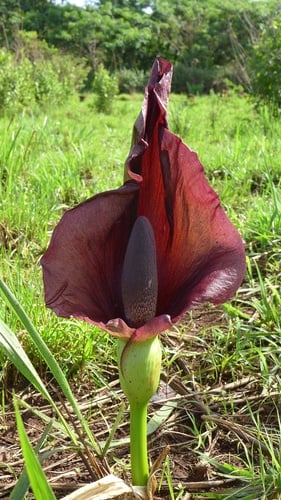
iNaturalist· cc-by-nc
(c) SunGW, some rights reserved (CC BY-NC), uploaded by SunGW
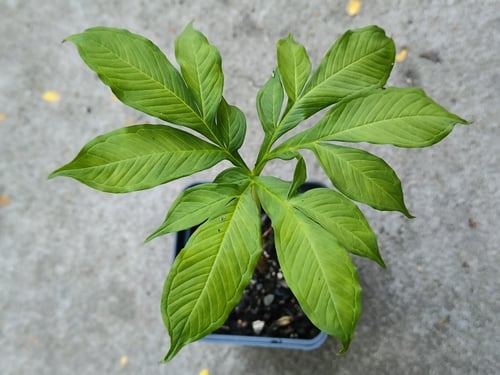
iNaturalist· cc-by-nc
(c) arulselvan, some rights reserved (CC BY-NC)
iNaturalist· cc-by-nc
(c) Jaide, some rights reserved (CC BY-NC), uploaded by Jaide
Summary
Source: WikipediaAlocasia macrorrhizos is a species of flowering plant in the arum family (Araceae) that is native to rainforests of Maritime Southeast Asia, New Guinea, and the Murray Islands group in the Torres Strait. It has long been cultivated in South Asia, the Philippines, many Pacific islands, and elsewhere in the tropics, in the order of tens of thousands of years. Common names include giant taro, giant alocasia, ʻape, biga, and pia. In Australia it is known as the cunjevoi (a term which also refers to a marine animal).
Description
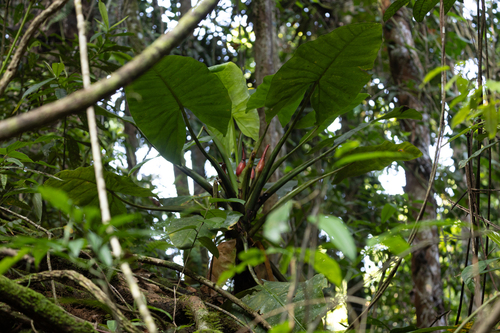
A very large herb. A taro family plant. It has a stout erect trunk up to 4 m tall. This has upright leaves which are arrow shaped. Leaves have round lobes at the bottom. The leaves are leathery and are often wavy around the edge. The secondary veins are not prominent. The leaf blade can be 1-1.2 m long. The leafy structure around the flower is yellow in the upper section. It forms a hood and drops off as the flower opens. The fruit are bright red berries. The corm is large, often curved and above the ground. It often has small cormels at the side. Brown trailing fibres of the leaf bases often hang from the stem. The leaves and petioles contain stinging crystals.
Edible Uses
The corm is edible when thoroughly cooked — cooking is necessary to destroy the calcium oxalate crystals it contains. The basal part of the stem, which can reach up to 1 metre tall and 20cm in diameter, is peeled and used as a cooked vegetable, suitable for adding to soups and stews. A very easily digested starch can also be extracted from the stem. In some cultivars, the leaves and stalks are edible as well.
Traditional Uses
The stems and corms are eaten after roasting or boiling. The main corm is cooked and eaten after being carefully peeled. The young leaves are edible. CAUTION The mouth can be irritated by chewing improperly cooked plant parts due to chemicals called oxalates. The stems are cut into small pieces and boiled and eaten in curries. The stems are boiled and the water thrown away. The starch is also extracted from the rootstocks. The young shoots are cooked and eaten. The harvested food can be stored for about one week.
Medicinal Uses
Giant taro is widely used in traditional medicine across the regions where it is grown as a food crop, with all parts of the plant employed. The stem sap is used to treat earache or boils in the ear, and applied externally to cuts. In New Guinea, the sap and leaves are used to treat headaches. The leaves are considered antimicrobial, antifungal, antioxidant, hepatoprotective, antidiarrheal, and antiprotozoal. The leaves and rhizome are used to treat impetigo, furunculosis, phlegmon, and snakebite — administered orally as a liquid extract, with the residue applied as a poultice. They are also used for colic and vomiting, in a daily dose of 10 to 20g of dried rhizome as a decoction. A plaster made from the rhizome is applied topically and is considered effective against furunculosis. Sexual insufficiency is treated by eating the leaves cooked in coconut milk. The roots are used for swollen lymph glands, and the wood for stomach-ache and diarrhoea. Leaves are collected throughout the year and used fresh; rhizomes are boiled to reduce itching compounds, then sun-dried or heat-dried.
Known Hazards
All parts of the plant contain calcium oxalate crystals. This substance is toxic fresh and, if eaten, makes the mouth, tongue and throat feel as if hundreds of small needles are digging in to them. However, calcium oxalate is easily broken down either by thoroughly cooking the plant or by fully drying it and, in either of these states, it is safe to eat the plant. People with a tendency to rheumatism, arthritis, gout, kidney stones and hyperacidity should take especial caution if including this plant in their diet.
Distribution
A tropical plant. It is widely distributed in open wetlands and along streams and in some types of humid forest. The plant grows wild from sea level up to 2600 m altitude in the tropics. Giant taro is a tropical plant and will not grow well below 10°C. It requires a well distributed rainfall and does not tolerate drought. Even though it grows along creek banks it cannot tolerate waterlogged soil. It is only used as food in a few coastal areas. Wild forms commonly seen growing are bitter and not used. It does not do well on atolls. It suits hardiness zones 11-12.
Where It Grows
Africa, American Samoa, Asia, Australia, Bangladesh, Bougainville, British Indian Ocean Terr., BIOT, Cambodia, Caroline Islands, Central America, Chuuk, Cook Islands, Cuba, Dominican Republic, East Timor, Easter Island, Ecuador, Fiji, French Polynesia, FSM, Guam, Guatemala, Guianas, Haiti, Hawaii, Himalayas, India, Indochina, Indonesia, Jamaica, Japan, Kiribati, Kosrae, Laos, Madagascar, Malaysia, Maldives, Marianas, Marquesas, Marshall Islands, Micronesia, Myanmar, Nauru, New Caledonia, Niue, Northeastern India, North America, Pacific, Pakistan, Palau, Papua New Guinea, PNG, Philippines, Pohnpei, Puerto Rico, Rotuma, Samoa, Sao Tome and Principe, SE Asia, Singapore, Solomon Islands, South America, Sri Lanka, St Helena, Suriname, Tahiti, Taiwan, Thailand, Timor-Leste, Tokelau, Tonga, Truk, Tuvalu, USA, Vanuatu, Vietnam, Wallis & Futuna, West Africa, West Indies, Yap,
Cultivation
The top of the main corm is planted. The small round cormels can be planted, but are slow to mature. A spacing of 1.2 x 1.2 m is suitable. Because the giant taro takes more than a year to be ready to harvest, it often ends up left growing in an old garden site without much care or weeding, until the owner wants to harvest it. The mouth can be irritated by chewing improperly cooked plant parts due to chemicals called oxalates. Giant taro contains small needle-like calcium oxalate crystals in the tissues. It is necessary to remove these during the preparation and cooking. The method of peeling is important. Normally some ladies who are especially experienced at peeling do this job. Also the taro corm is often left to wilt for a week after it is harvested and before it is used. Also to help remove some of the crystals, the stem is baked for a long time, or boiled in several changes of water. It is also important to use the right variety of giant taro because the kinds grown in gardens have less of the chemical than wild ones.
Propagation
Seed is best sown as soon as it is ripe and germinates best at 24°C. The rootstock can be divided as the plant comes into growth. Offsets appear at the base as the plant matures and can be easily transplanted.
Other Uses
The plant grows rapidly in wetland conditions and accumulates metal contaminants such as zinc, showing promise for use in sewerage treatment beds. A fibre is said to be obtainable from the plant. Giant taro is also noted for its role in carbon farming and food forest systems.
Production
Corms of 8.5 to 40 kg have been harvested from individual plants of unknown age. The time to maturity is about 12 months but plants are often left for 2-3 years.
Other Information
It is a commercially cultivated vegetable. This taro is of local importance only in some coastal areas and islands of Papua New Guinea e.g. Rabaul, Namatanai. It is important in several Pacific Islands and Sri Lanka.
Notes
There are about 60-70 Alocasia species.
Nutrition
| Part | Moisture | kJ | kcal | Protein | Vit A | Vit C | Iron | Zinc |
|---|---|---|---|---|---|---|---|---|
| Corm | 84 | 256 | 61 | 0.6 | 0 | 5 | 1 | 1.5 |
| Rhizome | 63.2 | — | — | 3.3 | — | — | — | — |
| Leaves | — | — | — | — | — | — | — | — |
| Leaf stalk | — | — | — | — | — | — | — | — |
Synonyms
Also Known As
Abis, Alu, Ape, 'Apea mamala, Babai, Bada gadri, Biga, Birah negeri, Birah, Bisech, Boafuredhdhe, Chara kanda, Conjevoi, Daun keladi, Desa-ala, Dhopa, Dranu, Elephant Ear, Fale, Fine, Gabi, Habarala, Hai yu, Henchala, Hensoksu, Honggu, Ka, Kadard, Kansalu, Kape, Karkalo, Kebei, Khajarikochai, Kiri ala, Kiri habarala, Kradat daeng, Lai, Maanaka, Mahuya-pein, Man kachu, Man kanda, Man kochu, Manaka, Mana saru, Mana thaso, Mankachu, Mankanda, Mankochu Marambu, Merukankilangu, Ohd, Oht, Onak, Pai, Papao-alaka, Papao-atolong, Papa sisa, Parum sembu, Pein-gyi, Piga, Puna, Qos tsov, Rata-ala, Sankhasaru, Saombia, Sente, Spoon Lily, Ta'amu, Tamu, Te kabe, Thagong, Totoa taco, Via, Via dalo, Via mila, Wod, Wot, Wut
References (158)
- Giant taro references
- Aberoumand, A. and Deokule, S. S., 2009, Determination of Elements Profile of Some Wild Edible Plants. Food Anal. Methods. 2:116-119 (As Alocasia indica)
- Allen, R.N., 1929, Photomicrographs of Philippine starches. Philipp. J.Sci., 38(2), 247.
- Ambasta S.P. (Ed.), 2000, The Useful Plants of India. CSIR India. p 29 (As Alocasia indica)
- Anderson, E. F., 1993, Plants and people of the Golden Triangle. Dioscorides Press. p 20
Show all 158 references Hide references
- Ara, R. I. T., 2015, Leafy Vegetables in Bangladesh. Photon eBooks. p 116 (As Alocasia indica)
- Asthana, R.P., 1946, Bacterial leaf-spot on arum. Curr. Sci., 15(12), 356.
- Backer, C.A., & Brink,B.,van den, 1968, Flora of Java.p 118.
- Bandyopadhyay, S. et al, 2009, Wild edible plants of Koch Bihar district, West Bengal. Natural Products Radiance 8(1) 64-72
- Bandyopadhyay, S., et al, 2012, A Census of Wild Edible Plants from Howrah District, West Bengal, India. Proceedings of UGC sponsored National Seminar 2012 (As Alocasia indica)
- Banerjee, A., et al, 2013, Ethnobotanical Documentation of Some Wild Edible Plants in Bankura District, West Bengal, India. The Journal of Ethnobiology and Traditional Medicine. Photon 120 (2013) 585-590 (As Alocasia indica)
- Baro, D., Baruah, S. and Borthukar, S. K. 2015, Documentation on wild vegetables of Baksa district, BTAD (Assam). Scholars Research Library. Archives of Applied Science Research, 2015, 7 (9):19-27 (As Alocasia indica)
- Barrau, J., 1958, Subsistence Agriculture in Melanesia. Bishop Museum Bulletin 219 p 43.
- Barrau, J., 1957, Les Aracees a tubercules alimentaires des iles du Pacifique sud. J.Agric. Trop. Bot. Appl. 4(1), 41-44.
- Barrau, J., 1976, Subsistence Agriculture in Polynesia and Micronesia. Bernice P. Bishop Museu, Bulletin 223 Honolulu Hawaii. Kraus reprint. p 39
- Bois, D., 1927, Les Plantes Alimentaires. Vol. 1 p 527.
- Bodkin, F., 1991, Encyclopedia Botanica. Cornstalk publishing, p 68
- Borrell, O.W., 1989, An Annotated Checklist of the Flora of Kairiru Island, New Guinea. Marcellin College, Victoria Australia. p 15, 156 (Also as Alocasia indica)
- Bourret, D., 1981, Bonnes-Plantes de Nouvelle-Caledonie et des Loyaute. ORSTOM. p 61
- Brickell, C. (Ed.), 1999, The Royal Horticultural Society A-Z Encyclopedia of Garden Plants. Convent Garden Books. p 99
- Brown, D., 2000, Aroids. Plants of the Arum family. Timber Press. (Second edition) p 262, 306,
- Brown, W.H., 1920, Wild Food Plants of the Philippines. Bureau of Forestry Bulletin No. 21 Manila. p 28
- Brown, 1951, Useful Plants of the Philippines p 343.
- Burkill, H. M., 1985, The useful plants of west tropical Africa, Vol. 1. Kew.
- Burkill, I.H., 1966, A Dictionary of the Economic Products of the Malay Peninsula. Ministry of Agriculture and Cooperatives, Kuala Lumpur, Malaysia. Vol 1 (A-H) p 107 (As Alocasia indica)
- Cable, W.J., 1985, Growth of giant taro (Alocasia sp.) cultivars at Alafua, Western Samoa. Alafua Ag Bulletin v 10(3) p13-19
- Cherikoff V. & Isaacs, J., The Bush Food Handbook. How to gather, grow, process and cook Australian Wild Foods. Ti Tree Press, Australia p 192, 194, 198
- Chowdery, T., et al, 2014, Wild edible plants of Uttar Dinajpur District, West Bengal. Life Science Leaflets. 47:pp 20-36 http://lifesciencesleaflets.ning.com
- Chowdhury, M. & Mukherjee, R., 2012, Wild Edible Plants Consumed by Local Communities of Maldah of West Bengal, India. Indian J.Sci.Res.3(2) : 163-170
- Coursey, D.G.,1967, The edible aroids. Wld.Crops. 20(4):25-30.
- Cribb, A.B. & J.W., 1976, Wild Food in Australia, Fontana. p 144
- Cundall, P., (ed.), 2004, Gardening Australia: flora: the gardener's bible. ABC Books. p 133 (As Alocasia macrorrhizos)
- Devarkar, V. D., et al, 2011, Dietary and Medicinal Significance of Wild Vegetables from Osmanabad Region, Maharashtra (India). Life sciences Leaflets 11:317-332. (As Alocasia indica)
- Devi, O. S., et al, 2021, Wild edible plants associated witht the people of Thoubal Khunou village and its migrated villagers. Int. J. Adv. Res. Biol. Sci. 8(9): 72-90
- Dobriyal, M. J. R. & Dobriyal, R., 2014, Non Wood Forest Produce an Option for Ethnic Food and Nutritional Security in India. Int. J. of Usuf. Mngt. 15(1):17-37
- Doi Shinji, 1944, Value of Dokuimo as a raw material for the fermentation industry. J.Agric. Chem.Japan 20,457-464.
- Dutta, U., 2012, Wild Vegetables collected by the local communities from the Churang reserve of BTD, Assam. International Journal of Science and Advanced Technology. Vol. 2(4) p 119 (As Alocasia indica)
- Elliot, W.R., & Jones, D.L., 1982, Encyclopedia of Australian Plants suitable for cultivation. Vol 2. Lothian. p 174
- Englberger, L., et al, 2006, Documentation of the traditional food system of Pohnpei. Indigenous People's food systems. Chp 6 p 119
- Enum. pl. 3:39. 1841 (As Colocasia indica)
- Ethnobotany of Karbis. Chapter 4 in p 82
- Flora of Pakistan. www.eFloras.org
- French, B., 1986, Food Plants of Papua New Guinea, Asia Pacific Science Foundation p 6
- French, B.R., 2010, Food Plants of Solomon Islands. A Compendium. Food Plants International Inc. p 6
- Furtado,C.X.,1941, Alocasia macrorrhiza and its varieties. Gdn's Bull. Straits Settl.,11(3),244-257.
- Gerlach, W.W.P., 1986, Annotated list of diseases of taro (Colocasia esculenta, Ta'amu (Alocasia macrorrhiza) and taro papalagi (Xanthosoma sagittifolium) in western Samoa. Alafua Ag Bulletin v 11(2) p69-79.
- Ghosh, C. & Das A. P., 2011, Some useful and poisonous tea garden weeds from the Darjiling District of West Bengal, India. Pleione 5(1): 91 - 114
- Gillaumin, R., 1954, Les Plantes utiles des Nouvelles-Hebrides (fin et complement) In: Journal d'agriculture tropicale et de botanique appliquee Vol. 1, No. 10-12 pp 453-460
- Gilliland, H.B.,1962, Common Malayan Plants. Univ. of Malaya. p 11.
- Global Plants JSTOR
- Greig, D., 1996, Flowering Natives for Home Gardens. Angus & Robertson. p 48
- Haudricourt, A., 1941, Les colocasiees alimentaires (taros et yautias). Les alocasia. Revue Bot. Appl. Agric. Trop. 21(1),55-58.
- Hedricks, U.P.(ed), 1919, Sturtevant's Edible Plants of the World. Dover, p 41, p 44 (As Alocasia indica)
- Henty, E.E., 1980, Harmful Plants in Papua New Guinea. Botany Bulletin No 12. Division Botany, Lae, Papua New Guinea. p 23, Pl. 8
- Hiddins, L., 1999, Explore Wild Australia with the Bush Tucker Man. Penguin Books/ABC Books. p 137
- Hinton, B & B., 1982, A Wilderness in Bloom. Wildflowers of tropical Australia. p 46
- Hist. nat. veg. 12:47. 1846 (As Alocasia indica)
- Hooker,J.D.,1894, Flora of British India Vol.VI p526.
- Hossain, U. & Rahman, A., 2018, Study and quantitative analysis of wild vegetable floral diversity available in Barisal district, Bangladesh. Asian J. Med. Biol. Res. 2018, 4 (4), 362-371
- Jardin, C., 1970, List of Foods Used In Africa, FAO Nutrition Information Document Series No 2.p 12 (As Colocasia indica)
- Jones D, L, 1986, Ornamental Rainforest Plants in Australia, Reed Books, p 251
- Kar, A., & Borthakur, S. K., 2008, Wild vegetables of Karbi - Anglong district, Assam, Natural Product Radiance, Vol. 7(5), pp 448-460
- Kay, D.E., 1973, Root Crops. T.P.I. Crop & Product Digest No 2 p 71
- Kays, S. J., and Dias, J. C. S., 1995, Common Names of Commercially Cultivated Vegetables of the World in 15 languages. Economic Botany, Vol. 49, No. 2, pp. 115-152
- Kiple, K.F. & Ornelas, K.C., (eds), 2000, The Cambridge World History of Food. CUP p 1890 (Also as Alocasia indica)
- Kiran, K. C., et al, 2019, Diversity and Seasonal Availability of Potential Wild Edible Plants from Vidarbha Region of Maharashtra State, India. Int.J.Curr.Microbiol.App.Sci (2019) 8(2): 1434-1446
- Kuhnlein, H. V., et al, 2009, Indigenous Peoples' food systems. FAO Rome p 119
- Kumar, S. A., Manus, D. & Mallika, M., 2018, Impact of non-timber forest products on Forest and in Livelihood Economy of the People of Adjoining Areas of Jalpaiguri Forest Division, West Bengal, India. Int. J. of Life Sciences, 2018; 6 (2):365-385
- Kundu,B.C., 1967, Some edible rhizomatous and tuberous crops of India. Proc. 1st Int. Sympos.Trop. Root Crops 1 Pt 1,124.
- Kuo, W. H. J., (Ed.) Taiwan's Ethnobotanical Database (1900-2000), http://tk.agron.ntu.edu.tw/ethnobot/DB1.htm
- Lazarides, M. & Hince, B., 1993, Handbook of Economic Plants of Australia, CSIRO. p 14
- Lepofsky, D., 2003, The Ethnobotany of Cultivated Plants of the Maohi of the Society Islands. Economic Botany, Vol. 57, No. 1, pp. 73-92
- Lim, T. K., 2015, Edible Medicinal and Non Medicinal Plants. Volume 9, Modified Stems, Roots, Bulbs. Springer p 6
- Llamas, K.A., 2003, Tropical Flowering Plants. Timber Press. p 77
- Lord, E.E., & Willis, J.H., 1999, Shrubs and Trees for Australian gardens. Lothian. p 148
- Low, T., 1991, Wild Food Plants of Australia. Australian Nature FieldGuide, Angus & Robertson. p 84
- Low, T., 1992, Bush Tucker. Australia’s Wild Food Harvest. Angus & Robertson. p (Contents)
- Macmillan, H.F. (Revised Barlow, H.S., et al) 1991, Tropical Planting and Gardening. Sixth edition. Malayan Nature Society. Kuala Lumpur. p 336
- Macmillan, H.F. (Revised Barlow, H.S., et al) 1991, Tropical Planting and Gardening. Sixth edition. Malayan Nature Society. Kuala Lumpur. p 336 (As Alocasia indica)
- Maghirang, R. G., et al, 2018. Ethnobotanical Studies of Some Plants Commonly Used as Vegetables in Selected Provinces of the Philippines. Journal of Nature Studies. 17(2), 30-43.
- Maikhuri, R, K, and Gangwar, A. K., 1993, Ethnobiological Notes on the Khasi and Garo Tribes of Meghalaya, Northeast India, Economic Botany, Vol. 47, No. 4, pp. 345-357 (As Alocasia indica)
- Mandal, P. et al, 2010, Antioxidant activity in the extracts of two edible aroids. Inidan Journal of Pharmaceutical Sciences. 72(1): pp 105-108
- Martin, F.W. & Ruberte, R.M., 1979, Edible Leaves of the Tropics. Antillian College Press, Mayaguez, Puerto Rico. p 175 (Also as Alocasia indica)
- Medhi, P. & Borthakur, S. K., 2012, Phytoresources from North Cachur Hills of Assam -3: Edible plants sold at Hflong market. Indian Journal of Natural Products and Resources. 3(1) pp 84-109 (As Alocasia indica)
- Mishra, N., et al, 2016, Indigenous knowledge in utilization of wetland plants in Bhadrak district, Odisha, India. Indian Journal of Natural Products and Resources. Vol. 7(1) pp. 82-89
- Misra, R. C., et al, 2013, Genetic resources of wild tuberous food plants traditionally used in Similipal Biosphere Reserve, Odisha, India. Genetic Resources and Crop Evolution. Vol. 60 No. 2. Springer
- Monsalud, M.R., Tongacan, A.L., Lopez, F.R., & Lagrimas, M.Q., 1966, Edible Wild Plants in Philippine Forests. Philippine Journal of Science. p 442
- Massal, E and Barrau, J., 1973, Food Plants of the South Sea Islands. SPC Technical Paper No 94. Nounea, New Caledonia. p 6-10.
- Medhi, P., Sarma, A and Borthakur, S. K., 2014, Wild edible plants from the Dima Hasao district of Assam, India. Pleione 8(1): 133-148
- Meitei, L. R., et al, 2022, An ethnobotanical study on the wild edible plants used by forest dwellers in Yangoupokpi Lokchao Wildlife Sanctuary, Manipur, India. Ethnobotany Research and Application 23:15
- Mishra, M., 2013, Utilization of wild tuberous plants in extreme environmental condition: A Case of Baiga Tribe of Central India. The Journal of Ethnobiology and Traditional Medicine. Photon 118 (2013) 366-372 (As Colocasia indica)
- Narzary, H., et al, 2013, Wild Edible Vegetables Consumed by Bodo tribe of Kokrajhar District (Assam), North-East India. Archives of Applied Science Research, 5(5): 182-190 (As Alocasia indica)
- Neal,C.M.,1965, In Gardens of Hawaii. Bishop Museum Press.
- Onwueme, I.C., 1978, The Tropical Tuber Crops. Wiley, p 199 (As Alocasia indica)
- Pagag, K. & Borthakur, S.K., 2012, Wild edible wetland plants from Lakhimpur district of Assam, India. Pleione 6(2): 322 - 327
- Pancho, J.V.,1959, Notes on cultivated edible aroids in the Philippines: Baileya, 7(1),63-70.
- Parham, B.E.V.,1942, Some useful plants of the Fiji Islands. Fiji Agric. J.,13(2),41.
- Parham, B. E. V., 1971, The Vegetation of the Tokelau Islands with special reference to the Plants of Nukunonu Atoll. New Zealand Journal of Botany. 9:4, 576-609
- Parham, B. E. V., 1972, Plants of Samoa. New Zealand Department of Scientific and Industrial Research. Information Series. No. 85 p 114
- Patiri, B. & Borah, A., 2007, Wild Edible Plants of Assam. Geethaki Publishers. p 155 (As Alocasia indica)
- Peduruhewa, P. S., et al, 2021, Potential of Underutilized Wild Edible Plants as the Food for the Future – A Review. Journal of Food Security, Vol. 9, No. 4, 136-147
- Peekel, P.G., 1984, (Translation E.E.Henty), Flora of the Bismarck Archipelago for Naturalists, Division of Botany, Lae, PNG. p 72, 73 (As Alocasia indica)
- Pena, R.S.de la, 1970, The edible aroids in the Asian Pacific area. Proc. 2nd. Int. Symp. Trop. Root & Tuber Crops. 1 Pt 5,138-139.
- Plants of Haiti Smithsonian Institute http://botany.si.edu
- Plowman,T.,1969, Folk uses of the new world aroids. Econ. Bot. 23(2),100
- Plucknett, D.L., 1970, Colocasia, Xanthosoma, Alocasia, Cyrtosperma, and Amorphophallus. Proc. 2nd Int. Symp. Trop. Root & Tuber Crops. 1Pt 5,127-135.
- Plucknett, D.L., Edible Aroids, in Simmonds, N.W., (Ed.), 1979, Evolution of Crop Plants. Longman. p 10 (As Alocasia indica)
- Polinag, M. A., 2003, Food from the Wilderness. Department of Environment and Natural Resources. Laguna.
- Pradheep, K., et al, 2016, Wild edible plants used by Konyak tribe in Mon district of Nagaland: Survey and inventorisation. Indian Journal of Natural Products and Resources. Vol 7(1) pp 74-81
- Prafulla, S., 2017, Wild Food Diversity of Nawegaon-Nagzira Tiger Reserve in Gondia-Bhandara district of Maharashtra, India. Int. J. of Life Sciences, 2017, Vol. 5 (4): 620-626
- Price, S.H. & J.L., Wild Food, Medicine and useful plants of the Wet tropics. Kwik Kopy, Cairns. p 4
- Purseglove, J.W., 1972, Tropical Crops. Monocotyledons. Longmans p 58
- Plucknett, D.L., Edible Aroids, in Simmonds, N.W., (Ed.), 1979, Evolution of Crop Plants. Longman. p 10
- Rajapaksha, U., 1998, Traditional Food Plants in Sri Lanka. HARTI, Sri Lanka. p 70 (Also as Alocasia indica)
- Rahman, S. A., et al, 2013, Cultivated Plants in the Diversified Homegardens of Local Communities in Ganges Valley, Bangladesh. Science Journal of Agricultural Research and Management. Vol. 2013
- Rashid, H. E., 1977, Geography of Bangladesh. Westview. p 264 (As Alocasia indica)
- Reark, J.B., 1953, Cultivation of the genus Alocasia in Florida. Proc. Fla.Sta.Hort.Soc., 66, 326-331.
- Recher, P, 2001, Fruit Spirit Botanical Gardens Plant Index. www.nrg.com.au/~recher/ seedlist.html p 4
- Safford, W.E., 1905, Useful Plants of Guam.
- Sarma, H., et al, 2010, Updated Estimates of Wild Edible and Threatened Plants of Assam: A Meta-analysis. International Journal of Botany 6(4): 414-423 (As Alocasia indica)
- Schott. & Endl.,1832, Melet.18
- Seeman, B., 1865-1873, Flora Vitiensis p 286 (Probably also confused with Cyrtosperma merkusii)
- Siemonsma, J. S. & Kasem Piluek, eds. 1993. Vegetables. In: Plant Resources of South-East Asia (PROSEA) 8:312
- Singh, H.B., Arora R.K., 1978, Wild edible Plants of India. Indian Council of Agricultural Research, New Delhi. p 10, 17
- Slocum, P.D. & Robinson, P., 1999, Water Gardening. Water Lilies and Lotuses. Timber Press. p 90
- Smith, K., 1998. Growing Uncommon Fruits and Vegetables. New Holland. p 72
- Srivastava, S.K. & Krishnan, P. S., 1959, Oxalate content of plant tissues. J. Sci. Res. (India) 18C(8), 146-148.
- Soyza, D. J. de, 1938, Yam cultivation in the Kegalla district. Trop. Agric. Mag. Ceylon. Agric. Soc., 90(2),73-75.
- Staples, G.W. and Herbst, D.R., 2005, A tropical Garden Flora. Bishop Museum Press, Honolulu, Hawaii. p 599
- Sujanapal, P., & Sankaran, K. V., 2016, Common Plants of Maldives. FAO & Kerala FRI, p 24
- Sukarya, D. G., (Ed.) 2013, 3,500 Plant Species of the Botanic Gardens of Indonesia. LIPI p 1056
- Suksri, S., et al, 2005, Ethnobotany in Bung Khong Long Non-Hunting Area, Northeast Thailand. Kasetsart J., (Nat. Sci) 39: 519-533
- R. Sweet, Hort. brit. ed. 3:631. 1839 "macrorhizon"
- Teron, R. & Borthakur, S. K., 2016, Edible Medicines: An Exploration of Medicinal Plants in Dietary Practices of Karbi Tribal Population of Assam, Northeast India. In Mondal, N. & Sen, J.(Ed.) Nutrition and Health among tribal populations of India. p 148
- Terra, G. J. A., 1973, Tropical Vegetables. Communication 54e Royal Tropical Institute, Amsterdam, p 20, 21, 22 (Also as Alocasia indica)
- Thaman, R.R., 1976, The Tongan Agricultural System, University of the South Pacific, Suva, Fiji. p 378
- Thaman, R. R., 1987, Plants of Kiribati: A listing and analysis of vernacular names. Atoll Research Bulletin No. 296
- Thaman, R. R., et al, 1994, The Flora of Nauru. Atoll Research Bulletin No. 392. Smithsonian Institute p 39
- Thaman, R. R, 2016, The flora of Tuvalu. Atoll Research Bulletin No. 611. Smithsonian Institute p 38
- Tindall, H.D., 1983, Vegetables in the tropics. Macmillan p. 49
- Topp, J. M. W., 1988, An Annotated Check List of the Flora of Diego Garcia, British Ocean Territory. Atoll Research Bulletin No. 313
- Torre, de la L., et al, 2008, Enciclopedia de las Plantas Útiles del Ecuador. Herbario QCA. Pontificia Universidad Católica del Ecuador. p 178
- Townsend, K., 1994, Across the Top. Gardening with Australian Plants in the tropics. Society for Growing Australian Plants, Townsville Branch Inc. p 77
- Uprety, Y., et al, 2016, Traditional use and management of NTFPs in Kangchenjunga Landscape: implications for conservation and livelihoods. Journal of Ethnobiology and Ethnomedicine (2016) 12:19
- USDA, ARS, National Genetic Resources Program. Germplasm Resources Information Network - (GRIN). [Online Database] National Germplasm Resources Laboratory, Beltsville, Maryland. Available: www.ars-grin.gov/cgi-bin/npgs/html/econ.pl (10 April 2000)
- Valenzuela,A.& Wester,P.J.,1930, Philip. J.Sci. 41,85.
- Vander Velde, N, 2003, The Vascular Plants of Majuro Atoll, Republic of the Marshall Islands. Atoll research Bulletin. No. 503. Smithsonian Institute. p 16
- Walter, A. & Lebot, V., 2007, Gardens of Oceania. ACIAR Monograph No. 122 p. 59
- Wealth of India p 60
- Wiersema, J. H. & Leon, B., 2013, World Economic Plants. A Standard Reference CRC Press. 2nd Ed. p 38
- Whistler, W. A., 1988, Ethnobotany of Tokelau: The Plants, Their Tokelau Names, and Their Uses. Economic Botany 42(2): 155-176
- Whitney, C. W., et al, 2014, Conservation and Ethnobotanical Knowledge of a Hmong Community in Long Lan, Luang Prabang, Lao People’s Democratic Republic. Ethnobotany Research and Applications 12:643-658
- Wilson, S., 1997, Some Plants are Poisonous. Reed. p 11
- World Checklist of Useful Plant Species 2020. Royal Botanic Gardens, Kew
- Yuncker, T. G., 1943, The Flora of Niue Island. Bernice P. Bishop Museum Bulletin 178 p 30
- Yuncker, T.G., 1959, Plants of Tonga, Bernice P. Bishop Museum, Hawaii, Bulletin 220. p 76
- Zeven, A. C. & de West, J. M. J., 1982, Dictionary of cultivated plants and their regions of diversity. Wageningen. p 49 (As Alocasia indica), p 71
- Zizka, G., 1991, Flowering Plants of Easter Island. Palmarum Hortus Francofurtensis