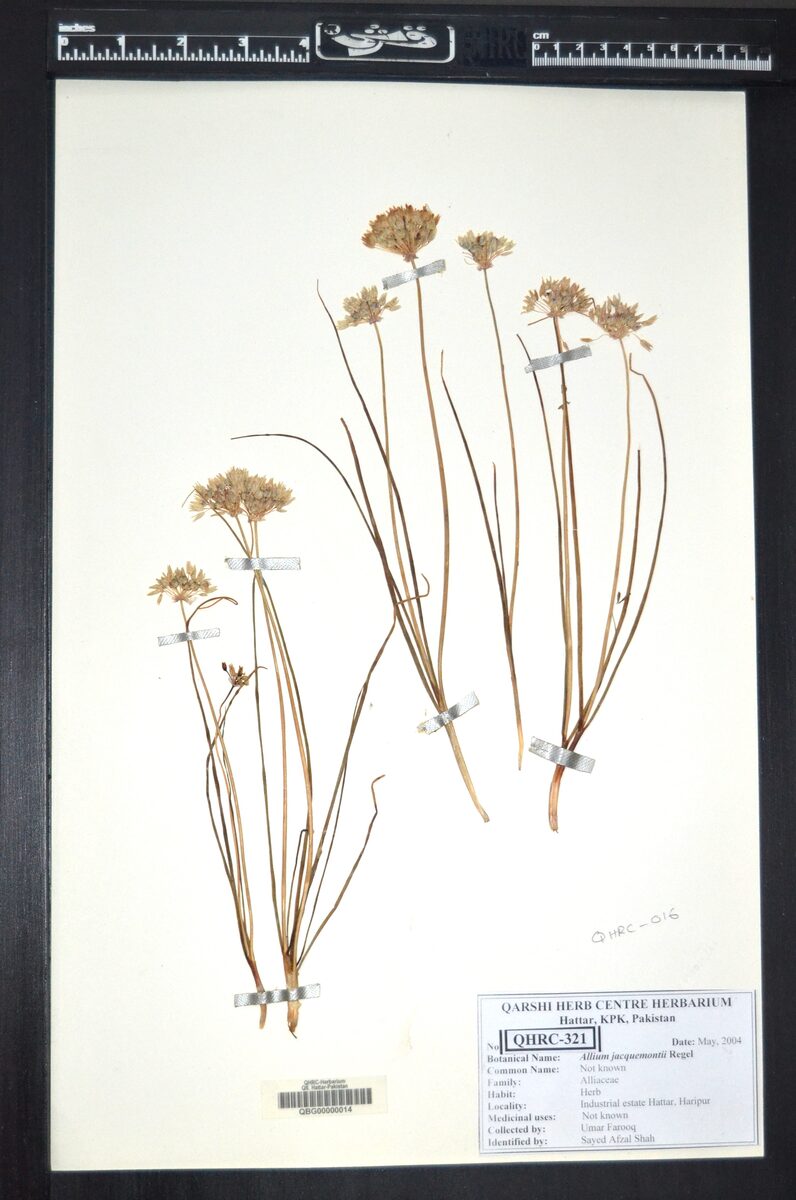
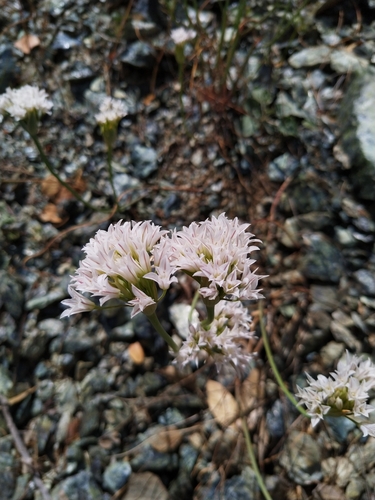
Allium rotundum
L.
Purple flowered garlic, Wild garlic, Sand Leek
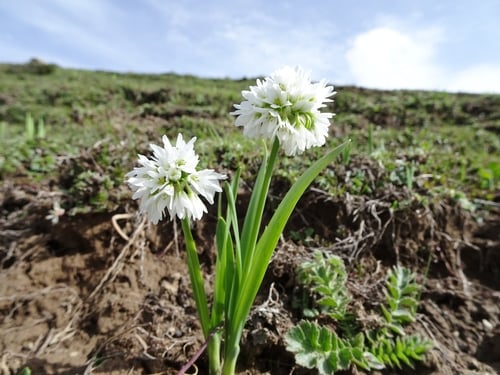
iNaturalist· cc-by-nc
(c) Jakob Fahr, some rights reserved (CC BY-NC), uploaded by Jakob Fahr
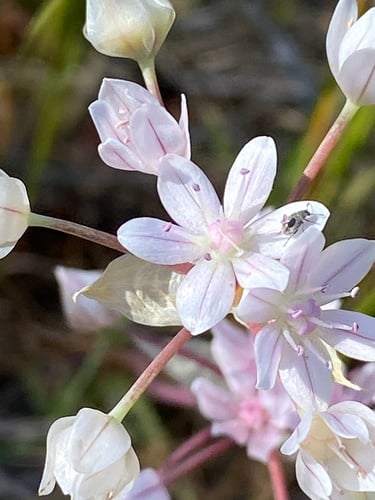
iNaturalist· cc-by-nc
(c) Теймуров А.А., some rights reserved (CC BY-NC), uploaded by Теймуров А.А.
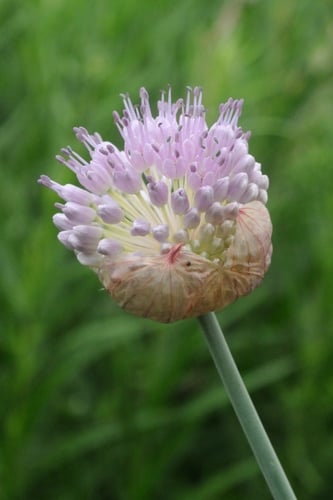
iNaturalist· cc-by-nc
(c) Olga Biryukova, some rights reserved (CC BY-NC), uploaded by Olga Biryukova
Summary
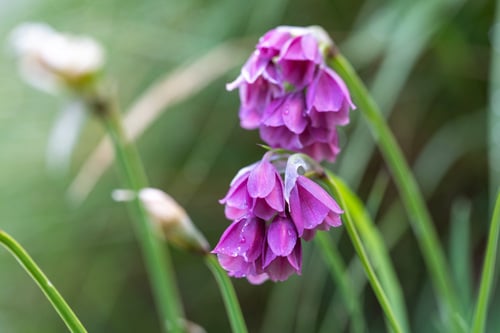
Source: WikipediaAllium rotundum, common name round-headed leek or purple-flowered garlic, is a Eurasian and North African species of wild onion. Its native range extends from Spain and Morocco to Iran and European Russia. It is sparingly naturalized in parts of the United States (Michigan and Iowa). The species grows in disturbed habitats such as roadsides, cultivated fields, etc. Allium rotundum produces large clumps of as many as 50 egg-shaped bulbs, each up to 1.5 cm long. Leaves are up to 40 cm long. Scapes are up to 90 cm tall. Umbels look round from a distance, and can contain as many as 200 flowers. Flowers are bell-shaped, up to 7 mm across; tepals purple, sometimes with white margins; anthers yellow or purple; pollen yellow or white.
Description
A bulbous herb in the Amaryllidaceae family (onion family) with an onion-like growth habit, native to temperate mountainous regions where it is sold in local markets.
Edible Uses
The leaves are used in cheese making and eaten raw in salads. The bulb is used as a spice like garlic. The flowers are also edible.
Traditional Uses
The leaves are used in cheese making. They are also eaten raw in salads. The bulb is used as a spice like garlic.
This uses section is brief — help expand it
Distribution
It is a temperate plant. It grows in mountains.
Where It Grows
Albania, Armenia, Asia, Australia, Caucasus, Europe, Georgia, Greece, Hungary, Iran, Luxembourg, Mediterranean, Middle East, New Zealand, Slovenia, Turkey, Türkiye,
Other Information
It is sold in local markets.
Notes
There are about 300-700 Allium species. Most species of Allium are edible (Flora of China). All alliums are edible but they may not all be worth eating! They have also been put in the family Alliaceae.
Synonyms
Also Known As
Dashtaskhtor, Kir sogani, Kormen
References (17)
- Ann. Mus. Goulandris 4:178. 1978
- Baktır, I., Yılmaz, G., Göktürk, R.S. and Karagüzel, O. (2013). EDIBLE FLOWERING GEOPHYTES OF TURKEY. Acta Hortic. 1002, 297-300
- Bussman, R. W., et al, 2021, Unity in diversity—food plants and fungi of Sakartvelo (Republic of Georgia), Caucasus. Journal of Ethnobiology and Ethnomedicine (2021) 17:72 p 5
- Cakir, E. A., 2017, Traditional knowledge of wild edible plants of Iğdır Province (East Anatolia, Turkey). Acta Soc Bot Pol. 2017;86(4):3568.
- Cerne, M., 1992, Wild Plants from Slovenia used as Vegetables. Acta Horticulturae 318.
Show all 17 references Hide references
- Denes, A., et al, 2012, Wild plants used for food by Hungarian ethnic groups living in the Carpathian Basin. Acta Societatis Botanicorum Poloniae 81 (4): 381-396
- Ertug, F, Yenen Bitkiler. Resimli Türkiye Florası -I- Flora of Turkey - Ethnobotany supplement (As Allium scorodoprasum subsp. rotundum)
- Gunes, S. et al, 2018, Survey of wild food plants for human consumption in Karaisali (Adana-Turkey). Indian Journal of Traditional Knowledge. Vol. 17(2), April 2018, pp 290-298 (As Allium scorodoprasum subsp. rotundum)
- Hedrick, U.P., 1919, (Ed.), Sturtevant's edible plants of the world. p 41
- Kargioglu, M., et al, 2008, An Ethnobotanical Survey of Inner-West Anatolia, Turkey. Human Ecology 36:763-777 (As Allium scorodoprasum subsp. rotundum)
- Lazarides, M. & Hince, B., 1993, Handbook of Economic Plants of Australia, CSIRO. p 13
- Low, T., 1991, Wild Herbs of Australia and New Zealand. Angus & Robertson. p 105
- Mukemre, M., et al, 2016, Survey of wild food plants for human consumption in villages of Catak, (Van-Turkey), Indian Journal of Traditional Knowledge. Vol. 15(2) pp. 183-191 (As Allium scorodoprasum subsp. rotundum)
- Nanagulyan, S., et al, 2020, Wild plants and fungi sold in the markets of Yerevan (Armenia). Journal of Ethnobiology and Ethnomedicine 16:26
- Plants for a Future database, The Field, Penpol, Lostwithiel, Cornwall, PL22 0NG, UK. http://www.scs.leeds.ac.uk/pfaf/ (As Allium scorodoprasum subsp. rotundum)
- Seidemann J., 2005, World Spice Plants. Economic Usage, Botany, Taxonomy. Springer. p 24 (As Allium scorodoprasum subsp. rotundum)
- Sp. pl. ed. 2, 1:423. 1762