Allium ampeloprasum var. porrum
L.; (L.) Gay
Leek
gbif· cc-by-sa
GBIF
gbif· cc0
East Tennessee State University, John C. Warden Herbarium (ETSU-)
gbif· cc-by
Royal Botanic Gardens, Kew
Summary
Source: WikipediaAllium ampeloprasum is a member of the onion genus Allium. The wild plant is commonly known as wild leek or broadleaf wild leek. Its native range includes southern Europe, southwestern Asia and North Africa, but it has been cultivated and naturalized in many other countries. Allium ampeloprasum has been differentiated into five cultivated vegetables: leek, elephant garlic, pearl onion, kurrat, and Persian leek.
Description
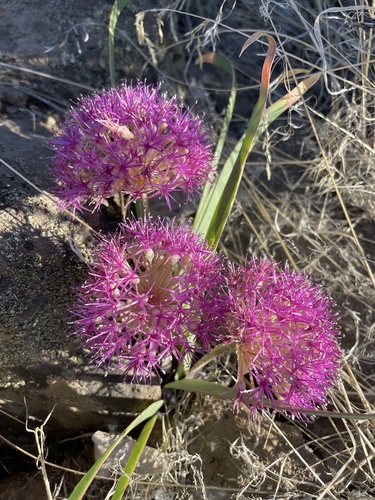
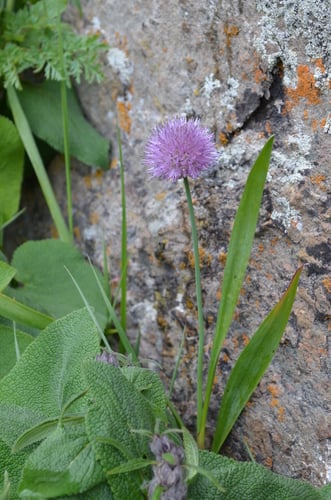
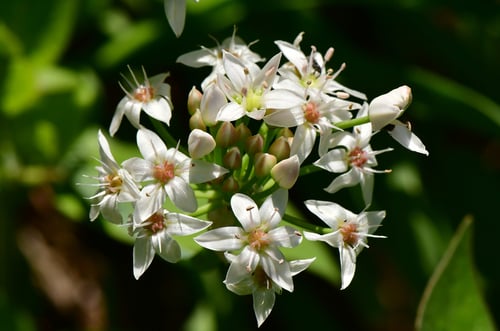
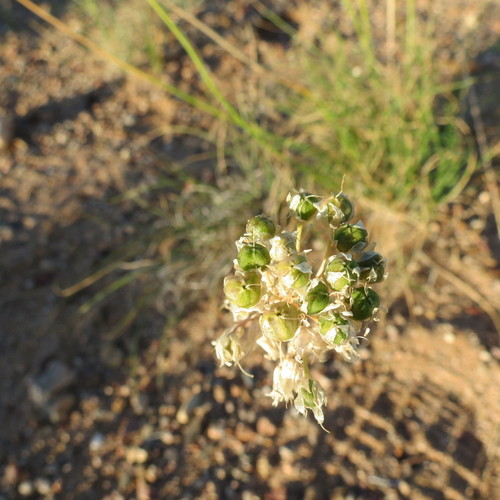
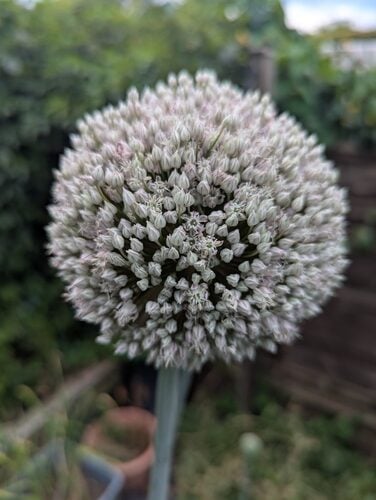
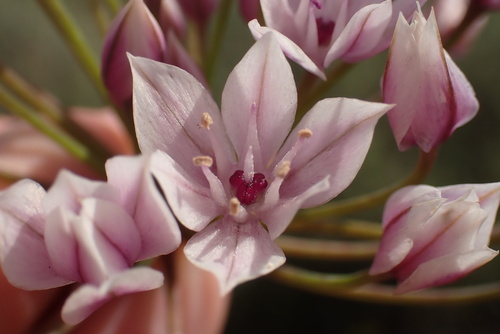
An onion like plant without a bulb and with flat leaves. It grows one year, then flowers the next. There is one bulb. There can be bulblets. The covering is white. The leaves are flattened and vary from 40-100 cm long by 1.2-2.5 cm wide. Many flowers are produced in a large flower head where small flowers are on equal length stalks forming a ball. Probably now Allium ampeloprasum
Edible Uses
The whole plant except the leaf tops is boiled or eaten raw. Sprouted seeds are also eaten.
Traditional Uses
The whole plant is boiled except for the tops of the leaves. They can also be eaten raw. Sprouted seeds are eaten.
This uses section is brief — help expand it
Distribution
A temperate plant. It does best with a day temperature below 24°C. So it is mostly over 800 m altitude in the tropics and grows up to 2600 m. It needs a fertile soil. It is very frost resistant. The soil needs to be well drained but retain moisture. It suits hardiness zones 5-10.
Where It Grows
Africa, Albania, Argentina, Asia, Australia, Balkans, Belgium, Britain, Bulgaria, Cambodia Canada, Caucasus, Central America, China, Costa Rica, Crete, Croatia, Cuba, Cyprus, East Africa, Ecuador, Egypt, Europe, Fiji, France, Georgia, Greece, Haiti, India, Indonesia, Iran, Iraq, Italy, Kurdistan, Laos, Lebanon, Lithuania, Macedonia, Madagascar, Mediterranean*, Malaysia, Middle East, Myanmar, Nauru, Netherlands, Niger, North Africa, North America, Pacific, Papua New Guinea, PNG, Philippines, Portugal, Romania, Sahel, SE Asia, Serbia, South Africa, Southern Africa, South America, Spain, Sri Lanka, Switzerland, Tasmania, Thailand, Turkey, Türkiye, USA, Vanuatu, Vietnam, West Africa, West Indies, Yugoslavia, Zimbabwe,
Cultivation
They can be grown from seed. Seedlings can be transplanted. They are transplanted when 15-20 cm high. The base of plants or suckers are more commonly used for planting. It is difficult to save seed in the wet tropics. If plants are planted in a hole 10-15 cm deep they develop long white edible stalks. The soil should be mounded up around the base of the plant. A spacing of 15-20 cm between plants and in rows 30-36 cm apart is suitable,
Production
Plants are ready for harvest after 16-20 weeks. A yield of 20 kg per 10 metres square is average.
Other Information
Moderately common in the highlands of Papua New Guinea. It is a commercially cultivated vegetable.
Notes
There are about 300-700 Allium species. Most species of Allium are edible (Flora of China). All alliums are edible but they may not all be worth eating! They have also been put in the family Alliaceae.
Nutrition
| Part | Moisture | kJ | kcal | Protein | Vit A | Vit C | Iron | Zinc |
|---|---|---|---|---|---|---|---|---|
| Leaves | 91 | 122 | 29 | 2 | 1827 | 29 | 7.5 | — |
Synonyms
Also Known As
Aga, Ajo porro, Bawang prei, Bawang sayuran, Hazir, Jiu cong, Krathiam-bai, Krathiam-ton, Kuse, Kutsai, Lauch, Likisi, Look, Luk, Pirassa, Poireau, Porro, Puerro, Sibuyas-bisaya, Yabani pirasa
References (46)
- Ambasta S.P. (Ed.), 2000, The Useful Plants of India. CSIR India. p 28 (As Allium porrum)
- Ann. Sci. Nat. Bot. ser. 3, 8:218. 1847
- Bernholt, H. et al, 2009, Plant species richness and diversity in urban and peri-urban gardens of Niamey, Niger. Agroforestry Systems 77:159-179
- Bianchini, F., Corbetta, F., and Pistoia, M., 1975, Fruits of the Earth. Cassell. p 86
- Bodkin, F., 1991, Encyclopedia Botanica. Cornstalk publishing, p 65 (As Allium porrum)
Show all 46 references Hide references
- Bussman, R. W., et al, 2016, A comparative ethnobotany of Khevsureti, Samtskhe-Javakheti, Tusheti, Svaneti, and Racha-Lechkhumi, Republic of Georgia (Sakartvelo), Caucasus. Journal of Ethnobiology and Ethnomedicine (2016) 12:43 (As Allium porrum)
- Cheifetz, A., (ed), 1999, 500 popular vegetables, herbs, fruits and nuts for Australian Gardeners. Random House p 32 (As Allium porrum)
- Chen Xinqi, Liang Songyun, Xu Jiemei, Tamura M.N., Liliaceae. Flora of China. p 130 (As Allium porrum)
- Chin, H. F., 1999, Malaysian Vegetables in Colour. Tropical Press. p 72
- Ciftcioglu, C. G., 2015, Sustainable wild-collection of medicinal and edible plants in Lefke region of North Cyprus. Agroforest Syst. Springer
- D'Ambrosio, U., & Puri, R. K., 2016, Foodways in transition: food plants, diet and local perceptions of change in a Costa Rican Ngäbe community. Journal of Ethnobiology and Ethnomedicine (2016) 12:3 p 26 (As Allium porrum)
- Facciola, S., 1998, Cornucopia 2: a Source Book of Edible Plants. Kampong Publications, p 5
- Flora of Pakistan. www.eFloras.org (As Allium porrum)
- Foo, J.T.S.(ed), 1996, A Guide to Common Vegetables. Singapore Science Foundation. p 108 (As Allium porrum)
- French, B., 1986, Food Plants of Papua New Guinea, Asia Pacific Science Foundation p 125 (As Allium porrum)
- Furusawa, T., et al, 2014, Interaction between forest biodiversity and people's used of forest resources in Roviana, Solomon Islands: implications for biocultural conservation under socioeconomic changes. Journal of Ethnobiology and Ethnomedicine, 10:10 (As Allium porrum)
- Grubben, G. J. H. and Denton, O. A. (eds), 2004, Plant Resources of Tropical Africa 2. Vegetables. PROTA, Wageningen, Netherlands. p 41
- Hadfield, J., 2001, The A-Z of Vegetable Gardening in South Africa. Struik p 108 (As Allium porrum)
- Hedrick, U.P., 1919, (Ed.), Sturtevant's edible plants of the world. p 40 (As Allium porrum)
- Hepper, E.N., 1993, Illustrated Encyclopedia of Bible Plants, IVP, England. p 127 (As Allium porrum)
- Jardin, C., 1970, List of Foods Used In Africa, FAO Nutrition Information Document Series No 2.p 53 (As Allium porrum)
- Kays, S. J., and Dias, J. C. S., 1995, Common Names of Commercially Cultivated Vegetables of the World in 15 languages. Economic Botany, Vol. 49, No. 2, pp. 115-152
- Kiple, K.F. & Ornelas, K.C., (eds), 2000, The Cambridge World History of Food. CUP p 1799 (As Allium porrum)
- Kybal, J., 1980, Herbs and Spices, A Hamlyn Colour Guide, Hamlyn Sydney p 26 (As Allium porrum)
- Lazarides, M. & Hince, B., 1993, Handbook of Economic Plants of Australia, CSIRO. p 13 (As Allium porrum)
- Macmillan, H.F. (Revised Barlow, H.S., et al), 1991, Tropical Planting and Gardening. Sixth edition. Malayan Nature Society. Kuala Lumpur. p 364
- Martin, F.W. & Ruberte, R.M., 1979, Edible Leaves of the Tropics. Antillian College Press, Mayaguez, Puerto Rico. p 202 (As Allium porrum)
- Ochse, J.J. et al, 1931, Vegetables of the Dutch East Indies. Asher reprint. p 446 (As Allium porrum)
- Oomen, H.A.P.C., & Grubben, G.J.H., 1978, Tropical Leaf Vegetables in Human Nutrition, Communication 69, Department of Agricultural research, RTI Amsterdam, p 36, (As Allium porrum)
- Peter, K. V. (Ed.), 2004, Handbook of Herbs and Spices Vol. 2 Woodhead Publishing and CRC Press. p (As Allium porrum)
- Pieroni, A., 2008, Local plant resources in the ethnobotany of Theth, a village in the Northern Albanian Alps. Genet Resour Crop Evol (2008) 55:1197–1214 (As Allium porrum)
- Plants for a Future database, The Field, Penpol, Lostwithiel, Cornwall, PL22 0NG, UK. http://www.scs.leeds.ac.uk/pfaf/ (As Allium porrum)
- PROSEA handbook Volume 13 Spices. p 273
- Schneider, E., 2001, Vegetables from Amaranth to Zucchini: The essential reference. HarperCollins. p 355
- Sharma, B.B., 2005, Growing fruits and vegetables. Publications Division. Ministry of Information and broadcasting. India. p 156 (As Allium porrum)
- Siemonsma, J. S. and Piluek, K. (Eds), 1994, Plant Resources of South-East Asia No. 8 Vegetables. Prosea Foundation, Bogor, Indonesia, p 62
- Solomon, C., 2001, Encyclopedia of Asian Food. New Holland. p 206 (As Allium porrum)
- Terra, G.J.A., 1973, Tropical Vegetables. Communication 54e Royal Tropical Institute, Amsterdam, p 20 (As Allium porrum)
- Tindall, H.D., & Williams, J.T., 1977, Tropical Vegetables and their Genetic Resources, International Board for Plant Genetic Resources, Rome, p 62 (As Allium porrum)
- Tindall, H.D., 1983, Vegetables in the tropics. Macmillan p. 14 (As Allium porrum)
- Torre, de la L., et al, 2008, Enciclopedia de las Plantas Útiles del Ecuador. Herbario QCA. Pontificia Universidad Católica del Ecuador. p 151
- USDA, ARS, National Genetic Resources Program. Germplasm Resources Information Network - (GRIN). [Online Database] National Germplasm Resources Laboratory, Beltsville, Maryland. Available: www.ars-grin.gov/cgi-bin/npgs/html/econ.pl (10 April 2000) (As Allium porrum)
- Walter, A. & Lebot, V., 2007, Gardens of Oceania. ACIAR Monograph No. 122. p 223 and Walter, A. & Lebot, V., 2007, Gardens of Oceania. ACIAR Monograph No. 122. CD-ROM minor species p 21
- Wiersema, J. H. & Leon, B., 2013, World Economic Plants. A Standard Reference CRC Press. 2nd Ed. p 35 (As Allium porrum)
- Woodward, P., 1996, Garlic and Friends. The History, Growth and Use of Edible Alliums. Hyland House. p 85
- Zeven, A. C. & de West, J. M. J., 1982, Dictionary of cultivated plants and their regions of diversity. Wageningen. p 87 (As Allium porrum)