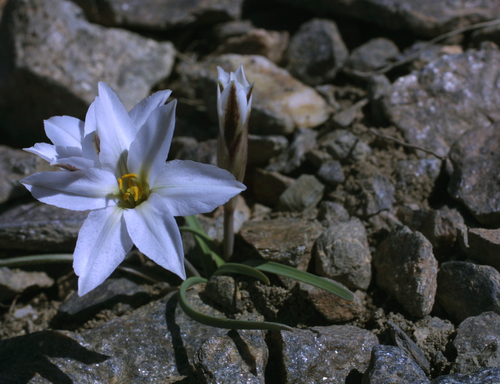
Allium monanthum
Maxim.
Korean wild chive
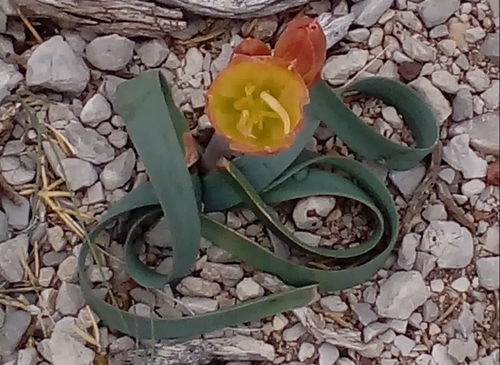
iNaturalist· cc-by-nc
(c) krestov, some rights reserved (CC BY-NC), uploaded by krestov
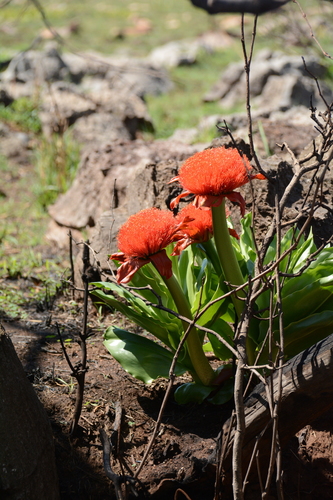
iNaturalist· cc-by-nc
(c) V.S. Volkotrub, some rights reserved (CC BY-NC), uploaded by V.S. Volkotrub
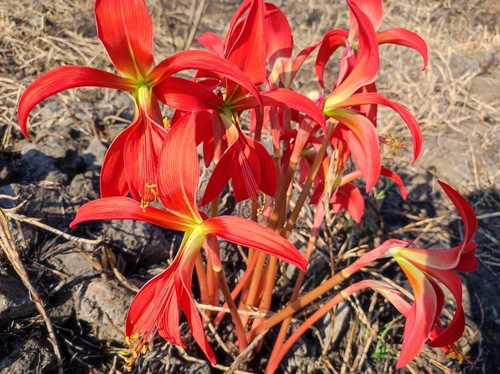
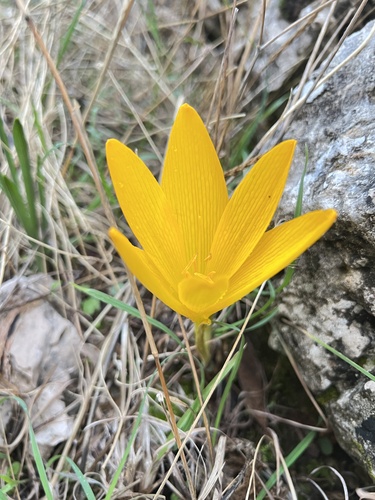
iNaturalist· cc-by-nc
(c) V.S. Volkotrub, some rights reserved (CC BY-NC), uploaded by V.S. Volkotrub
Summary
Source: WikipediaAllium monanthum, the Korean wild chive, is a spring vegetable with minuscule bulbous roots that have a mild onion flavor and found in the woodlands of Korea, Japan, northeastern Russia (Primorye), and northeastern China (Hebei, Heilongjiang, Jilin, Liaoning).
Description
An onion family plant. A bulb plant. It grows to 10 cm high. The bulb occurs singly and is 0.5-1 cm across. It has a yellowish brown covering. This is sometimes tinged with red. There are 1 or 2 leaves and these are broadly linear. They are 1.5-2 times as long as the scape and 3-8 mm wide. They are flat on one side. They are almost a half circle when cut through. The scape is 5-10 cm long. It is covered with leaf sheaths only at the base.
Edible Uses
The bulbs, up to 1cm in diameter, can be eaten raw or cooked. The leaves are also edible raw or cooked. The flowers are eaten raw and can be used as a garnish on salads.
Traditional Uses
The bulbs are eaten raw or cooked. The leaves are eaten raw or cooked. The flowers are used raw to flavour salads.
This uses section is brief — help expand it
Medicinal Uses
No specific medicinal uses have been recorded for this species, but members of this genus are generally considered healthy dietary additions. They contain sulphur compounds — responsible for their onion flavour — which, when eaten regularly, can help reduce blood cholesterol levels, support digestive health, and tonify the circulatory system.
Known Hazards
Although no individual reports regarding this species have been seen, there have been cases of poisoning caused by the consumption, in large quantities and by some mammals, of certain members of this genus. Dogs seem to be particularly susceptible.
Distribution
It is a temperate plant. It grows naturally on low mountains all over Japan. It grows in forests and on slopes in N China.
Where It Grows
Asia, China, Japan, Korea, Manchuria, Russia,
Cultivation
We have very little information on this species and do not know if it will be hardy in Britain, though judging by its native range it should succeed outdoors in most parts of the country. This species might succeed in light woodland in Britain. The following notes are based on the general needs of the genus. Prefers a sunny position in a light well-drained soil. The bulbs should be planted fairly deeply. Most members of this genus are intolerant of competition from other plants. Grows well with most plants, especially roses, carrots, beet and chamomile, but it inhibits the growth of legumes. This plant is a bad companion for alfalfa, each species negatively affecting the other. Members of this genus are rarely if ever troubled by browsing deer. Unusual in the genus for having dioecious flowers. This means that male and female flowers are borne on different plants and at least one plant of each sex needs to be grown in order for fertilization to take place.
Propagation
Sow seed in spring in a cold frame. Prick out seedlings into individual pots once large enough to handle — placing three plants per pot will produce clumps more quickly. Grow on in a greenhouse through at least the first winter, then plant out in spring once growing vigorously. Division is best done in spring, though plants can be divided successfully at any point during the growing season. Pot up divisions in a cold frame or greenhouse until they are growing well before planting into permanent positions.
Other Uses
The plant juice can be used as a moth repellent, and the whole plant is said to repel both insects and moles.
Notes
There are about 300-700 Allium species. Most species of Allium are edible (Flora of China). All alliums are edible but they may not all be worth eating! They have also been put in the family Alliaceae.
Synonyms
Also Known As
Dallae-i, Dallongkae, Dalrae, Dan hua xie
References (6)
- BARANOV
- Brevard County Edible Acres
- Chen Xinqi, Liang Songyun, Xu Jiemei, Tamura M.N., Liliaceae. Flora of China. p 133
- Ong, H. G., et al, 2015, Ethnobotany of the wild edible plants gathered in Ulleung Island, South Korea. Genet Resourc Crop Evol. Springer
- Plants for a Future database, The Field, Penpol, Lostwithiel, Cornwall, PL22 0NG, UK. http://www.scs.leeds.ac.uk/pfaf/
Show all 6 references Hide references
- Song, M., et al, 2013, Traditional knowledge of wild edible plants in Jeju Island, Korea. Indian Journal of Traditional Knowledge. 12(2) pp 177-194