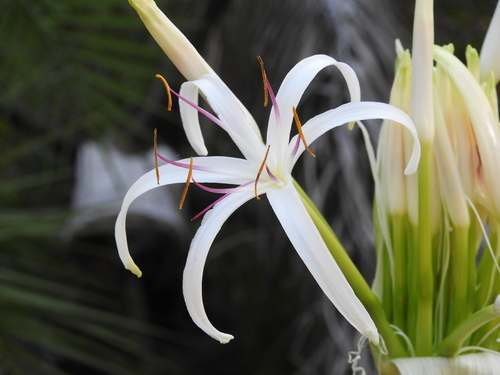
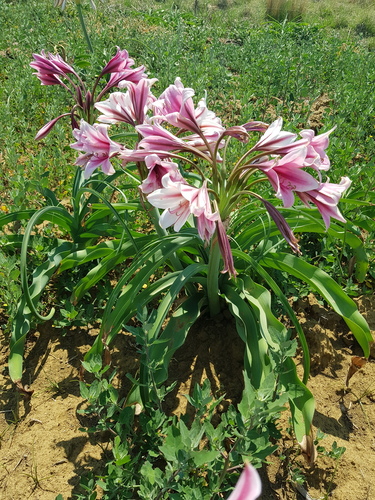
Tulbaghia leucantha
Baker
Highland wild garlic, Veld onion
iNaturalist· cc-by-nc
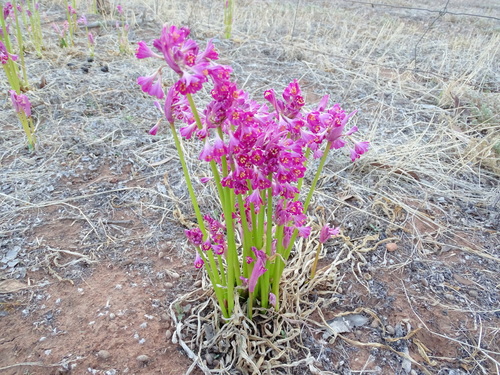
(c) Peter Warren, some rights reserved (CC BY-NC), uploaded by Peter Warren
iNaturalist· cc-by-nc
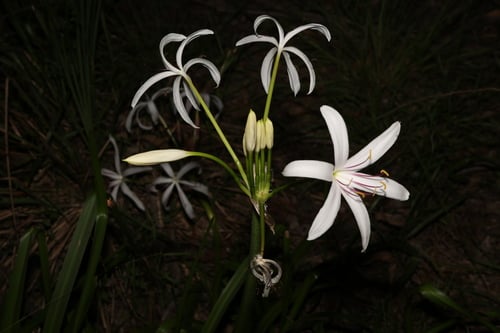
(c) Richard Gill, some rights reserved (CC BY-NC)
Summary
Source: WikipediaTulbaghia leucantha, the mountain wild garlic, is a species of flowering plant in the family Amaryllidaceae, widely distributed in southern Africa. It has gained the Royal Horticultural Society's Award of Garden Merit as an ornamental.
Description
An onion family herb. It keeps growing from year to year. It has small corms and an underground stem. The plant smells of garlic. The leaves are slender. The flowering stems are 20 cm long. The flowers are green to white.
Edible Uses
Rhizome - cooked. The rhizome is scraped clean and boiled in stews or roasted as a vegetable. Leaves and stems - cooked. A flavour like a mild onion. They can be cooked like spinach or chopped fine and used as a relish or added to soups and stews.
Traditional Uses
It is used as a vegetable relish. The young plants are eaten.
This uses section is brief — help expand it
Distribution
It is a tropical plant. It grows in wet grassland and open woodland. It is often on sandy soil.
Where It Grows
Africa, Botswana, East Africa, Eswatini, South Africa, Southern Africa*, Swaziland, Zambia, Zimbabwe,
Cultivation
Requires a well-drained soil. Members of this genus tend to hybridize freely in cultivation or if their wild ranges overlap.
Propagation
Seed - best sown as soon as it is ripe. Sown in a sunny position, the seed usually germinates within 14 days at a temperatures of 18 - 21°c. Prick out the seedlings into individual pots once they are large enough to handle and grow them on until large enough to plant out. Division. Best carried out as the plant comes back into growth after dormancy.
Notes
Also put in the families Alliaceae and Liliaceae.
Synonyms
Also Known As
Fonteinknoffel, Mhondya, Nyalamudavhi
References (9)
- Fowler, D. G., 2007, Zambian Plants: Their Vernacular Names and Uses. Kew. p 85
- Grubben, G. J. H. and Denton, O. A. (eds), 2004, Plant Resources of Tropical Africa 2. Vegetables. PROTA, Wageningen, Netherlands. p 538
- Long, C., 2005, Swaziland's Flora - siSwati names and Uses http://www.sntc.org.sz/flora/
- Magwede, K., van Wyk, B.-E., & van Wyk, A. E., 2019, An inventory of Vhavenḓa useful plants. South African Journal of Botany 122 (2019) 57–89
- Peters, C. R., O'Brien, E. M., and Drummond, R.B., 1992, Edible Wild plants of Sub-saharan Africa. Kew. p 8
Show all 9 references Hide references
- Ruiters-Welcome, A. K., 2019, Food plants of southern Africa. Ph.D. thesis. Univ. of Johannesburg p 9
- Swaziland's Flora Database http://www.sntc.org.sz/flora
- Welcome, A. K. & Van Wyk, B.-E., 2019, An inventory and analysis of the food plants of southern Africa. South African Journal of Botany 122 (2019) 136–179
- Wild, 1975,