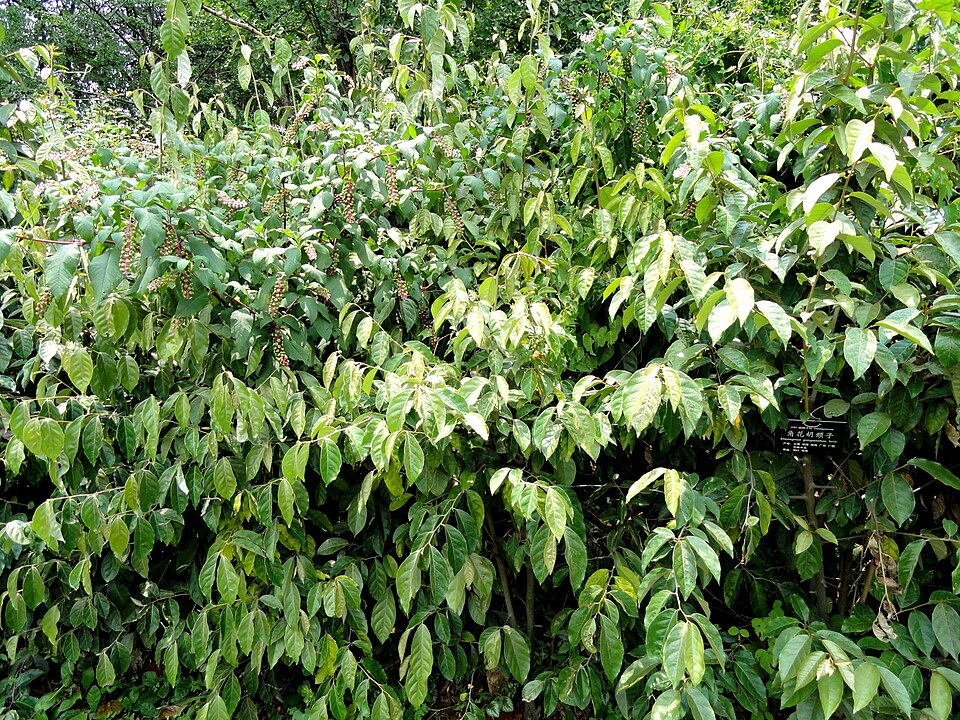
Elaeagnus pyriformis
Hook. f.
Doukhiguti
gbif· cc-by
Royal Botanic Gardens, Kew
gbif· cc-by
Royal Botanic Gardens, Kew
gbif· cc-by
Royal Botanic Gardens, Kew
Summary
Deciduous shrub growing at medium rate. Not frost tender. Hermaphroditic and bee-pollinated. Nitrogen-fixing. Grows in light sandy, medium loamy, and heavy clay soils; prefers well-drained conditions and tolerates poor fertility. Adapts to mildly acidic, neutral, and basic soils. Requires full sun; cannot tolerate shade. Handles both dry and moist soil conditions with drought tolerance. Withstands maritime exposure.
Description
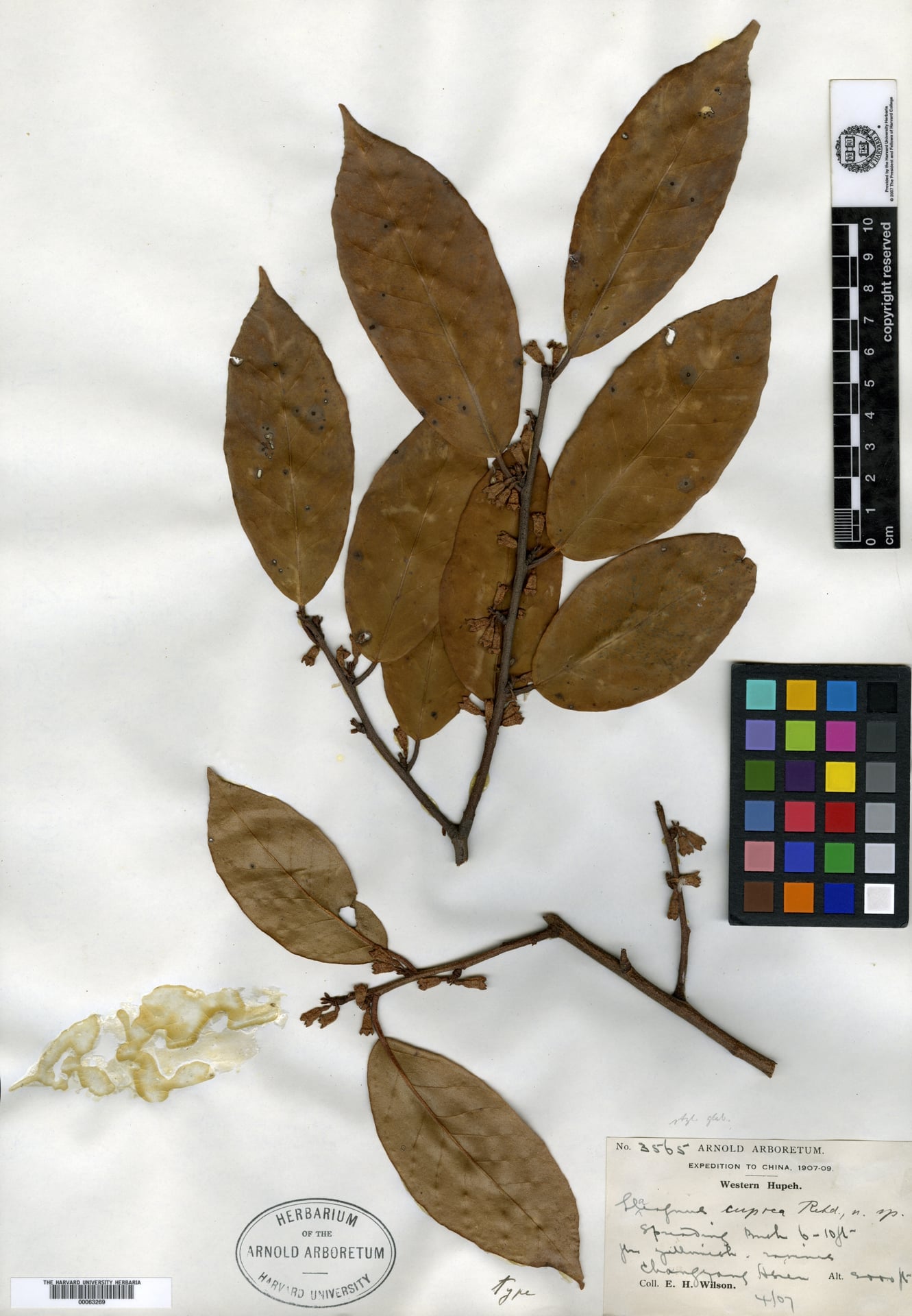
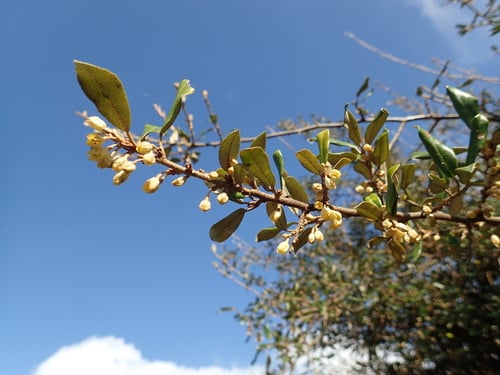
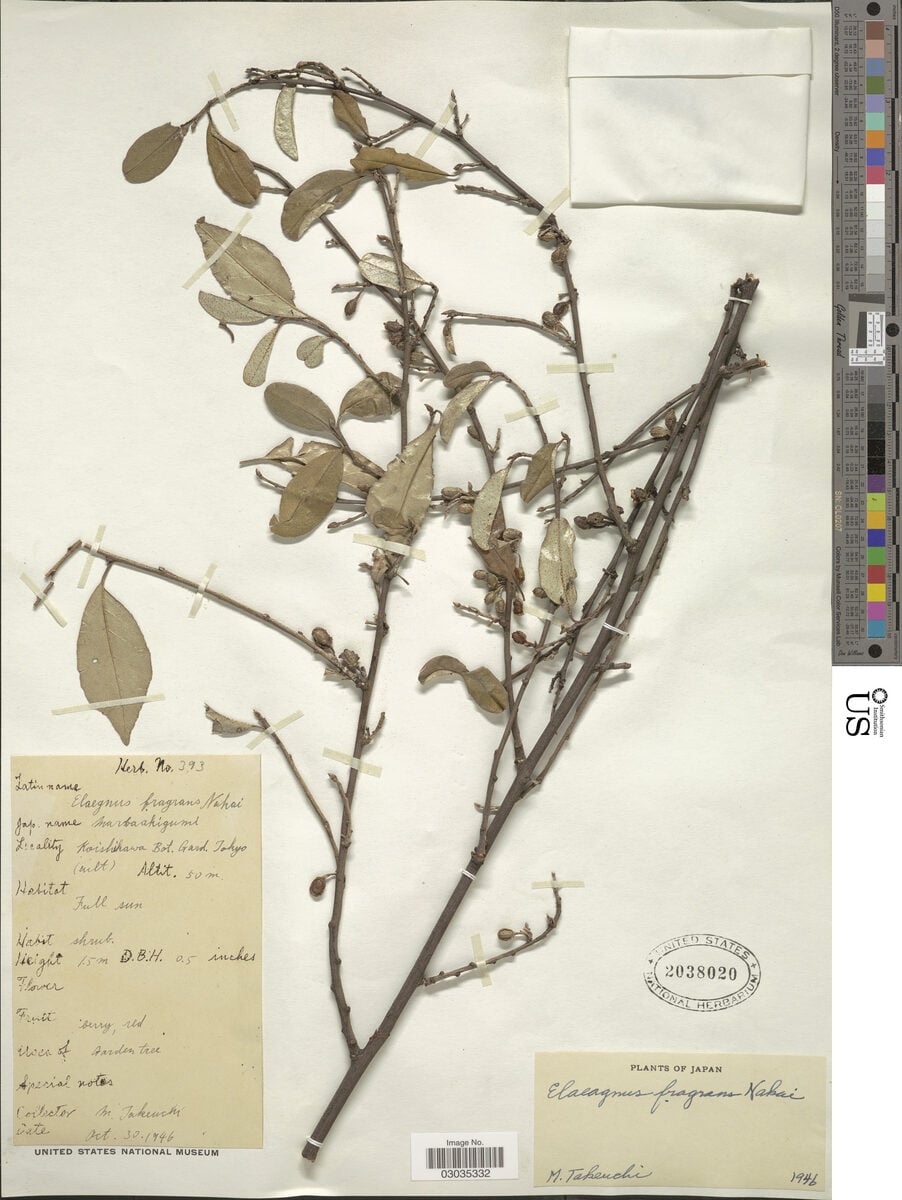
A woody climbing shrub. It can be spiny. The leaves are simple and alternate. The leaves are sword shaped and 4-14 cm long by 1-5 cm wide. The leaf underneath is covered with a silvery white coat. The flowers can occur singly or in clusters. The fruit are pear shaped. They are yellow when ripe and covered with copper coloured scales. The fruit are 1 cm long. They have one large seed.
Edible Uses
The fruit can be eaten raw or cooked but must be fully ripe before eating raw — even slightly underripe fruit is quite astringent. It contains a single large seed, which can also be eaten raw or cooked alongside the fruit, though the seed casing is rather fibrous.
Traditional Uses
The ripe fruit are eaten raw. They are also used for jam. The unripe fruit are very sour and used for pickles.
This uses section is brief — help expand it
Medicinal Uses
Like many in its genus, the fruit is a very rich source of vitamins and minerals — particularly vitamins A, C and E — along with flavonoids and other bio-active compounds. It is also a fairly good source of essential fatty acids, which is unusual for a fruit. It is being investigated for its potential to reduce the incidence of cancer and to halt or reverse cancer growth.
Distribution
It is a subtropical plant. It can grow in acid soils low in nutrients. The soil needs to be well-drained. It can tolerate drought.
Where It Grows
Asia, Bhutan, Himalayas, India, Northeastern India,
Cultivation
We have very little information on this species and do not know how hardy it will be in Britain. The following details are based on the general information for this genus. Succeeds in most soils that are well-drained. Prefers a soil that is only moderately fertile, succeeding in poor soils and dry soils. Requires a sunny position. Tolerates maritime exposure. This species is notably resistant to honey fungus. This species has a symbiotic relationship with certain soil bacteria, these bacteria form nodules on the roots and fix atmospheric nitrogen. Some of this nitrogen is utilized by the growing plant but some can also be used by other plants growing nearby. An excellent companion plant, when grown in orchards it can increase yields from the fruit trees by up to 10%.
Propagation
Seed is best sown as soon as it is ripe in a cold frame, where it should germinate in late winter or early spring, though it may take 18 months. Stored seed can be very slow to germinate, often taking more than 18 months. A warm stratification of 4 weeks followed by 12 weeks of cold stratification can help. Prick out seedlings into individual pots as soon as they are large enough to handle and plant out when at least 15cm tall. Cuttings of half-ripe wood, 7–10cm with a heel, taken in July/August in a frame. Cuttings of mature wood from the current year's growth, 10–12cm with a heel, taken in October/November in a frame — these are rather slow and difficult to root, so leave for 12 months. Layering in September/October takes 12 months.
Other Uses
No other uses are known. It is a nitrogen fixer.
Production
In NE India plants flower and fruit November to April.
Other Information
Fruit are sold in local markets.
Notes
There are 45 Elaeagnus species.
Nutrition
| Part | Moisture | kJ | kcal | Protein | Vit A | Vit C | Iron | Zinc |
|---|---|---|---|---|---|---|---|---|
| Fruit | 82 | — | — | 5.3 | — | 87.5 | — | — |
Also Known As
Buiehthei, Chishoshikatii, Dablut sitai, Dieng-soh-blor, Doukhiguti, Heiyai, Kotarangjang, Maza sok bizi, Ruunochu, Sar-zuk-te, Sarzukpui, Shoushi, Srzu kung
References (20)
- Ambasta, S.P. (Ed.), 2000, The Useful Plants of India. CSIR India. p 191
- Angami, A., et al, 2006, Status and potential of wild edible plants of Arunachal Pradesh. Indian Journal of Traditional Knowledge 5(4) October 2006, pp 541-550
- Chase, P. & Singh, O. P., 2016, Bioresources of Nagaland: A Case of Wild 4 Edible Fruits in Khonoma Village Forest. in J. Purkayastha (ed.), Bioprospecting of Indigenous Bioresources of North-East India. p 50
- Fl. Brit. India 5:202. 1886
- Gangwar, A. K. & Ramakrishnan, P. S., 1990, Ethnobotanical Notes on Some Tribes of Arunachal Pradesh, Northeastern India. Economic Botany, Vol. 44, No. 1 pp. 94-105
Show all 20 references Hide references
- Guite, C., 2016, A study of wild edible plants associated with the Paite tribe of Manipur, India, International Journal of Current Research. Vol. 8, Issue, 11, pp. 40927-40932
- Jeeva, S., 2009, Horticultural potential of wild edible fruits used by the Khasi tribes of Meghalaya. Journal or Horticulture and Forestry Vol. 1(9) pp. 182-192
- Kar, A., et al, 2013, Wild Edible Plant Resources used by the Mizos of Mizoram, India. Kathmandu University Journal of Science, Engineering and Technology. Vol. 9, No. 1, July, 2013, 106-126
- Lalfakzuala, R., 2007, Ethnobotanical usages of plants in western Mizoram. Indian Journal of Traditional Knowledge. Vol 6(3) pp 480-493
- Mozhui, R., et al, 2011, Wild edible fruits used by the tribals of Dimapur district of Nagaland, India. Pleione 5(1): 56 - 64.
- Patiri, B. & Borah, A., 2007, Wild Edible Plants of Assam. Geethaki Publishers. p 122
- Pfoze, N. L., et al, 2012, Survey and assessment of floral diversity on wild edible plants from Senapati district of Manipur, Northeast India. Journal of Biodiversity and Environmental Sciences. 1(6):50-52
- Plants for a Future, The Field, Penpol, Lostwithiel, Cornwall, PL22 0NG, UK. http://www.scs.leeds.ac.uk/pfaf/
- Sarma, H., et al, 2010, Updated Estimates of Wild Edible and Threatened Plants of Assam: A Meta-analysis. International Journal of Botany 6(4): 414-423
- Sawian, J. T., et al, 2007, Wild edible plants of Meghalaya, North-east India. Natural Product Radiance Vol. 6(5): p 416
- Seal, T., 2012, Evaluation of Nutritional Potential of Wild Edible Plants, Traditionally Used by the Tribal People of Meghalaya. American Journal of Plant Nutrition and FertilizationTechnology 2(1): 19-26
- Singh, H.B., Arora R.K.,1978, Wild edible Plants of India. Indian Council of Agricultural Research, New Delhi. p 59
- Singh, V. B., et al, (Ed.) Horticulture for Sustainable Income and Environmental Protection. Vol. 1 p 216
- Salvi, J. et al, 2016, A review: Underutilized wild edible plants as a potential source of alternative nutrition. International Journal of Botany Studies. Volume 1; Issue 4; May 2016; Page No. 32-36
- Wild edible plants of Himachal Pradesh