Hibiscus surattensis
L.
Wild sour, Bush sorrel
iNaturalist· cc-by-nc
(c) Bart Wursten, some rights reserved (CC BY-NC), uploaded by Bart Wursten
iNaturalist· cc-by
(c) Jacy Chen, some rights reserved (CC BY)
iNaturalist· cc0
no rights reserved
Summary
Source: WikipediaHibiscus surattensis, the bush sorrel or wild sour, is a widespread species of flowering plant in the family Malvaceae. It is native to the seasonally dry tropical (and subtropical) Old World, and has been introduced to many islands of the Indian Ocean. As the common names imply, it is eaten as a leafy green by local peoples.
Description
A spiny vine or shrub. It grows each year from seed. It is 0.5-2 m high but often lies over. The leaf stalk is 2-7 cm long. It is densely hairy. The leaves are alternate and deeply lobed. There are 3-5 lobes. They are somewhat hairy and with toothed edges. The leaves are 5-10 cm long by 5-11 cm wide. The lobes are sword shaped and 3-7 cm long by 1.5-3 cm wide. The flowers occur singly in the axils of leaves. The flowers are large and yellowish or whitish and tinged with red. The fruit is a capsule which is oval or round and 1.2 cm across. The seeds are kidney shaped with very fine white hairs.
Edible Uses
Young leaves are cooked as a vegetable and used in curries. Mature leaves are cooked as a sour flavouring with fish and meat, and can be used to thicken sauces. The leaves are sold in local markets as a popular vegetable. Flowers are used as flavouring.
Traditional Uses
The leaves are cooked as a flavouring with fish and meat. They are sour. The young leaves are cooked as a vegetable. They are also used in curries. It can be used to thicken sauces.
Medicinal Uses
The leaves are commonly used in traditional preparations.
Distribution
A tropical plant. They are found throughout the Philippines in open grasslands. In China it grows in valleys and open slopes between 1000-1180 m altitude in S China. It Africa it grows up to 1,700 m above sea level. It often grows in areas with a rainfall between 1,000-1,600 mm. It can grow in arid places. It can grow in coastal places on sand dunes. In Yunnan.
Where It Grows
Africa, Angola, Asia, Australia, Bangladesh, Benin, Bhutan, Botswana, Burundi, Cambodia, Cameroon, Central Africa, Central African Republic, CAR, China, Congo, Côte d'Ivoire, East Africa, Eswatini, Ethiopia, Gabon, Gambia, Ghana, Guinea, Guinée, Guinea-Bissau, Himalayas, India, Indochina, Indonesia, Ivory Coast, Kenya, Laos, Liberia, Madagascar, Malawi, Malaysia, Mauritius, Mozambique, Myanmar, Nigeria, Northeastern India, Pacific, Philippines, Sao Tome and Principe, SE Asia, Senegal, Seychelles, Sierra Leone, South Africa, Southern Africa, Sri Lanka, Sudan, Swaziland, Taiwan, Tanzania, Thailand, Togo, Uganda, Vietnam, West Africa, Zambia, Zimbabwe,
Cultivation
A plant of moist tropical areas where it is found at elevations up to 1,700 metres. It is found in regions with an average annual rainfall of 1,000 - 1,600mm. Succeeds in a variety of soil types.
Propagation
Seed - sow in situ or in containers. Germination is usually fairly rapid and no special pretreatment is needed, although germination will be faster if the seed is abraded or soaked prior to sowing. Prick out container-grown seedlings into individual pots when they are large enough to handle and plant them out into their permanent positions when they are 10cm or more tall.
Other Uses
The bark yields a fibre, which is occasionally used as cordage. A good quality fibre. The cooked leaves are used to coagulate the latex of Landolphia spp.
Production
The leaves are collected in the early rainy season.
Other Information
It is a cultivated food plant. It is a popular vegetable in some places. Leaves are sold in local markets.
Notes
There are about 220 Hibiscus species.
Synonyms
Also Known As
Baguitchi-di-mato, Bisulsug, Bup xuoc, Chemeenpuli, Ci fu rong, Conistanto, Hansrong, Jehe keng, Jukut riyut, Kakonda, Kalatuytuy, Kashlikirai, Kololwe, Labuang, Lumaka, Madiso, M'bat'u, M'datu, Mala-lum, Mankin-aoi, Mizo-an-thur, Mullu gogu, Mwalavi, Mwawawu, Ogwenjere, Ran-bhindi, Ranbhendy, Taw-chin-baung, Tongwe, Wetma-chin-baung
References (40)
- Altschul, S.V.R., 1973, Drugs and Foods from Little-known Plants. Notes in Harvard University Herbaria. Harvard Univ. Press. Massachusetts. no. 2760
- Ambasta, S.P. (Ed.), 2000, The Useful Plants of India. CSIR India. p 267
- Batawila, K., et al, 2007, Diversite et gestion des legumes de cueillete au Togo. African Journal of Food, Agriculture, Nutrition and Development 7( 3& 4): 66
- Brown, W.H., 1920, Wild Food Plants of the Philippines. Bureau of Forestry Bulletin No. 21 Manila. p 114
- Burkill, I.H., 1966, A Dictionary of the Economic Products of the Malay Peninsula. Ministry of Agriculture and Cooperatives, Kuala Lumpur, Malaysia. Vol 1 (A-H) p 1190
Show all 40 references Hide references
- Catarino, L. et al, 2019, Edible Leafy Vegetables from West Africa (Guinea-Bissau): Consumption, Trade and Food Potential. Foods 2019, 8, 493
- Dalziel, J. M., 1937, The Useful plants of west tropical Africa. Crown Agents for the Colonies London.
- Dobriyal, M. J. R. & Dobriyal, R., 2014, Non Wood Forest Produce an Option for Ethnic Food and Nutritional Security in India. Int. J. of Usuf. Mngt. 15(1):17-37
- Facciola, S., 1998, Cornucopia 2: a Source Book of Edible Plants. Kampong Publications, p 148
- Fowler, D. G., 2007, Zambian Plants: Their Vernacular Names and Uses. Kew. p 82
- Goode, P., 1989, Edible Plants of Uganda. FAO p 39
- Jadhav, R., et al, 2015, Forest Foods of Northern Western Ghats: Mode of Consumption, Nutrition and Availability. Asian Agri-History Vol. 19, No. 4: 293-317
- Jardin, C., 1970, List of Foods Used In Africa, FAO Nutrition Information Document Series No 2.p 81
- Kar, A., et al, 2013, Wild Edible Plant Resources used by the Mizos of Mizoram, India. Kathmandu University Journal of Science, Engineering and Technology. Vol. 9, No. 1, July, 2013, 106-126
- Kumar, Y J. et al, 1987, Further Contribution to the Ethnobotany of Meghalaya: Plants used by "War jaintia" of Jaintia Hill District. Econ. Tax. Bot. Vol 11 No. 1 pp 65-
- Lugod, G.C. and de Padua L.S., 1979, Wild Food Plants in the Philippines. Vol. 1. Univ. of Philippines Los Banos. p 51
- Maghirang, R. G., et al, 2018. Ethnobotanical Studies of Some Plants Commonly Used as Vegetables in Selected Provinces of the Philippines. Journal of Nature Studies. 17(2), 30-43.
- Martin, F.W. & Ruberte, R.M., 1979, Edible Leaves of the Tropics. Antillian College Press, Mayaguez, Puerto Rico. p 203
- Monsalud, M.R., Tongacan, A.L., Lopez, F.R., & Lagrimas, M.Q., 1966, Edible Wild Plants in Philippine Forests. Philippine Journal of Science. p 491
- Neogi, B., Prasad, M. N. V. and Rao, R. R., 1989, Ethnobotany of Some Weeds of Khasi and Garo Hills, Meghalaya, Northeastern India. Economic Botany 43(4): 471-479
- Peters, C. R., O'Brien, E. M., and Drummond, R.B., 1992, Edible Wild plants of Sub-saharan Africa. Kew. p 145
- Pham-Hoang Ho, 1999, An Illustrated Flora of Vietnam. Nha Xuat Ban Tre. p 525
- Pickering, H., & Roe, E., 2009, Wild Flowers of the Victoria Falls Area. Helen Pickering, London. p 81
- Ramachandran, V.S. and Nair, V.J., 1981, Ethnobotanical studies in Cannanore District, Kerala State (India). J Econ. Tax. Bot. Vol 2 pp 65-72
- Recher, P, 2001, Fruit Spirit Botanical Gardens Plant Index. www.nrg.com.au/~recher/ seedlist.html p 6
- Reitveld, S., 2013, The Animals and Plants of the Zazamalala Forest in Western Madagascar. p 110
- Royal Botanic Gardens, Kew (1999). Survey of Economic Plants for Arid and Semi-Arid Lands (SEPASAL) database. Published on the Internet; http://www.rbgkew.org.uk/ceb/sepasal/internet [Accessed 3rd May 2011]
- Ruffo, C. K., Birnie, A. & Tengnas, B., 2002, Edible Wild Plants of Tanzania. RELMA p 378
- Sang, D. T., & Mizoue, K. O. N., 2012, Use of Edible Forest Plants among Indigenous Ethnic Minorities in Cat Tien Biosphere Reserve, Vietnam. Asian Journal of Biodiversity Vol. 3 (1), p 23-49
- Seidemann J., 2005, World Spice Plants. Economic Usage, Botany, Taxonomy. Springer. p 177
- Singh, H.B., Arora R.K.,1978, Wild edible Plants of India. Indian Council of Agricultural Research, New Delhi. p 26
- Sp. pl. 2:696. 1753
- Swaziland's Flora Database http://www.sntc.org.sz/flora
- Tanaka,
- Tang ya, Malvaceae. Flora of China. p
- Terra, G.J.A., 1973, Tropical Vegetables. Communication 54e Royal Tropical Institute, Amsterdam, p 50
- Thoa P. T. K., et al, 2013, Biodiversity indices and utilization of edible wild plants: a case study of the Cham Island in Quang Nam Province, Vietnam. Journal of Research in Environmental Science and Toxicology 2(9) :167-174
- Uphof,
- World Checklist of Useful Plant Species 2020. Royal Botanic Gardens, Kew
- Yesodharan, K. & Sujana, K. A., 2007, Wild edible plants traditionally used by the tribes in the Parambokulam Wildlife Sanctuary, Kerala, India. Natural Product Radiance 6(1) pp 74-80
More from Malvaceae
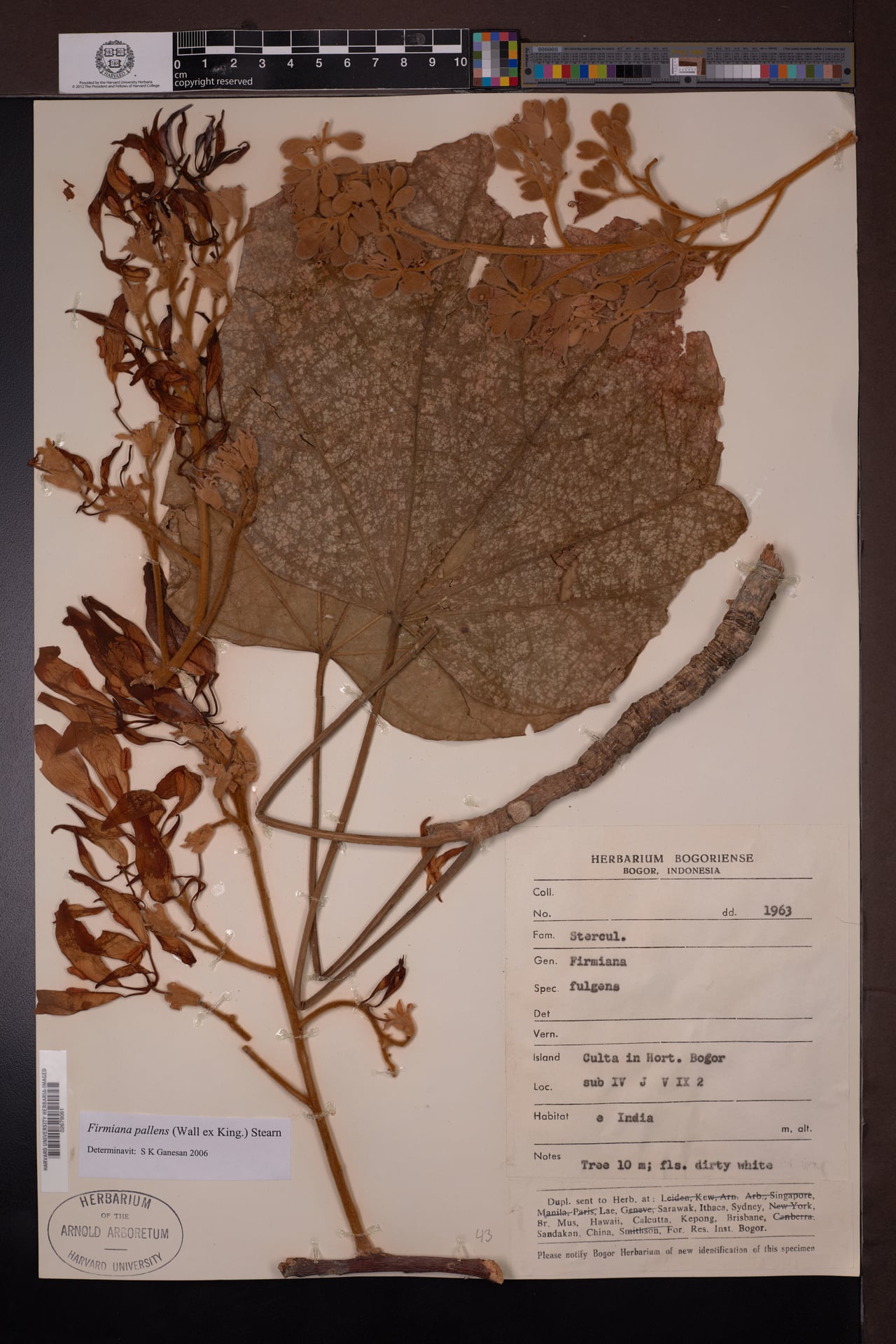
Firmiana fulgens
Pale sterculia
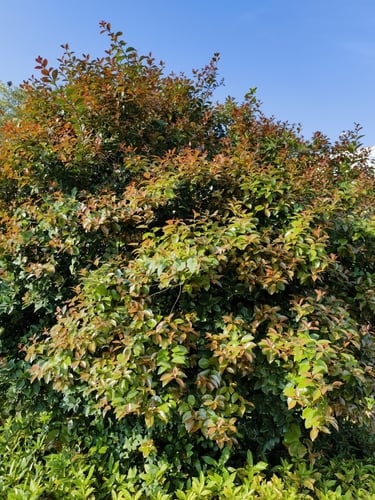
Firmiana simplex
Chinese parasol tree, Phoenix tree, Japanese varnish tree, Chinese bottle tree
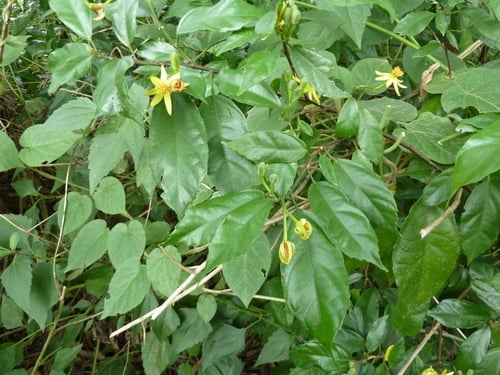
Glyphaea brevis
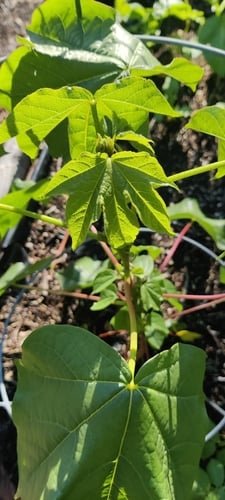
Gossypium arboreum
Tree Cotton, Cotton tree
Gossypium barbadense
Sea Island Cotton, Egyptian cotton, Brazilian cotton
Gossypium herbaceum
Short-staple cotton