Hibiscus mutabilis
L.
Rose of Sharon, Confederate rose
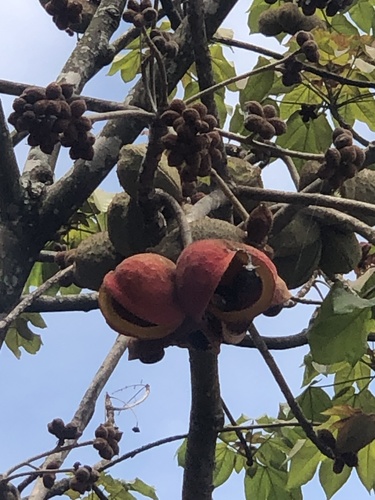
iNaturalist· cc-by-nc
(c) Suma Urang, some rights reserved (CC BY-NC), uploaded by Suma Urang
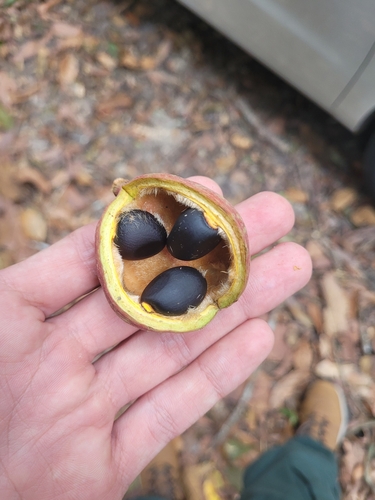
iNaturalist· cc-by-nc
(c) Robert LaPlante, some rights reserved (CC BY-NC), uploaded by Robert LaPlante
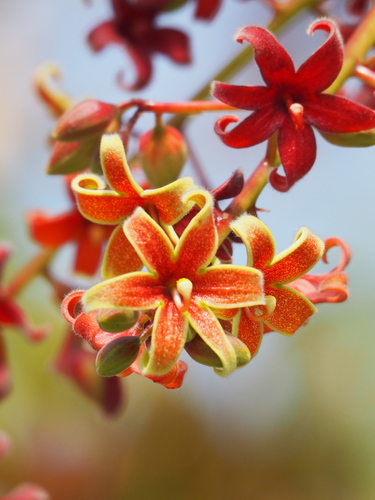
iNaturalist· cc-by-nc
(c) AMAKSS99, some rights reserved (CC BY-NC), uploaded by AMAKSS99
Summary
Source: WikipediaHibiscus mutabilis, also known as the cotton rose or rosemallow, a plant long cultivated for its showy flowers. Originally native to southern China, where it is known as 木芙蓉, ("Mùfúróng")[1]it is now found on all continents except Antarctica. It is a mallow (family Malvaceae) not a true rose (family Rosaceae). Alternative names in parts of the United States are Confederate rose and Dixie rosemallow.
Description
A shrub which loses its leaves during the year. It grows to 3 m high and spreads to 2m across. The stem is erect and branching. The stem is covered with soft, star shaped hairs. The leaves are large and oval and divided like fingers on a hand and have 3-7 pointed lobes. The leaves can be 17 cm long. The flowers are funnel shaped and white and turn deep pink in a day. They can be double or single. They are 10 cm across. There are some named varieties.
Edible Uses
The leaves contain rutin, though no quantity is specified. The roots are edible but highly fibrous, with a mucilaginous texture and very little flavour.
Traditional Uses
The root is edible but it contains a lot of fibre. The leaves are eaten. They contain rutin. The leaves are boiled and eaten with oil and salt.
This uses section is brief — help expand it
Medicinal Uses
The leaves are anodyne, antidotal, demulcent, expectorant and refrigerant. Applied together with the flowers, they are used as a topical treatment for burns, swellings and other skin complaints. The flowers are antiphlogistic, depurative, febrifuge, pulmonary and stimulant; a decoction of the flowers is used in the treatment of lung ailments.
Distribution
A tropical plant. It grows best in light to medium, well drained soils. It needs an open sunny position. It needs a humus rich, fertile soil. It is damaged by frost and cannot tolerate drought. It needs a temperature above 13°C. It suits hardiness zones 8-10. In Sichuan and Yunnan.
Where It Grows
Africa, Asia, Australia, Bangladesh, China*, Dominican Republic, East Africa, Ecuador, Europe, Fiji, Gambia, Guianas, Haiti, Hawaii, Himalayas, India, Indochina, Indonesia, Italy, Japan, Korea, Madagascar, Malaysia, Marquesas, Mauritius, Mediterranean, Mozambique, Myanmar, Nauru, Nepal, Lord Howe Island, Niue, Norfolk Island, Northeastern India, Pacific, Pakistan, Papua New Guinea, PNG, Philippines, Reunion, Rotuma, Sao Tome and Principe, SE Asia, Slovenia, Suriname, Taiwan, USA, Thailand, Trinidad-Tobago, Vietnam, West Indies, Winward Is., Zambia, Zimbabwe,
Cultivation
Prefers a well-drained humus rich fertile soil in full sun. Prefers a warm but wet winter. This species is not very hardy in Britain, it is frost-tender and top growth will be killed by even a slight frost. However, the roots are somewhat hardier and the plant can resprout from the base after a few degrees of frost. The plant can probably be grown outdoors in the mildest areas of the country especially if given a good mulch in the winter. It is widely cultivated in tropical and occasionally in temperate areas as an ornamental plant, there are many named varieties.
Propagation
Sow seed in early spring in a warm greenhouse; germination is usually fairly rapid. Prick seedlings into individual pots when large enough to handle. For annual cultivation, plant out in early summer with frame or cloche protection until established. For perennial cultivation, grow on in the greenhouse for the first year and plant out in early summer of the following year. Half-ripe cuttings taken in July or August can be rooted in a frame, overwintered in a warm greenhouse, and planted out after the last expected frosts.
Other Uses
A fibre obtained from the bark is used for making cords and rope.
Other Information
It is cultivated as an ornamental shrub. It is sold in local markets in China.
Notes
There are about 220 Hibiscus species. The leaves are used in medicine as an expectorant.
Synonyms
Also Known As
Bettada tavare, Changeable rose, Changing Rose, Chinaparatti, Chinese rose, Cotton rose, Fu rong hua, Gul-i-ajaib, Hinaparutti, Irratai-vellaichembarattam, Jushuanghua, Kyet-shaw, Mu fu rong, Neladavare, Phudung, Phuttan, Resisting frost flower, Sembarattai, Shalapara, Sthal kamal, Sthalopidmo, Sthalpadma, Suryakanti, Taw-wah, Tholopodmo, Thon-ban-hla, Tree lotus, Waru ladak, White Mallow
References (32)
- Ambasta, S.P. (Ed.), 2000, The Useful Plants of India. CSIR India. p 266
- Bodkin, F., 1991, Encyclopedia Botanica. Cornstalk publishing, p 558
- Borrell, O.W., 1989, An Annotated Checklist of the Flora of Kairiru Island, New Guinea. Marcellin College, Victoria Australia. p 96
- Brickell, C. (Ed.), 1999, The Royal Horticultural Society A-Z Encyclopedia of Garden Plants. Convent Garden Books. p 522
- Burkill, I.H., 1966, A Dictionary of the Economic Products of the Malay Peninsula. Ministry of Agriculture and Cooperatives, Kuala Lumpur, Malaysia. Vol 1 (A-H) p 1186
Show all 32 references Hide references
- Cundall, P., (ed.), 2004, Gardening Australia: flora: the gardener's bible. ABC Books. p 702
- DARLINGTON & AMMAL,
- Engel, D.H., & Phummai, S., 2000, A Field Guide to Tropical Plants of Asia. Timber Press. p 168
- Etherington, K., & Imwold, D., (Eds), 2001, Botanica's Trees & Shrubs. The illustrated A-Z of over 8500 trees and shrubs. Random House, Australia. p 379
- Flora of Australia Volume 49, Oceanic Islands 1, Australian Government Publishing Service, Canberra. (1994) p 117
- Flora of Pakistan. www.eFloras.org
- Fowler, D. G., 2007, Zambian Plants: Their Vernacular Names and Uses. Kew. p 82
- Hibbert, M., 2002, The Aussie Plant Finder 2002, Florilegium. p 139
- Kew Plants of the World Online
- Li, D. et al, 2017, Ethnobotanical survey of herbal tea plants from the traditional markets in Chaoshan, China. Journal of Ethnopharmacology. 205 (2017) 195-206
- Liu, Yi-tao, & Long, Chun-Lin, 2002, Studies on Edible Flowers Consumed by Ethnic Groups in Yunnan. Acta Botanica Yunnanica. 24(1):41-56 (As Hibiscus mutabilis f plenus)
- Llamas, K.A., 2003, Tropical Flowering Plants. Timber Press. p 257
- McMakin, P.D., 2000, Flowering Plants of Thailand. A Field Guide. White Lotus. p 28
- Peekel, P.G., 1984, (Translation E.E.Henty), Flora of the Bismarck Archipelago for Naturalists, Division of Botany, Lae, PNG. p 363, 360
- Pham-Hoang Ho, 1999, An Illustrated Flora of Vietnam. Nha Xuat Ban Tre. p 524
- Plants for a Future database, The Field, Penpol, Lostwithiel, Cornwall, PL22 0NG, UK. http://www.scs.leeds.ac.uk/pfaf/
- Plants of Haiti Smithsonian Institute http://botany.si.edu/antilles/West Indies
- READ,
- Recher, P, 2001, Fruit Spirit Botanical Gardens Plant Index. www.nrg.com.au/~recher/ seedlist.html p 6
- Sp. pl. 2:694. 1753
- Staples, G.W. and Herbst, D.R., 2005, A tropical Garden Flora. Bishop Museum Press, Honolulu, Hawaii. p 389
- Sukarya, D. G., (Ed.) 2013, 3,500 Plant Species of the Botanic Gardens of Indonesia. LIPI p 642
- Swaminathan, M.S., and Kochnar, S.L., 2007, An Atlas of Major Flowering Trees in India. Macmillan. p 37
- Tang ya, Malvaceae. Flora of China. p
- Valder, P., 1999, The Garden Plants of China. Florilegium. p 290
- World Checklist of Useful Plant Species 2020. Royal Botanic Gardens, Kew
- Young, J., (Ed.), 2001, Botanica's Pocket Trees and Shrubs. Random House. p 442