Sterculia foetida
Linn.
Java olive, Skunk Tree, Poon tree, Wild almond
iNaturalist· cc0
no rights reserved, uploaded by 葉子
iNaturalist· cc-by-nc
(c) nanying, some rights reserved (CC BY-NC), uploaded by nanying
iNaturalist· cc0
no rights reserved, uploaded by 葉子
Summary
Source: WikipediaSterculia foetida is a soft-wooded tree that can grow up to 35 metres (115 feet) tall. Common names for the plant are the bastard poon tree, Java olive tree, hazel sterculia, wild almond tree, and skunk tree.
Description
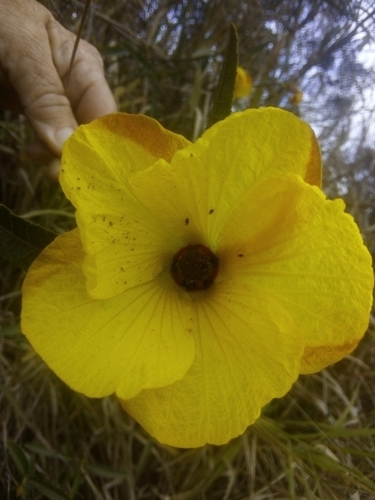
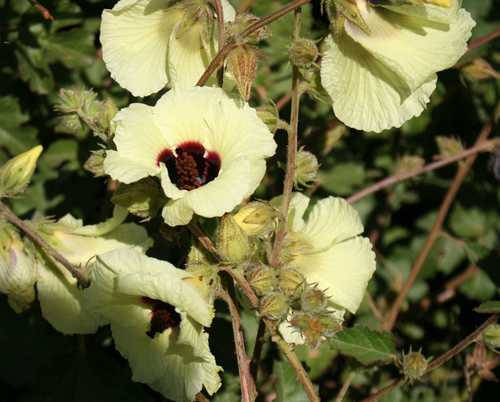
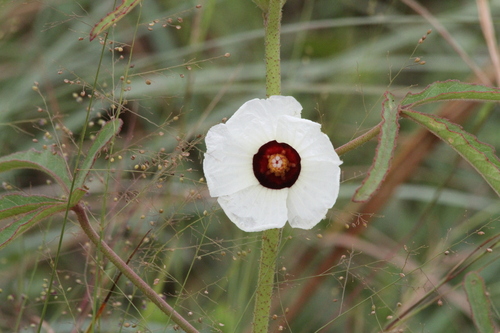
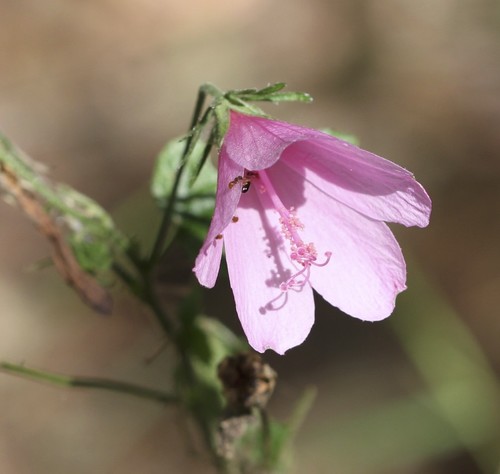
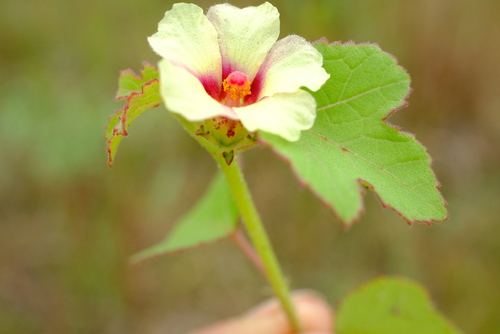
A medium sized tree. It grows to 10-20 m high. The tree has a straight trunk and branches to form a small crown. The bark is brown and flakes off. It loses its leaves during the year. The leaves are crowded at the ends of branches. They are compound and with 7 to 9 leaflets borne in a ring at the end of the leaf stalk. Each leaflet is 10-18 cm long by 3-5 cm wide. They have a pointed tip. The leaf stalk is 15-24 cm long and grooved. The flowers are strongly scented. They are red, dull yellow or purple. They are 2-4 cm wide in clusters 15-20 cm long and shaped like a pyramid. Male and female flowers are separate. The fruit are large, woody, nearly smooth and oval. They are 7.5-10 cm long and flattened. They turn red when ripe. The ripe fruit splits open showing large black seeds. The seeds are edible.
Edible Uses
The seed kernels are eaten raw or roasted like chestnuts, and can be soaked to remove skins before roasting. The seeds can also be pressed for oil. The rootstock of young plants can be eaten raw, and the leaves are used for food.
Traditional Uses
The seed kernels are eaten raw. They can also be roasted like chestnuts. They can be soaked to remove the skins before roasting. The seeds can be used for oil. CAUTION: The seeds eaten in large numbers can cause diarrhoea and headaches. They probably should be cooked well. Immature seeds are not eaten. The rootstock of the young plant can be eaten raw. The leaves are used for food.
Medicinal Uses
The bark is aperient, diaphoretic and diuretic. It is used in the treatment of dropsy and rheumatism. The leaves are aperient, diuretic and laxative. They are also used in the treatment of epilepsy[2058 The fruit is astringent and mucilaginous. It is used in the treatment of gonorrhoea. The seeds are used as a purgative in Ghana. Combining the boiled seeds with a decoction of the wood has been found to be an effective medication for the alleviation of rheumatism. The oil from the seed is laxative and carminative. It is applied externally to treat itches and other skin diseases. It is extracted on a local scale to be used in medicine.
Known Hazards
The oil of Sterculia foetida has been found to be comparable to sunflower, soybean, and grapeseed oils for the use of biofuels. Sterculia foetida oil contains cyclopropene fatty acids (CPFA) such as 8,9 methylene-heptadec-8-enoic acid (malvalic acid) and 9,10-methylene-ocadec-9-enoic acid (sterculic acid). The flash point, iodine value, free fatty acid count, phosphorus content, cloud point, pour point, viscosity at 40 °C, oxidative stability at 110 °C, density, and trace metal count are all within ASTM and EN specifications. Evidence suggests that the seeds are edible, but purgative, and should be roasted prior to eating. At least one review indicates that CPFA such as sterculic acid are carcinogenic, co-carcinogenic, and have medical and other effects on animals; according to this review, "CPFA in food is dangerous to human health". In Vietnam, the tree is called Trôm and its sap is harvested to use as a soft drink called "Mủ Trôm".
Distribution
A tropical plant. Plants grow in the tropical lowlands in dry woodlands. They are common throughout the islands of the Philippines along the seashores and partly open forests at low and medium altitudes. In Nepal it grows up to 300 m altitude. It can grow in arid places. It suits hardiness zones 10-12.
Where It Grows
Africa, Asia, Australia, Bangladesh, Cambodia, China, Cambodia, Cuba, Djibouti, East Africa, East Timor, Eritrea, Ethiopia, Ghana, Hawaii, Himalayas, India, Indochina, Indonesia, Kenya, Laos, Malaysia, Middle East, Mozambique, Myanmar, Nepal, Northeastern India, Oman, Pacific, Pakistan, Papua New Guinea, PNG, Philippines, Puerto Rico, SE Asia, Senegal, Somalia, South Africa, Southern Africa, Sri Lanka, Taiwan, Tanzania, Thailand, Timor-Leste, Uganda, USA, Vietnam, West Africa, West Indies, Yemen,
Cultivation
Plants are grown from seed. It can also be grown from mature cuttings. Some trees need cross pollination to produce fruit.
Propagation
Seed - needs to be sown when fresh. Seedlings grow rapidly and form long taproots. They need to be planted into their permanent positions as soon as possible. A physical dormancy caused by the hard seed coat of the mature seeds of many species in this genus can be overcome by scarifying the seed. This is carried out by cutting away or abrading some of the seed coat to allow the ingress of water, though great care must be taken not to damage the embryo. The aril surrounding the seed should also be removed - this is easiest when it has been softened through soaking in water. The seeds germinate optimally at temperatures between 20 - 30°c. They can be sown in a nursery seedbed or in containers. A germination rate of about 95%, occurring within about 2 weeks can be expected if the seed has been properly treated. Cuttings
Other Uses
A fibre is obtained from the bark and the roots. The fibre is the inner bark of the tree and, when freshly stripped, has a lace-like character which adapts it for fancy work. It is used for making mats, bags, cordage, and paper A gum that resembles 'gum tragacanth', is obtained from the trunk and branches and is used for bookbinding and similar purposes. The leaves are insect repellent. A non-drying oil is obtained from the seed. The oil is used for lighting. An unusual feature of the seed is that oil is present in the testa as well as the kernel. The total oil content is about 34%. Traditionally, the oil is mixed with white earth and used as a paint. The timber is greyish-white and soft but is harder than most other species of the genus. It is easy to saw and work, finishes fairly well, is very perishable when exposed to the weather or is in contact with the ground, although it is fairly durable for interior work. It is used for making rough packing cases, and locally for making doors of huts, dugout canoes, boat planking, guitars and carved toys.
Production
It is fast growing. A tree can yield 20 kg of nuts.
Notes
Seeds are above-average for angiospermous plants for the amino acids: Alanine, Aspartic acid, Histidine, Isoleucine, Lysine, Methionine, Proline, and Valine. Also put in the family Sterculiaceae.
Nutrition
| Part | Moisture | kJ | kcal | Protein | Vit A | Vit C | Iron | Zinc |
|---|---|---|---|---|---|---|---|---|
| Seed | — | — | 21 | — | — | — | — | — |
Synonyms
Also Known As
Ai-nitas, Arbol del clavo, Badam, Bana, Bhatala penari, Chamahong, Gurapa badam chettu, Gurapa-orguttapubadamu, Hill coconut, Jangkang, Jangali badam, Jangli badam, Jangli-the, Kadung-hta, Kaju, Kalumpang, Kelumpang, Kempuh, Kepoh, Khau-rang, Koleangka, Kongatti, Letkok, Letpan-shaw, Peenaree marum, Poh, Pohon kepuh, Pohu odal, Pottaikavalam, Pottakavalam, Sam rang, Sam, Samraong, Samrong breng, Shaw-byu, Shaw-wah, Sumrong, Telambu, Trom hoi
References (54)
- Ambasta, S.P. (Ed.), 2000, The Useful Plants of India. CSIR India. p 600
- Anderson, E. F., 1993, Plants and people of the Golden Triangle. Dioscorides Press. p 222
- Arinathan, V., et al, 2007, Wild edibles used by Palliyars of the western Ghats, Tamil Nadu. Indian Journal of Traditional Knowledge. 6(1) pp 163-168
- Ashton, M. S., et al 1997, A Field Guide to the Common Trees and Shrubs of Sri Lanka. WHT Publications Ltd. pdf p 375
- Bajpai, O., et al, 2015, Tree species of the Himalayan Terai region of Uttar Pradesh, India: a checklist. Check List 11(4): 1718
Show all 54 references Hide references
- Barwick, M., 2004, Tropical and Subtropical Trees. A Worldwide Encyclopedic Guide. Thames and Hudson p 384
- Bodkin, F., 1991, Encyclopedia Botanica. Cornstalk publishing, p 949
- Brown, W.H., 1920, Wild Food Plants of the Philippines. Bureau of Forestry Bulletin No. 21 Manila. p 114
- Burkill, I.H., 1966, A Dictionary of the Economic Products of the Malay Peninsula. Ministry of Agriculture and Cooperatives, Kuala Lumpur, Malaysia. Vol 2 (I-Z) p 2116
- Chin, H.F., & Yong, H.S., 1996, Malaysian Fruits in Colour. Tropical press, Kuala Lumpur p 72
- Coronel, R.E., 1982, Fruit Collections in the Philippines. IBPGR Newsletter p 10
- Cowie, I, 2006, A Survey of Flora and vegetation of the proposed Jaco-Tutuala-Lore National Park. Timor-Lests (East Timor) www.territorystories.nt/gov.au p 53
- Davis, S.D., Heywood, V.H., & Hamilton, A.C. (eds), 1994, Centres of plant Diversity. WWF. Vol 1 or 2. p 139
- Facciola, S., 1998, Cornucopia 2: a Source Book of Edible Plants. Kampong Publications, p 239
- FAO Forestry Department. Non-wood forest products in Indochina - Focus Vietnam 5.4 Edible Plant Products
- Flora of Pakistan. www.eFloras.org
- Gardner, S., et al, 2000, A Field Guide to Forest Trees of Northern Thailand, Kobfai Publishing Project. p 78
- Hazarika, B. et al. (2020). An overview of the unexplored underutilized fruit crops of Assam, India. Journal of Applied and Natural Science, 12(3): 442 - 453
- Hearne, D.A., & Rance, S.J., 1975, Trees for Darwin and Northern Australia. AGPS, Canberra p 107
- Hedrick, U.P., 1919, (Ed.), Sturtevant's edible plants of the world. p 635
- http://palaeoworks.anu.edu.au/Nuno_PhD/04.pdf
- Hu, Shiu-ying, 2005, Food Plants of China. The Chinese University Press. p 546
- Jardin, C., 1970, List of Foods Used In Africa, FAO Nutrition Information Document Series No 2.p 36
- Krishen P., 2006, Trees of Delhi, A Field Guide. DK Books. p 217
- Lim, T. K., 2015, Edible Medicinal and Non Medicinal Plants. Volume 9, Modified Stems, Roots, Bulbs. Springer p 79
- Llamas, K.A., 2003, Tropical Flowering Plants. Timber Press. p 269
- Lugod, G.C. and de Padua L.S., 1979, Wild Food Plants in the Philippines. Vol. 1. Univ. of Philippines Los Banos. p 71
- Manandhar, N.P., 2002, Plants and People of Nepal. Timber Press. Portland, Oregon. p 442
- Martin, F. W., et al, 1987, Perennial Edible Fruits of the Tropics. USDA Handbook 642 p 63
- McMakin, P.D., 2000, Flowering Plants of Thailand. A Field Guide. White Lotus. p 37
- Menninger, E.A., 1977, Edible Nuts of the World. Horticultural Books. Florida p 42
- Miguel, E., et al, 1989, A checklist of the cultivated plants of Cuba. Kulturpflanze 37. 1989, 211-357
- Milow, P., et al, 2013, Malaysian species of plants with edible fruits or seeds and their evaluation. International Journal of Fruit Science. 14:1, 1-27
- Mishra, S. & Chaudhury, S. S., 2012, Ethnobotanical flora used by four major tribes of Koraput, Odisha, India. Genetic Resources Crop Evolution 59:793-804
- Pasha, M. K. & Uddin, S. B., 2019, Minor Edible Fruits of Bangladesh. Bangladesh J. Plant Taxon. 26(2): 299–313
- Patiri, B. & Borah, A., 2007, Wild Edible Plants of Assam. Geethaki Publishers. p 16
- Paul, A., 2013, Minor and uncultivated fruits of Eastern India, 2nd International Symposium on Minor Fruits and Medicinal Plants
- Pham-Hoang Ho, 1999, An Illustrated Flora of Vietnam. Nha Xuat Ban Tre. p 505
- Phon, P., 2000, Plants used in Cambodia. © Pauline Dy Phon, Phnom Penh, Cambodia. p 570
- Royal Botanic Gardens, Kew (1999). Survey of Economic Plants for Arid and Semi-Arid Lands (SEPASAL) database. Published on the Internet; http://www.rbgkew.org.uk/ceb/sepasal/internet [Accessed 11th June 2011]
- SHORTT,
- Singh, H.B., Arora R.K.,1978, Wild edible Plants of India. Indian Council of Agricultural Research, New Delhi. p 85
- Sp. pl. 2:1008. 1753
- Staples, G.W. and Herbst, D.R., 2005, A tropical Garden Flora. Bishop Museum Press, Honolulu, Hawaii. p 543 (Drawing)
- Sukarya, D. G., (Ed.) 2013, 3,500 Plant Species of the Botanic Gardens of Indonesia. LIPI p 521
- Swaminathan, M.S., and Kochnar, S.L., 2007, An Atlas of Major Flowering Trees in India. Macmillan. p 63
- Tewari, D.N., 1994, Important Plants of India. International Book Distributors, India. p 47
- Thai Forestry Bulletin 23:62-108, 1995
- VAN ETTEN et al (1963),
- Walter, A. & Sam C., 2002, Fruits of Oceania. ACIAR Monograph No. 85. Canberra. p 248, 281
- WATT,
- Wickens, G.E., 1995, Edible Nuts. FAO Non-wood forest products. FAO, Rome. p156
- World Checklist of Useful Plant Species 2020. Royal Botanic Gardens, Kew
- www.worldagroforestrycentre.org/treedb/