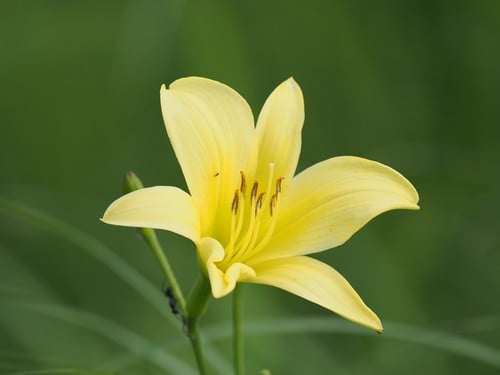
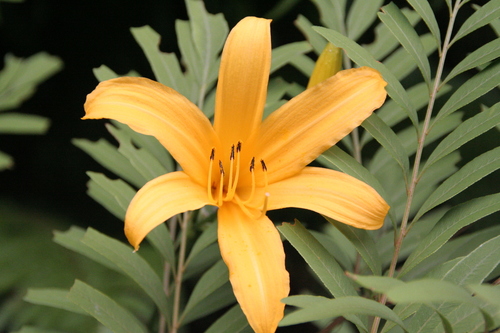
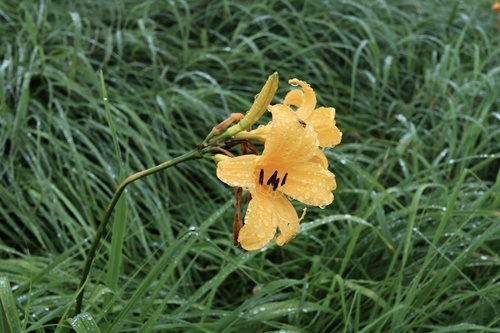
Hemerocallis species
wikimedia· cc-by-sa
Wikimedia Commons - Dinesh Valke from Thane, India
wikimedia· cc-by-sa
Wikimedia Commons - Dinesh Valke from Thane, India
Summary
Source: WikipediaHemerocallis species is a perennial growing to 1.2m tall. Not frost tender. Flowers bloom from July to September. The species is hermaphrodite and insect-pollinated. It adapts to light sandy, medium loamy, or heavy clay soils across mildly acidic to mildly alkaline pH ranges. The plant grows in semi-shade or full sun and tolerates both dry and moist soils.
Description
Hemerocallis species is a perennial growing to 1.2m tall. Not frost tender. Flowers bloom from July to September. The species is hermaphrodite and insect-pollinated. It adapts to light sandy, medium loamy, or heavy clay soils across mildly acidic to mildly alkaline pH ranges. The plant grows in semi-shade or full sun and tolerates both dry and moist soils.
Edible Uses
Leaves and young shoots are cooked and have a delicious sweet flavour, but must be eaten when very young before they become fibrous. Flowers and flower buds can be eaten raw or cooked; quality varies between cultivars — all are pleasantly sweet and crunchy, though some leave an unpleasant aftertaste. In general, cultivars with yellow or scented flowers are considered less desirable for eating than those with brown to red flowers. Roots are also edible raw or cooked.
Medicinal Uses
The juice of the roots is an effective antidote in cases of arsenic poisoning. A tea made from boiled roots is used as a diuretic.
Known Hazards
Eating too many uncooked flowers of some species can cause diarrhea. Hemerocallis species are toxic to cats and ingestion may be fatal. Treatment is usually successful if started before kidney failure has developed. Daylilies are an economically important group of plants used medicinally, as food, and as horticultural plants. They have been cultivated in East Asia starting in China for thousands of years. Hemerocallin, a root neurotoxin, has been used as poison and therapeutically as part of traditional oriental medicine. Some flowers of certain species such as Hemerocallis citrina are used in Chinese cuisine. They are sold fresh or dried in Asian markets as gum jum (金针 in Chinese; pinyin: jīn zhēn) or yellow flower vegetables (黃花菜 in Chinese; pinyin: huáng huā cài). These are used in hot and sour soup, daylily soup (金針花湯), Buddha's delight, and moo shu pork. The tubers and young leaves of H. fulva can be eaten raw or cooked. The flowers are more palatable upon cooking. Moreover, Daylilies are among the most popular North American garden plants. Registered cultivars of Hemerocallis now exceed 38,000, including more than 13,000 named clones of H. fulva.
Distribution
It is a temperate plant.
Propagation
Sow seed in mid-spring in a greenhouse; germination is usually fairly rapid and good. Prick seedlings into individual pots when large enough to handle, overwinter in the greenhouse, and plant out in late spring. Note that Hemerocallis cultivars will not breed true from seed, though seedlings do offer an opportunity to develop superior varieties for eating. Divide plants in spring or after flowering in late summer or autumn — division is quick and easy at almost any time of year. Larger clumps can go straight into permanent positions; smaller clumps are best potted up and grown on in a cold frame until rooting well, then planted out in spring.
Other Uses
The tough dried foliage can be plaited into cord and used for making footwear.
Notes
There are about 15 Hemerocallis species. Also put in the family Hemerocallidaceae.
Synonyms
References (1)
- Plants for a Future database, The Field, Penpol, Lostwithiel, Cornwall, PL22 0NG, UK. http://www.scs.leeds.ac.uk/pfaf/