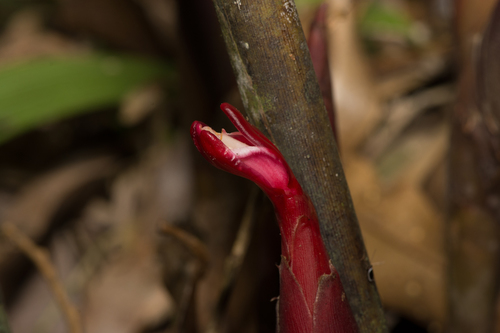
Hedychium spicatum
Buch.-Ham. ex Smith
Eastern spiked ginger, Spiked ginger lily
iNaturalist· cc-by
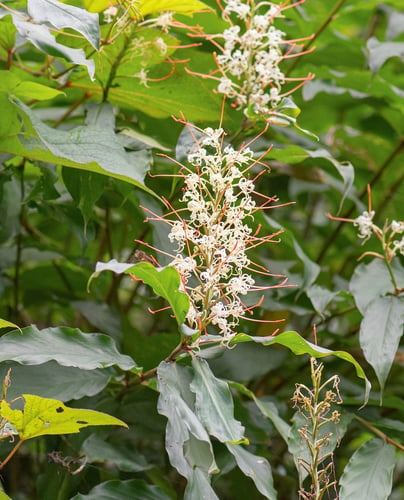
(c) Siddarth Machado, some rights reserved (CC BY), uploaded by Siddarth Machado
iNaturalist· cc-by-nc
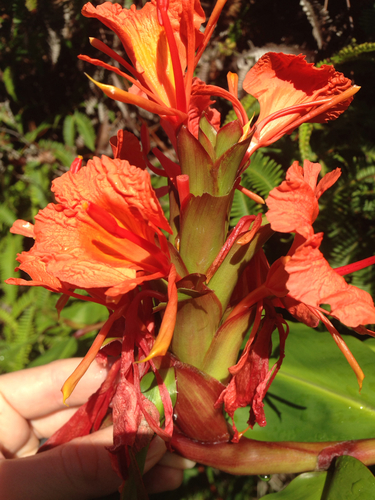
(c) bigbiter, some rights reserved (CC BY-NC)
iNaturalist· cc-by-nc
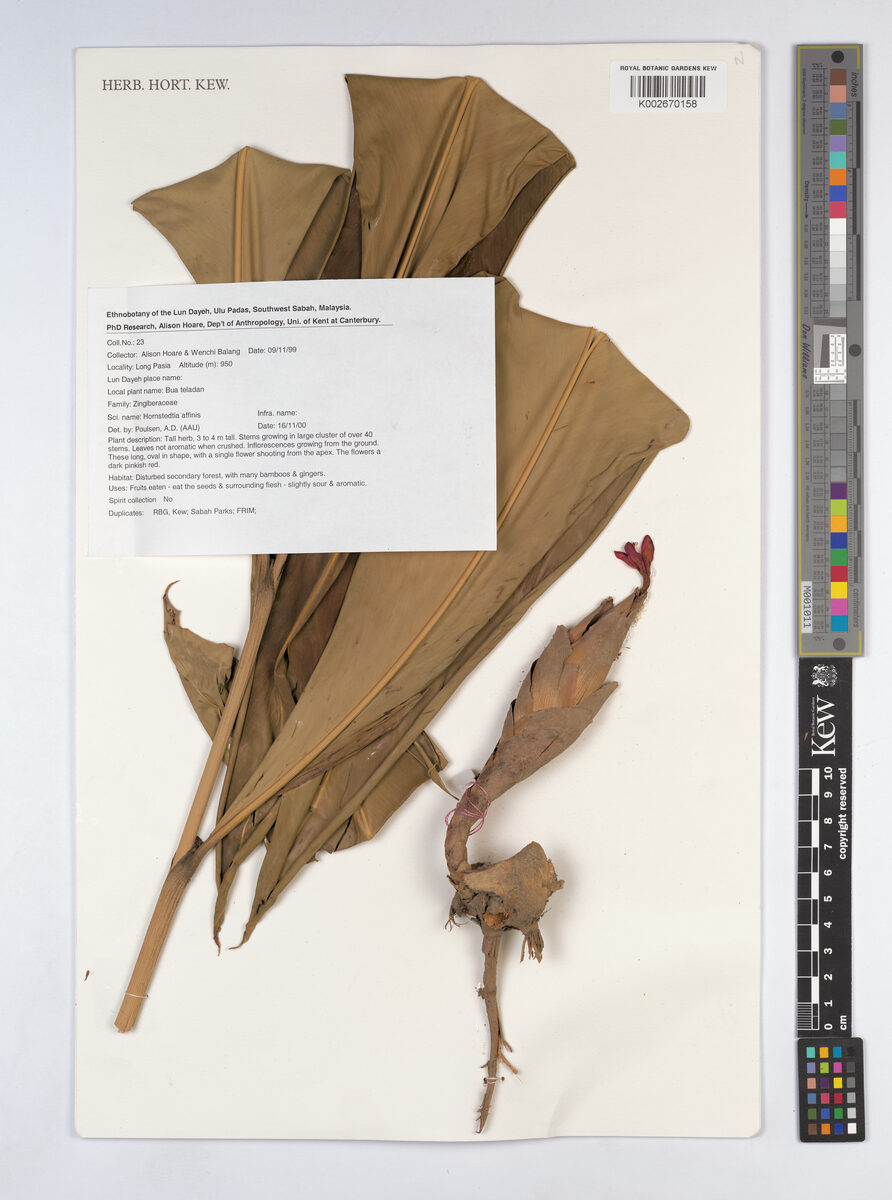
(c) bigbiter, some rights reserved (CC BY-NC)
Summary
Source: WikipediaHedychium spicatum is a plant species native to China (Guizhou, Sichuan, Tibet, Yunnan), the Himalayas, Myanmar, and Thailand. Hedychium spicatum is a small, hardy perennial that grows to around 1 m (3 ft 3 in), with green leaves and large orange and white flowers. It is also commonly known as spiked ginger lily, or perfume ginger.
Description
A ginger family herb. The false stem is about 1 m tall. The leaves do not have leaf stalks or they are short. The leaf blade is oblong or sword shaped and 10-40 cm long by 3-10 cm wide. They taper to the tip. The flower spikes can be 20 cm long. There can be a few loose flowers or many densely packed flowers. The bracts are oblong surrounding one flower. The flowers have a smell. The flowers are yellowish but sometimes purplish red at the tip. The fruit is a capsule which is half round and 1.5-2.5 cm across. It has 3 valves. There are about 6 seeds in each valve. Varieties are described on how many flowers they have.
Edible Uses
The fruit is edible cooked and is eaten in savoury dishes with lentils.
Traditional Uses
The tuberous roots or rhizomes are edible and used as a spice.
This uses section is brief — help expand it
Medicinal Uses
The rootstock is carminative, emmenagogue, expectorant, stimulant, stomachic, and tonic. It is useful for liver complaints and has been used to treat fevers, vomiting, diarrhoea, inflammation, pains, and snake bite. In Tibetan medicine, the root is considered to have an acrid taste and heating potency. It acts as a digestive, stomachic, and vasodilator, and is used for indigestion and poor circulation caused by thickening of the blood.
Distribution
A tropical and subtropical plant. It grows in forests between 1200-3200 m altitude in S China. It suits hardiness zones 8-11. In Yunnan.
Where It Grows
Asia, Australia, Bhutan, China, Hawaii, Himalayas, India, Indochina, Myanmar, Nepal, Northeastern India, Pacific, SE Asia, Sikkim, Thailand, Tibet, USA,
Cultivation
Requires a rich moist soil and a sunny position. They can be grown in a sunny border as a summer sub-tropical bedding plant. Plants are not very cold-hardy, tolerating temperatures down to about -2°c. They can be grown at the foot of a south-facing wall if given a good mulch in the winter. Plants succeed outdoors in Tresco Gardens, Isles of Scilly. This species succeeds outdoors in most parts of S. England, especially if the rhizomes are mulched with dry leaves in the autumn. Plants have been known to withstand temperatures down to -16°c in Germany. Plants seem to be immune to the predations of rabbits. The tubers should only just be covered with soil. The flowers are sweetly scented, the scent being most pronounced towards evening. Both the bruised and the dried root are very aromatic with a fragrant, somewhat pungent smell that is similar to orris root but more powerful.
Propagation
Sow seed as soon as it is ripe in a warm greenhouse at 18°C. Prick seedlings into individual pots when large enough to handle and keep them under glass through at least their first winter. Plant out in late spring after the last expected frosts. Division can be done as growth begins in spring — dig up the clump and divide with a sharp spade or knife, ensuring each section has a growing shoot. Larger divisions can go straight into permanent positions, while smaller ones are best potted and grown on in a greenhouse until established, then planted out in summer or the following late spring.
Other Uses
The rootstock yields 4% essential oil with a scent somewhat like hyacinths — so potent that a single drop will leave clothes noticeably perfumed for a considerable period. The dried root is also burnt as an incense.
Notes
There are about 50 Hedychium species.
Synonyms
Also Known As
Ai-thur, Cao guo yao, Gandhashati, Kapur, Karpurakachali, Kapurkachari, Kapurakachari, Kunsa-gamon-akyi, Saro, Shaildu, Sheduri, Shimai-kichchilik-kishangu, Sitruti, Takhellei hangampal, Telli, White ginger lily
References (13)
- Ambasta, S.P. (Ed.), 2000, The Useful Plants of India. CSIR India. p 258
- Cundall, P., (ed.), 2004, Gardening Australia: flora: the gardener's bible. ABC Books. p 680
- Kar, A., et al, 2013, Wild Edible Plant Resources used by the Mizos of Mizoram, India. Kathmandu University Journal of Science, Engineering and Technology. Vol. 9, No. 1, July, 2013, 106-126 (As Hedychium acuminatum)
- Meitei, L. R., et al, 2022, An ethnobotanical study on the wild edible plants used by forest dwellers in Yangoupokpi Lokchao Wildlife Sanctuary, Manipur, India. Ethnobotany Research and Application 23:15
- Morley, B. & Everard, B., 1970, Wild Flowers of the World. Ebury press. Plate 124
Show all 13 references Hide references
- Murtem, G. & Chaudhrey, P., 2016, An ethnobotanical note on wild edible plants of Upper Eastern Himalaya, India. Brazilian Journal of Biological Sciences, 2016, v. 3, no. 5, p. 63-81
- Negi, K.S., 1988, Some little known wild edible plants of U.P. Hills. J. Econ. Tax. Bot. Vol. 12 No. 2 pp 345-360
- Plants for a Future database, The Field, Penpol, Lostwithiel, Cornwall, PL22 0NG, UK. http://www.scs.leeds.ac.uk/pfaf/
- Recher, P, 2001, Fruit Spirit Botanical Gardens Plant Index. www.nrg.com.au/~recher/ seedlist.html p 4
- A. Rees, Cycl. 17: Hedychium no. 3. 1819
- Staples, G.W. and Herbst, D.R., 2005, A tropical Garden Flora. Bishop Museum Press, Honolulu, Hawaii. p 767
- Wu Delin, Larsen, K., Zingiberaceae. Flora of China.
- Xu, Z., Tao, G. & Tan, J., 1988, Tropical Wild Flowers and Plants in Xishuangbanna, Agricultural Publishing House. photo 53 (var. acuminatum)