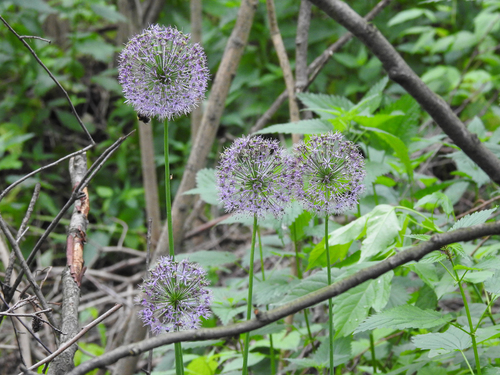
Allium carolinianum
DC,
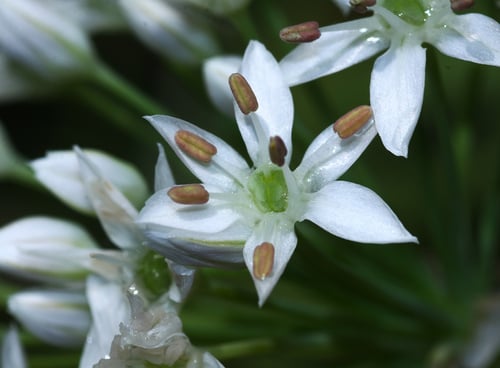
iNaturalist· cc-by
(c) Dmitry Kulakov, some rights reserved (CC BY), uploaded by Dmitry Kulakov
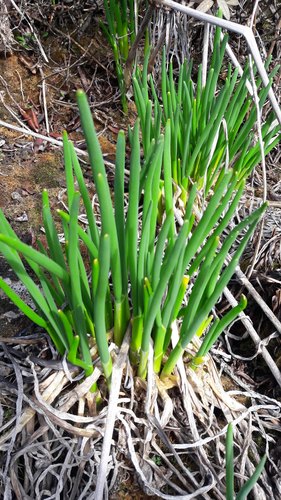
iNaturalist· cc-by
(c) Dmitry Kulakov, some rights reserved (CC BY), uploaded by Dmitry Kulakov
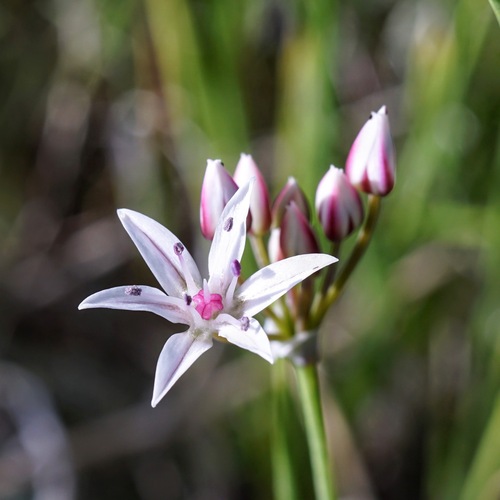
iNaturalist· cc-by-nc
(c) Kulbhushansingh Suryawanshi, some rights reserved (CC BY-NC), uploaded by Kulbhushansingh Suryawanshi
Summary
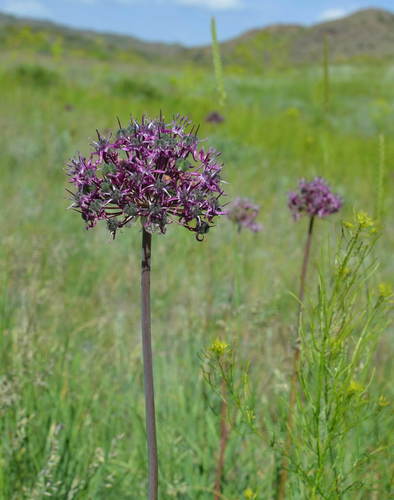
Source: WikipediaAllium carolinianum is a species of onions native to central and southern Asia (Xinjiang, Xizang (Tibet), Afghanistan, Bhutan, India, Kazakhstan, Kyrgyzstan, Nepal, Pakistan, Tajikistan, Uzbekistan). It grows in sunlit slopes at elevations of 3000–5000 m. Allium carolinianum produces egg-shaped bulbs up to 25 mm across. Scapes are round in cross-section, up to 60 cm tall. Leaves are narrow, flat, shorter than the scape. Umbel is round, with many white, red or purplish flowers.
Description
An onion family plant. A bulb plant. The bulbs are usually in pairs. They are 1-2.5 cm across. The covering is brown to yellowish brown and leathery. It grows to 40 cm high and 12 cm across. The leaves are broadly linear. They are 5-15 mm wide. They are flat and smooth. The scape is 20-40 cm long. It is covered with leaf sheaths for 1/2 its length. The flower head is round and dense with many flowers.
Edible Uses
The bulb can be eaten raw or cooked. The bulbs typically grow in pairs and reach up to 25mm in diameter. Leaves are also eaten raw or cooked. Flowers are eaten raw and can be used as a garnish on salads.
Traditional Uses
The bulbs are eaten raw or cooked. The leaves are eaten raw or cooked. They are also dried and used in curries and pickles. The flowers are used raw or to flavour salads. The leaves are crushed and dried cakes made out of this mass then stored for later use.
Medicinal Uses
No specific medicinal uses have been recorded for this species, but like other members of this genus it is considered a healthy addition to the diet. It contains sulphur compounds responsible for its onion flavour, and eaten regularly it helps reduce blood cholesterol levels, tones the digestive system, and supports the circulatory system.
Known Hazards
Although no individual reports regarding this species have been seen, there have been cases of poisoning caused by the consumption, in large quantities and by some mammals, of certain members of this genus. Dogs seem to be particularly susceptible.
Distribution
It is a temperate plant. It grows naturally in the Himalayas from Afghanistan to Nepal on stony slopes between 3000 - 4500 metres. In China it grows on gravely or stony slopes between 3000-5000 m altitude in W China.
Where It Grows
Afghanistan, Asia, Bhutan, Central Asia, China, Himalayas, India, Kazakhstan, Kyrgyzstan, Mongolia, Nepal, NW India, Pakistan, Tajikistan, Tibet, Uzbekistan,
Cultivation
Easily grown from seed, succeeding in a sunny position in a light well-drained soil. The bulbs should be planted fairly deeply. Most members of this genus are intolerant of competition from other growing plants. Grows well with most plants, especially roses, carrots, beet and chamomile, but it inhibits the growth of legumes. This plant is a bad companion for alfalfa, each species negatively affecting the other. Members of this genus are rarely if ever troubled by browsing deer.
Propagation
Sow seed in spring in a cold frame. Prick seedlings into individual pots when large enough to handle — three per pot will produce clumps more quickly. Grow on in a greenhouse through at least the first winter, then plant out in spring once vigorous and large enough. Division in spring works well; plants can be divided successfully at any point in the growing season. Pot divisions in a cold frame or greenhouse until established before planting out permanently.
Other Uses
The plant juice acts as a moth repellent. The whole plant is also said to repel insects and moles.
Notes
There are about 300-700 Allium species. Most species of Allium are edible (Flora of China). All alliums are edible but they may not all be worth eating! They have also been put in the family Alliaceae.
Nutrition
| Part | Moisture | kJ | kcal | Protein | Vit A | Vit C | Iron | Zinc |
|---|---|---|---|---|---|---|---|---|
| Leaves -dry wt | — | — | 15.8 | — | — | 272 | — | — |
| Leaves | — | — | — | — | — | — | — | — |
| Bulb | — | — | — | — | — | — | — | — |
| Flowers | — | — | — | — | — | — | — | — |
Synonyms
Also Known As
Farn, Ghra pyoz, Ghra yazza, Jangli ganda, Jangli peyaz, Jangli poloond, Jangli pyaz, Jangli wasal, Khokhai, Khush, Ladam, Laodh, Ogai, Rasgokpa, Stokche, Sukoche, Wozza
References (23)
- Ahmad, K. & Pieroni, A., 2016, Folk knowledge of wild food plants among the tribal communities of Thakht-e-Sulaiman Hills, North-West Pakistan. Journal of Ethnobiology and Ethnomedicine, 12:17
- Amin, M. et al, 2023, Edible wild plant species used by different linguistic groups of Kohistan Upper Khyber Pakhtunkhwa (KP), Pakistan. Journal of Ethnobiology and Ethnomedicine 19:6 p 8
- Badwar, R. R., & Fernandez, R. R., 2011, Edible Wild Plants of the Himachal Pradesh State by IHBT, Himalayas, Daya Publishing House,. Delhi, India. (As Allium thomsonii)
- Battacharyya, A., 1991, Ethnobotanical Observations in the Ladakh Region of Northern Jammu and Kashmir State, India. Economic Botany, Vol. 45, No. 3, pp. 305-308
- Bhattarai, S and Chaudary, R. P., 2009, Wild Edible Plants Used by the People of Manang District, Central Nepal. Ecology of Food and Nutrition, 48:1-20
Show all 23 references Hide references
- Chen Xinqi, Liang Songyun, Xu Jiemei, Tamura M.N., Liliaceae. Flora of China. p 119
- Dorjey, K., 2015, Exploration of Plant based Traditional Knowledge from Sham region of Ladakh (J. & K.), India. Journal of Plant Development Sciences Vol. 7 (5) : 429-433.
- Gautam, R. S., et al, 2022, Ethnobotanical Review of Wild Edible Plants of Nepal. Journal of Natural History Museum Volume 32, 2021-22 p 101
- Ghimire, S. K., et al, 2008, Non-Timber Forest Products of Nepal Himalaya. WWF Nepal p 18
- Kaul, M.K. et al, 1985, Ethno-botanic studies in North-West and Trans-Himalaya - contribution to the wild food plants of Ladakh. J.Econo. Tax. Bot. Vol. 6 No. 3 pp 523-527
- Khalid, N., et al, 2023, Wild food plants gathered by four cultural groups in North Waziristan, Pakistan. Genet Resour Crop Evol. 70:1243–1276
- Khan, A. H., et al, 2023, Traditional foraging for ecological transition? Wild food ethnobotany among three ethnic groups in the highlands of the eastern Hindukush, North Pakistan. Journal of Ethnobiology and Ethnomedicine 19:9
- Majeed, M., et al, 2021, Gathered Wild Food Plants among Diverse Religious Groups in Jhelum District, Punjab, Pakistan. Foods 2021, 10, 594.
- Negi, K. S., and Pant, K. C., 1992, Less-Known Wild Species of Allium L. (Amaryllidaceae) from Mountainous Regions of India. Economic Botany, Vol. 46, No. 1, pp. 112-114
- Plants for a Future database, The Field, Penpol, Lostwithiel, Cornwall, PL22 0NG, UK. http://www.scs.leeds.ac.uk/pfaf/
- Rana, J.C. et al, 2011, Genetic resources of wild edible plants and their uses among tribal communities of cold arid regions of India. Genetic Resources and crop Evolution. (2012) 59:135-149
- Rawat, G.S., & Pangtey, Y.P.S., 1987, A Contribution to the Ethnobotany of Alpine Regions of Kumaon. J. Econ. Tax. Bot. Vol. 11 No. 1 pp 139-147
- P. J. Redoute;, Liliac. 2: t. 101. 1804
- Sharma, L. et al, 2018, Diversity, distribution pattern, endemism and indigenous uses of wild edible plants in Cold Desert Biosphere Reserve of Indian Trans Himalaya. Indian Journal of Traditional Knowledge. Vol 17(1) January 2018 pp 122-131
- Urgamal, M., et al, 2014, Conspectus of the Vascular Plants of Mongolia. Mongolia Academy of Sciences Institute of Botany and National University of Mongolia Department of Biology. p 46
- Wiersema, J. H. & Leon, B., 2013, World Economic Plants. A Standard Reference CRC Press. 2nd Ed. p 33
- Wild edible plants of Himachal Pradesh (As Allium thomsonii)
- World Checklist of Useful Plant Species 2020. Royal Botanic Gardens, Kew