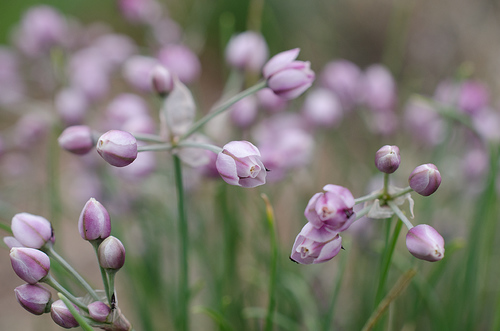
Allium fistulosum
L.
Japanese bunching onion, Spring onion
iNaturalist· cc-by
(c) ajikang, some rights reserved (CC BY)
iNaturalist· cc-by-sa
(c) National Institute of Korean Language, some rights reserved (CC BY-SA)
Summary
Source: WikipediaAllium fistulosum, the Welsh onion, also commonly called bunching onion, long green onion, Japanese bunching onion, and spring onion, is a species of perennial plant, often considered to be a kind of scallion. The species is very similar in taste and odor to the related common onion, Allium cepa, and hybrids between the two (tree onions) exist. A. fistulosum, however, does not develop bulbs, and its leaves and scapes are hollow (fistulosum means 'hollow'). Larger varieties of A. fistulosum, such as the Japanese negi, resemble the leek, and smaller varieties resemble chives. A. fistulosum can multiply by forming perennial evergreen clumps. It is also grown in a bunch as an ornamental plant.
Description
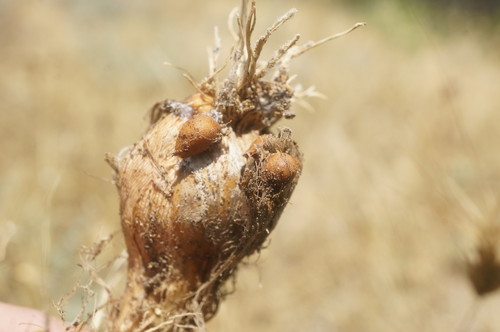
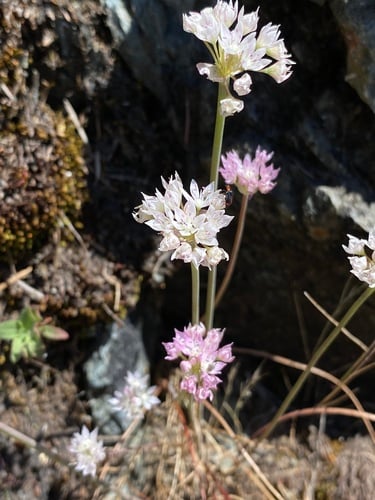
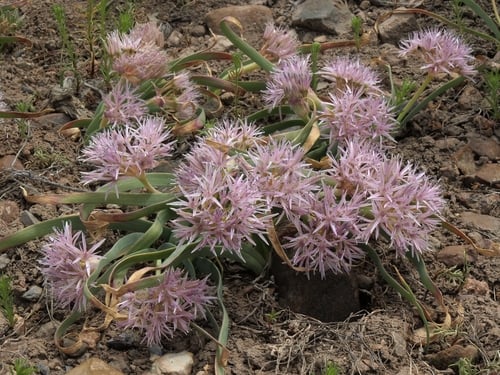
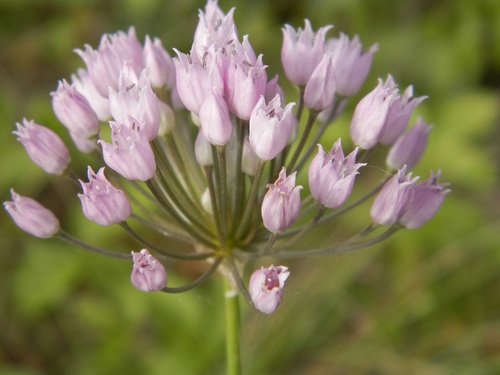
An onion family plant. A bulb plant but the bulb is indistinct. It grows to 60 cm high and 20 cm wide. The roots are side roots and fibrous. They grow in large clumps. The leaves are rounded in cross section and hollow. They grow to 15-30 cm long by 5-20 mm wide. The bulbs are very small and 4-8 cm long but only 5-25 mm across. The plant produces many side buds which develop as offshoots. Flowers grow on a stalk which comes from underground and there are many flowers on stalks around one head. This hollow stalk is 40-80 cm long. The flowers are yellow and they open from the top of the flower head downwards. There can sometimes be bulbils on the flower head.
Edible Uses
The bulbs can be eaten raw or cooked, delivering a strong onion flavour that works well in salads, as a cooked vegetable, or as a flavouring in cooked dishes. They are typically small — usually 10–25mm in diameter, though occasionally reaching 45mm — and are sometimes used as spring onions. The leaves have a milder onion flavour and can be eaten raw in salads or cooked as a vegetable. They are often available throughout winter in mild weather and contain approximately 1.4% protein, 0.3% fat, 4.6% carbohydrate, and 0.8% ash, along with some vitamin B1 and moderate levels of vitamin C. The flowers are also edible raw and carry a pleasant onion flavour, though they tend to be on the dry side.
Medicinal Uses
The bulb contains an essential oil rich in sulphur compounds and is antibacterial, antiseptic, diaphoretic, diuretic, galactogogue, stomachic, vermifuge, and vulnerary. It is used in the treatment of colds and abdominal coldness and fullness. A tea made from the roots acts as a sedative for children. Including the bulb regularly in the diet helps impede internal parasites. Externally, the bulb can be made into a poultice to draw pus from sores, boils, and abscesses.
Known Hazards
Although no individual reports regarding this species have been seen, there have been cases of poisoning caused by the consumption, in large quantities and by some mammals, of certain members of this genus. Dogs seem to be particularly susceptible.
Distribution
A temperate plant. It prefers a sunny position and a light well drained soil. It prefers a pH in the range 6.5 to 7.5, but it tolerates a pH in the range 4.9 to 7.5. A hardy plant which produces leaves throughout the winter. They are also tolerant of high temperatures and can grow in the tropics. Plants yield better when grown above 1,000 m in the tropics. In PNG it has been recorded from sea level to 2,800 m above sea level. Temperatures above 25°C give less production. It suits hardiness zones 5-9. In Yunnan.
Where It Grows
Africa, Amazon, Andes, Asia, Australia, Brazil, Britain, Cambodia, Cameroon, Canada, Cape Verde, Caucasus, Central Africa, Chad, China, Colombia, Congo DR, Cook Islands, Côte d'Ivoire, Cuba, East Africa, East Timor, Ecuador, Europe, Fiji, Georgia, Guam, Hawaii, India, Indochina, Indonesia, Ivory Coast, Japan, Kenya, Kiribati, Korea, Lithuania, Malaysia, Marshall Islands, Mironesia, Nauru, Nigeria, North America, Pacific, Papua New Guinea, PNG, Philippines, Rotuma, Russia, SE Asia, Serbia, Siberia, Sierra Leone, Slovenia, Solomon Islands, South Africa, Southern Africa, South America, Sri Lanka, Taiwan, Tasmania, Thailand, Timor-Leste, Tuvalu, USA, Vanuatu, Vietnam, West Africa, West Indies, West Timor, Zambia, Zimbabwe,
Cultivation
An easily grown plant, it prefers a sunny position in a light well-drained soil but tolerates most soils including those that are damp and acid. Prefers a pH in the range 6.5 to 7.5, but it tolerates a pH in the range 4.9 to 7.5. A very hardy species, it is related to the cultivated onion (A. cepa) and could be of value in breeding programmes. It is sometimes cultivated in the garden for its edible leaves which can be produced throughout the winter if the weather is not too severe. A very popular cultivated vegetable in the Orient, it probably arose through cultivation from A. altaicum. The oriental forms of this species, known as bunching onions, tend to be hardier and more robust than the welsh onion. There are two basic forms, multi-stem types and single-stem types. The single-stem types divide less freely than the multi-stems. Plants will often retain their leaves even when covered in snow. They are also tolerant of high temperatures and can be grown in the tropics. The plants are often eaten by slugs. The bulbs should be planted fairly deeply. Most members of this genus are intolerant of competition from other growing plants. Grows well with most plants, especially roses, carrots, beet and chamomile, but it inhibits the growth of legumes. This plant is a bad companion for alfalfa, each species negatively affecting the other. Members of this genus are rarely if ever troubled by browsing deer. Alliums are typically harvested in late spring to early summer, when the bulbs mature and the tops begin to yellow. Allium species typically flower in late spring to early summer, depending on the species and local climate conditions. Allium species generally have a moderate growth rate, with bulbs typically taking about 100 to 150 days from planting to harvest, depending on the variety and growing conditions.
Propagation
Sow seed in spring in a greenhouse — germination occurs across a wide temperature range but is faster at higher temperatures. Prick seedlings into individual pots once large enough to handle. Well-grown plants should be ready to plant out by summer; if they are not sufficiently developed, overwinter them in the greenhouse and plant out in late spring. Division is straightforward and can be carried out at almost any time of year, though spring is preferred. Divisions can be planted directly into their permanent positions if needed.
Other Uses
The plant's juice serves as a moth repellent, and the whole plant is said to deter insects and moles. The flowers are rich in nectar and pollen, attracting pollinators such as bees and butterflies. The bulbs, leaves, and flowers provide food for both humans and wildlife, and the leaf litter offers some habitat value. The strong sulphur-based aroma also acts as a natural pest confuser in the garden. This plant is noted for use in food forest systems.
Other Information
It is a commercially cultivated vegetable.
Notes
The leaves contain about 1.4% protein, 0.3% fat, 4.6% carbohydrate, 0.8% ash, some vitamin B1 and moderate levels of vitamin C Root (Dry weight) Water: 0 Calories: 349 Protein: 18.6 Fat: 3.5 Carbohydrate: 70.9 Fibre: 9.3 Ash: Calcium: 640 Phosphorus: 477 Iron: 13 Sodium: 174 Potassium: 2233 Vitamin A: 7326 Thiamine: 0.69999 Riboflavin: 0.93 Niacin: 5.81 Vitamin C: 221. There are about 300-700 Allium species. Most species of Allium are edible (Flora of China). All alliums are edible but they may not all be worth eating! They have also been put in the family Alliaceae. It has 14.5 mg per 100 g dry weight and 7.5 mg fresh weight of alpha-tocopherol (Vitamin E).
Nutrition
| Part | Moisture | kJ | kcal | Protein | Vit A | Vit C | Iron | Zinc |
|---|---|---|---|---|---|---|---|---|
| Leaves raw | 90.1 | 147 | 36 | 1.9 | 328 | 19 | 1.5 | — |
| Bulb | — | — | — | — | — | — | — | — |
| Flowers | — | — | — | — | — | — | — | — |
Synonyms
Also Known As
Atasuki, Bawang daun, Bawang bakung, Bawang oncang, Bola, Bola di nseki, Buyah, Cebolinha, Ceboule, Chang fa, Chibol, Ch'lakhvi, Ciboule, Cong, Da cong, Daun bawang, Hanh la, Hari piaz, Hom-chin, Hom-ton, Japanese leek, Lunu kolle, Multiplier onion, Ndembi, Negi, Niasibola, Oriental bunching onion, Pa, Quing cong, Scallion, Sibuyas na mura, Stony leek, Tai tsung, Te anian, Ton hom, Ts'ung fa, Welsh onion, Zimska čebula
References (70)
- Ambasta S.P. (Ed.), 2000, The Useful Plants of India. CSIR India. p 28
- Bernal, R., et al, (Eds), 2016, Catalogo de Plantas y Liquenes de Colombia, Volumen 2, Magnoliaceae a Zygophyllaceae. Universidad Nacional de Colombia. p 2495
- Bremness, L., 1994, Herbs. Collins Eyewitness Handbooks. Harper Collins. p 142
- Brown, D., 2002, The Royal Horticultural Society encyclopedia of Herbs and their uses. DK Books. p 113
- Bussman, R. W., et al, 2016, A comparative ethnobotany of Khevsureti, Samtskhe-Javakheti, Tusheti, Svaneti, and Racha-Lechkhumi, Republic of Georgia (Sakartvelo), Caucasus. Journal of Ethnobiology and Ethnomedicine (2016) 12:43
Show all 70 references Hide references
- Cheifetz, A., (ed), 1999, 500 popular vegetables, herbs, fruits and nuts for Australian Gardeners. Random House p 32
- Chen Xinqi, Liang Songyun, Xu Jiemei, Tamura M.N., Liliaceae. Flora of China. p 1239
- Ching, L. S. & Mohamed, S., 2001, Alpha-Tocopherol Content in 62 Edible Tropical Plants. J. Agric. Food Chem. 2001, 49, 3101−3105
- Creasy, R., 2000, The Edible Asian Garden. Periplus p 29
- Cundall, P., (ed.), 2004, Gardening Australia: flora: the gardener's bible. ABC Books. p 126
- Dahlen, M., 1995, A Cook's Guide to Chinese Vegetables. Odyssey Guides. p 21
- Duarte, M. C., et al, 2022, Diversity of Useful Plants in Cabo Verde Islands: A Biogeographic and Conservation Perspective. Plants 2022, 11, 1313 p 8
- Facciola, S., 1998, Cornucopia 2: a Source Book of Edible Plants. Kampong Publications, p 5
- Flora of Pakistan. www.eFloras.org
- French, B.R., 2010, Food Plants of Solomon Islands. A Compendium. Food Plants International Inc. p 149
- Fu, Yongneng, et al, 2003, Relocating Plants from Swidden Fallows to Gardens in Southwestern China. Economic Botany, 57(3): 389-402
- Gouldstone, S., 1983, Growing your own Food-bearing Plants in Australia. Macmillan p 176
- Grubben, G. J. H. and Denton, O. A. (eds), 2004, Plant Resources of Tropical Africa 2. Vegetables. PROTA, Wageningen, Netherlands. p 53
- Hadfield, J., 2001, The A-Z of Vegetable Gardening in South Africa. Struik p 112
- Hedrick, U.P., 1919, (Ed.), Sturtevant's edible plants of the world. p 39
- Hide, R., et al, 1979, A checklist of some plants in the territory of the Sinasina Nimai (Simbai Province, Papua New Guinea), with ntoes on their uses. Department Anthropology, University of Aukland
- Hutton, W., 1997, Tropical Herbs and Spices of Indonesia. Periplus. p 53
- Hu, Shiu-ying, 2005, Food Plants of China. The Chinese University Press. p 312
- Jardin, C., 1970, List of Foods Used In Africa, FAO Nutrition Information Document Series No 2.p 52
- Katz, E., et al, 2012, No greens in the forest? Note on the limited consumption of greens in the Amazon. Acta Soc Bot Pol 81(4):283–293
- Kays, S. J., and Dias, J. C. S., 1995, Common Names of Commercially Cultivated Vegetables of the World in 15 languages. Economic Botany, Vol. 49, No. 2, pp. 115-152
- Kiple, K.F. & Ornelas, K.C., (eds), 2000, The Cambridge World History of Food. CUP p 1878
- Kuo, W. H. J., (Ed.) Taiwan's Ethnobotanical Database (1900-2000), http://tk.agron.ntu.edu.tw/ethnobot/DB1.htm
- Kybal, J., 1980, Herbs and Spices, A Hamlyn Colour Guide, Hamlyn Sydney, p24
- Larkcom, J., 1991, Oriental Vegetables, John Murray, London, p 101
- Latham, P., 2004, Useful Plants of Bas-Congo province. Latham & DFID p 23
- Latham, P. & Mbuta, A. K., 2014, Useful Plants of Bas-Congo Province, Democratic Republic of Congo. Volume 1. p 36
- Latham, P. & Mbuta, A. K., 2017, Plants of Kongo Central Province, Democratic Republic of Congo. Volume 1. 3rd ed p 40
- Lim, T. K., 2015, Edible Medicinal and Non Medicinal Plants. Volume 9, Modified Stems, Roots, Bulbs. Springer p 3
- Liu, Yi-tao, & Long, Chun-Lin, 2002, Studies on Edible Flowers Consumed by Ethnic Groups in Yunnan. Acta Botanica Yunnanica. 24(1):41-56
- Macmillan, H.F. (Revised Barlow, H.S., et al), 1991, Tropical Planting and Gardening. Sixth edition. Malayan Nature Society. Kuala Lumpur. p 367
- Martin, F.W. & Ruberte, R.M., 1979, Edible Leaves of the Tropics. Antillian College Press, Mayaguez, Puerto Rico. p 105, 201
- McCollum, G.D., 1979, Onions and allies, in Simmonds N.W.,(ed), Crop Plant Evolution. Longmans. London. p 186
- Miguel, E., et al, 1989, A checklist of the cultivated plants of Cuba. Kulturpflanze 37. 1989, 211-357
- Ochse, J.J. et al, 1931, Vegetables of the Dutch East Indies. Asher reprint. p 446
- Oomen, H.A.P.C., & Grubben, G.J.H., 1978, Tropical Leaf Vegetables in Human Nutrition, Communication 69, Department of Agricultural research, RTI Amsterdam, p 93
- Peter, K. V. (Ed.), 2004, Handbook of Herbs and Spices Vol. 2 Woodhead Publishing and CRC Press. p
- Phatlamphu, N., et al, 2021, Ethnobotany of edible plants in Muang District, Kalasin Province, Thailand, Biodiversitas Vol. 22, No. 12 pp 5432-5444
- Phon, P., 2000, Plants used in Cambodia. © Pauline Dy Phon, Phnom Penh, Cambodia. p 23
- Plants for a Future database, The Field, Penpol, Lostwithiel, Cornwall, PL22 0NG, UK. http://www.scs.leeds.ac.uk/pfaf/
- PROSEA handbook Volume 13 Spices. p 273
- Schneider, E., 2001, Vegetables from Amaranth to Zucchini: The essential reference. HarperCollins. p 433
- Siemonsma, J. S. and Piluek, K. (Eds), 1994, Plant Resources of South-East Asia No. 8 Vegetables. Prosea Foundation, Bogor, Indonesia, p 73
- Small, E., 2009, Top 100 Food Plants. The world's most important culinary crops. NRC Research Press. p 377
- Solomon, C., 2001, Encyclopedia of Asian Food. New Holland. p 357
- Song, M., et al, 2013, Traditional knowledge of wild edible plants in Jeju Island, Korea. Indian Journal of Traditional Knowledge. 12(2) pp 177-194 (As Allium wakegi)
- Sp. pl. 1:301. 1753
- Staples, G.W. and Herbst, D.R., 2005, A tropical Garden Flora. Bishop Museum Press, Honolulu, Hawaii. p 680
- Sukenti, K., et al, 2016, Ethnobotanical study on local cuisine of the Sasak tribe in Lombok Island, Indonesia. Journal of Ethnic Foods. 3 (2016) 189-200 p 198
- Terra, G.J.A., 1973, Tropical Vegetables. Communication 54e Royal Tropical Institute, Amsterdam, p 19
- Thaman, R. R., 1987, Plants of Kiribati: A listing and analysis of vernacular names. Atoll Research Bulletin No. 296
- Thaman, R. R, 2016, The flora of Tuvalu. Atoll Research Bulletin No. 611. Smithsonian Institute p 35
- Tindall, H.D., & Williams, J.T., 1977, Tropical Vegetables and their Genetic Resources, International Board for Plant Genetic Resources, Rome, p 61
- Tindall, H.D., 1983, Vegetables in the tropics. Macmillan p. 23
- USDA, ARS, National Genetic Resources Program. Germplasm Resources Information Network - (GRIN). [Online Database] National Germplasm Resources Laboratory, Beltsville, Maryland. Available: www.ars-grin.gov/cgi-bin/npgs/html/econ.pl (10 April 2000)
- Vander Velde, N, 2003, The Vascular Plants of Majuro Atoll, Republic of the Marshall Islands. Atoll research Bulletin. No. 503. Smithsonian Institute. p 21
- van Wyk, B., 2005, Food Plants of the World. An illustrated guide. Timber press. p 49
- Vermeulen, N, 1998, The Complete Encyclopedia of Herbs. Rebo Publishers. p 35
- Walter, A. & Lebot, V., 2007, Gardens of Oceania. ACIAR Monograph No. 122. p 223
- Woodward, P., 1996, Garlic and Friends. The History, Growth and Use of Edible Alliums. Hyland House. p 179
- Woodward, P., 2000, Asian Herbs and Vegetables. Hyland House. p 13
- World Checklist of Useful Plant Species 2020. Royal Botanic Gardens, Kew
- http://cookislands.bishopmuseum.org
- Wiersema, J. H. & Leon, B., 2013, World Economic Plants. A Standard Reference CRC Press. 2nd Ed. p 34
- Zhang, L., et al, 2016, Ethnobotanical study of traditional edible plants used by the Naxi people during droughts. Journal of Ethnobiology and Ethnomedicine. 12:39