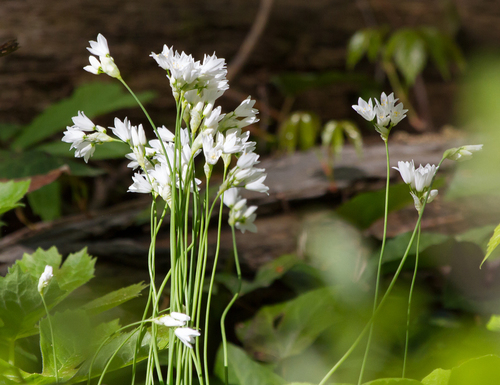
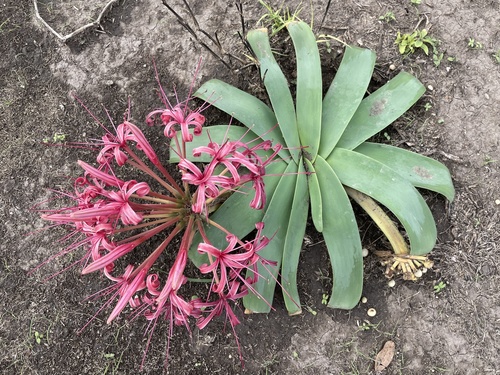
Allium canadense
L.
Wild garlic, Canadian garlic, Meadow Garlic, Olympic Onion, American wild garlic, Rose garlic, Tree onion
iNaturalist· cc-by-sa
(c) Mike B, some rights reserved (CC BY-SA), uploaded by Mike B
iNaturalist· cc-by
(c) aarongunnar, some rights reserved (CC BY), uploaded by aarongunnar
iNaturalist· cc-by-nc
(c) S. Queen, some rights reserved (CC BY-NC), uploaded by S. Queen
Summary
Source: WikipediaAllium canadense, the Canada onion, Canadian garlic, wild garlic, meadow garlic and wild onion is a perennial plant native to eastern North America from Texas to Florida to New Brunswick to Montana. The species is also cultivated in other regions as an ornamental and as a garden culinary herb. The plant is also reportedly naturalized in Cuba.
Description
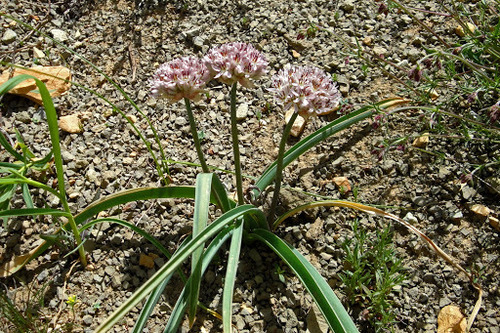
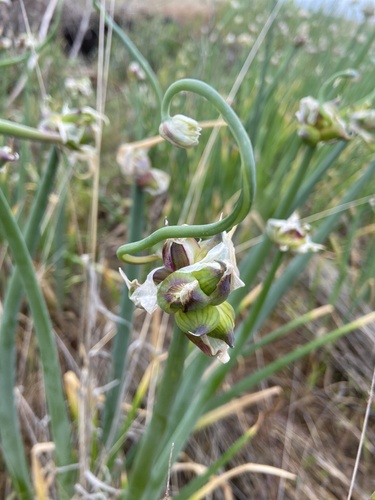
An onion family plant. A bulb plant. It grows to 45 cm tall and spreads to 20 cm wide. The bulb is up to 30 mm wide. There are 3 or 4 leaves to each bulb. The flowers are bell-shaped and pink or white. They are in round compact clusters. These can be 2.5-4 cm across. There can be one or more bulbils in the flower head.
Edible Uses
The bulb can be eaten raw or cooked — used as a vegetable, a flavouring in soups and stews, or pickled. It grows up to 30mm in diameter and has a crisp, mild, pleasant flavour. It has been described as both a leek substitute and a garlic substitute depending on the source. Leaves are eaten raw or cooked and have a delicious mild flavour available from early spring through autumn; they work well in salads, as cooked greens, or as a flavouring. Flowers are eaten raw and have a slightly stronger flavour than the leaves, intensifying as seeds begin to form — suitable as a garnish or flavouring in salads. Some forms produce top-setting bulbils, which make an excellent onion-flavoured pickle said to be superior in flavour to other pickled onions.
Traditional Uses
The bulbs are eaten raw or cooked. The leaves are eaten raw or cooked. They need to be picked before the flower stalk appears. The flowers are used raw or to flavour salads. Some forms have bulbils which are pickled.
Medicinal Uses
The plant is antiasthmatic, carminative, cathartic, diuretic, expectorant, and stimulant. A tincture is used to prevent worms and colic in children and as a remedy for croup. Like other members of this genus, it is a healthy dietary addition — it contains sulphur compounds that give it its onion flavour, and regular consumption helps reduce blood cholesterol, tones the digestive system, and supports circulatory health.
Known Hazards
Although no individual reports regarding this species have been seen, there have been cases of poisoning caused by the consumption, in large quantities and by some mammals, of certain members of this genus. Dogs seem to be particularly susceptible.
Distribution
It grows naturally in North America from New Brunswick to Minnesota, south to Florida and Colorado in low woods, thickets and meadows. It is often in dry locations. It suits hardiness zones 3-9.
Where It Grows
Australia, Canada, Cuba, North America, USA, West Indies,
Cultivation
Prefers a sunny position in a light well-drained soil. A moisture loving plant according to another report. The bulbs should be planted fairly deeply. Bulbs grow to a good size under cultivation. Some forms of this species produce many bulbils and are considered to be a pernicious weed in some areas of America, there is some risk that they could spread aggressively in Britain. A. canadense mobilense. (Reg.)F.M.Ownb. is a form that does not produce bulbils and is much better behaved. Grows well with most plants, especially roses, carrots, beet and chamomile, but it inhibits the growth of legumes. This plant is a bad companion for alfalfa, each species negatively affecting the other. Members of this genus are rarely if ever troubled by browsing deer.
Propagation
Sow seed in spring in a cold frame. Prick seedlings into individual pots when large enough to handle — three plants per pot will build clumps more quickly. Grow on in a greenhouse through at least the first winter, then plant out in spring once growing vigorously and large enough. Division in spring is very easy; plants can be divided at any point during the growing season and divisions planted straight into their permanent positions if needed. Bulbils can be planted in situ when ripe.
Other Uses
The plant juice acts as a moth repellent. The whole plant is said to repel insects and moles. It can also be rubbed directly onto exposed skin to protect against insect bites and the bites of scorpions, lizards, and similar creatures.
Notes
There are about 300-700 Allium species. Most species of Allium are edible (Flora of China). All alliums are edible but they may not all be worth eating! They have also been put in the family Alliaceae.
Synonyms
References (17)
- Beckstrom-Sternberg, Stephen M., and James A. Duke. "The Foodplant Database." http://probe.nalusda.gov:8300/cgi-bin/browse/foodplantdb.(ACEDB version 4.0 - data version July 1994)
- Bircher, A. G. & Bircher, W. H., 2000, Encyclopedia of Fruit Trees and Edible Flowering Plants in Egypt and the Subtropics. AUC Press. p 19
- Elias, T.S. & Dykeman P.A., 1990, Edible Wild Plants. A North American Field guide. Sterling, New York p 61
- Esperanca, M. J., 1988. Surviving in the wild. A glance at the wild plants and their uses. Vol. 2. p 328
- Facciola, S., 1998, Cornucopia 2: a Source Book of Edible Plants. Kampong Publications, p 5
Show all 17 references Hide references
- Hedrick, U.P., 1919, (Ed.), Sturtevant's edible plants of the world. p 33
- Kiple, K.F. & Ornelas, K.C., (eds), 2000, The Cambridge World History of Food. CUP p 1890
- Lim, T. K., 2015, Edible Medicinal and Non Medicinal Plants. Volume 9, Modified Stems, Roots, Bulbs. Springer p 3
- Loughmiller, C & L., 1985, Texas Wildflowers. A Field Guide. University of Texas, Austin. p 143
- MacKinnon, A., et al, 2009, Edible & Medicinal Plants of Canada. Lone Pine. p 192
- Seidemann J., 2005, World Spice Plants. Economic Usage, Botany, Taxonomy. Springer. p 16
- Small, E., 2009, Top 100 Food Plants. National Research Council of Canada. p 253
- Sp. pl. 2:1195. 1753
- Wiersema, J. H. & Leon, B., 2013, World Economic Plants. A Standard Reference CRC Press. 2nd Ed. p 33
- Wild Edible Plants of the Whitmire Wildflower Garden. Missouri Botanical Gardens.
- Woodward, P., 1996, Garlic and Friends. The History, Growth and Use of Edible Alliums. Hyland House. p 192
- World Checklist of Useful Plant Species 2020. Royal Botanic Gardens, Kew