Allium tenuissimum
L.
iNaturalist· cc-by-nc
(c) Шильников Дмитрий Сергеевич, some rights reserved (CC BY-NC), uploaded by Шильников Дмитрий Сергеевич
iNaturalist· cc-by-nc
(c) Nyambayar Batbayar, some rights reserved (CC BY-NC)
iNaturalist· cc-by-nc
(c) Nyambayar Batbayar, some rights reserved (CC BY-NC)
Summary
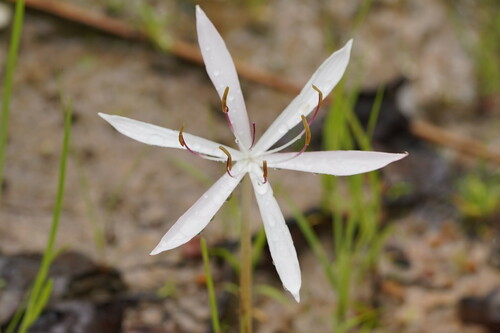
Source: WikipediaAllium tenuissimum is an Asian species of wild onion native to Mongolia, Asiatic Russia, Korea, Kazakhstan and China. Allium tenuissimum produces a cluster of small, narrow bulbs. Scapes are up to 50 cm tall. Leaves are tubular, shorter than the scapes, about 10 mm in diameter. Flowers are white or pink with a narrow red midvein along each of the tepals. Varieties Allium tenuissimum var. nalinicum S.Chen - Inner Mongolia Allium tenuissimum var. tenuissimum - most of specific range formerly included Allium tenuissimum var. anisopodium, now called Allium anisopodium Allium tenuissimum f. zimmermannianum, now called Allium anisopodium var. zimmermannianum
Description
A herb. It has a cluster of bulbs. The leaves are 0.5-1 mm wide. The stalk is 10-35 cm long.
This description is brief — help expand it
Edible Uses
The leaves are eaten.
Distribution
It is a temperate plant. It grows on slopes and sandy places from near sea level to 2,000 m above sea level. It grows in Inner Mongolia in China. In Sichuan.
Where It Grows
Asia, Central Asia, China, Kazakhstan, Mongolia, Russia,
Synonyms
References (2)
- Urgamal, M., et al, 2014, Conspectus of the Vascular Plants of Mongolia. Mongolia Academy of Sciences Institute of Botany and National University of Mongolia Department of Biology. p 48
- Wujisguleng, W., & Khasbagen. K., 2010, An integrated assessment of wild vegetable resources in Inner Mongolian Autonomous Region, China. Journal of Ethnobiology and Ethnomedicine 6:34