Gnaphalium affine
D. Don
Chinese cudweed, Cotton weed
iNaturalist· cc0
no rights reserved
iNaturalist· cc0
no rights reserved
iNaturalist· cc-by-nc
(c) 黃淑真, some rights reserved (CC BY-NC)
Summary
Source: WikipediaGnaphalium affine is a biennial herb reaching 0.3 m in height. Hermaphroditic flowers are insect-pollinated. It grows well in light sandy or medium loamy well-drained soils with mildly acidic to mildly alkaline pH. The plant tolerates semi-shade or full sun and adapts to both dry and moist soil conditions.
Description
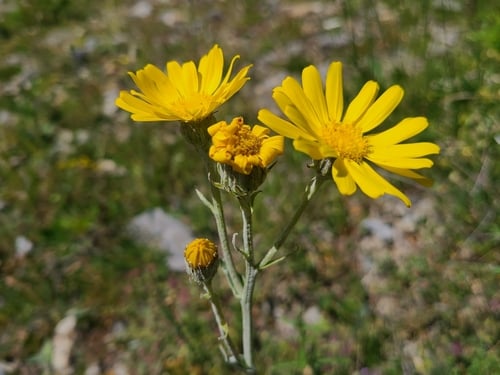
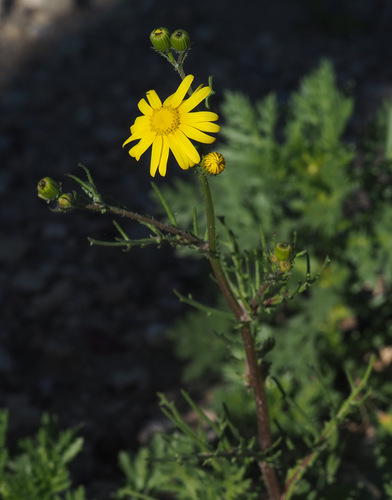
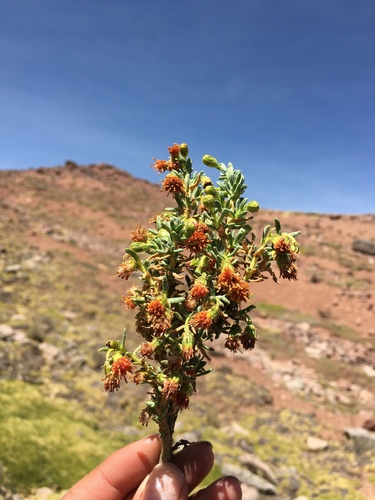
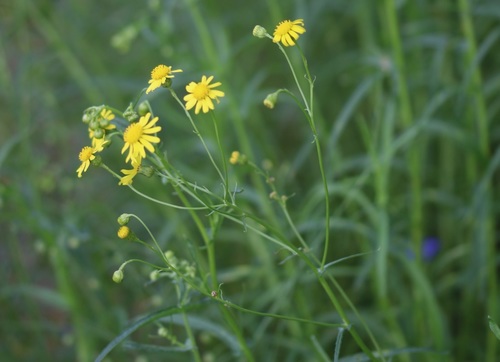
A herb. It grows 10-15 cm high. The plant takes 2 years to mature. There are small white hairs over the plant. The leaves are white long and narrow. They are 2-6 cm long by 3-10 mm wide. Leaves fall off after the flowers develop. The male and female flowers are in separate clusters. They are yellow. The fruit are oval. Probably now Laphangium affine (D. Don) Tzvelev
Edible Uses
The leaves are used in rice dumplings. The plant contains a large amount of carotene.
Traditional Uses
The young shoots are gathered before flowering and ground and mixed with rice flour then seasoned and used for a pastry. The leaves are also eaten raw or cooked.
Medicinal Uses
The whole plant is antiperiodic, antitussive, expectorant, and febrifuge. A decoction is used to treat influenza, sore throat, productive coughing, rheumatoid arthralgia, traumatic injuries, leucorrhoea, seminal emissions, hives, and weeping pruritis of the skin.
Distribution
It grows in warm temperate and subtropical places. It grows in open waste areas and along roads. In Yunnan. In Sichuan.
Where It Grows
Asia, China, Himalayas, India, Indochina, Japan, Korea, Myanmar, Nepal, Northeastern India, SE Asia, Tibet,
Cultivation
We have very little information on this species but it should succeed as a spring-sown annual in Britain. The following notes are based on the general needs of the genus. Requires a well-drained soil in a sunny position.
Propagation
Sow seed in late spring directly in situ, covering only just barely.
Other Uses
The woolly hairs of the dried leaves can be used as a tinder.
Other Information
Leaves are sold in markets.
Notes
There are about 200 Gnaphalium species. It is used in medicine.
Synonyms
Also Known As
A mi sha chu, Buki phool-yellow, Diqmevq, Hahako-Gusa, Jung Mu, Paaput, Qingmincal
References (15)
- Chen, B. & Qiu, Z., Consumer's Attitudes towards Edible Wild Plants, Ishikawa Prefecture, Japan. p 23 www.hindawi.com/journals/ijfr/aip/872413.pdf
- Hani Medicine of Xishuangbanna, 1999, p 215
- Hu, Shiu-ying, 2005, Food Plants of China. The Chinese University Press. p 730
- Hui, Y. H., Handbook of Food Science, Technology, and Engineering. Volume 2. Table 98:8(As Cnaphalium)
- Hwang, H., et al, 2013, A Study on the Flora of 15 Islands in the Western Sea of Jeollanamdo Province, Korea. Journal of Asia-Pacific Biodiversity Vol. 6, No. 2 281-310
Show all 15 references Hide references
- Hwang, HS, et al, 2014, Distribution characteristics of plant in the Ungseokbong Mountain, Gyeongsangnam-do, Korea. Journal of Asia-Pacific Biodiversity. 7(2014) e164-e178
- Ju, Y., et al, 2013, Eating from the wild: diversity of wild edible plants used by Tibetans in Shangri-la region, Yunnan, China, Journal of Ethnobiology and Ethno medicine 9:28
- Li, D. et al, 2017, Ethnobotanical survey of herbal tea plants from the traditional markets in Chaoshan, China. Journal of Ethnopharmacology. 205 (2017) 195-206
- Liu, Yi-tao, & Long, Chun-Lin, 2002, Studies on Edible Flowers Consumed by Ethnic Groups in Yunnan. Acta Botanica Yunnanica. 24(1):41-56
- Luo, B., et al, 2019, Wild edible plants collected by Hani from terraced rice paddy agroecosystem in Honghe Prefecture, Yunnan, China. Journal of Ethnobiology and Ethnomedicine 15:56
- Plants for a Future database, The Field, Penpol, Lostwithiel, Cornwall, PL22 0NG, UK. http://www.scs.leeds.ac.uk/pfaf/
- Prodr. fl. nepal. 173. 1825
- Taram, M., et al, 2018, Wild Food Plant Resources of Komkar Adi Tribe of Upper Siang District in Arunachal Pradesh, India. Bulletin of Arunachal Forest Research, Vol. 33(2), 27-35
- Wang, J. et al, 2013, A Study on the Utilization of Wild Plants for Food in Liangshan Yi Autonomous Prefecture. Plant Diversity and Resources. 35(4): 416-471
- Xu, You-Kai, et al, 2004, Wild Vegetable Resources and Market Survey in Xishuangbanna, Southwest China. Economic Botany. 58(4): 647-667.