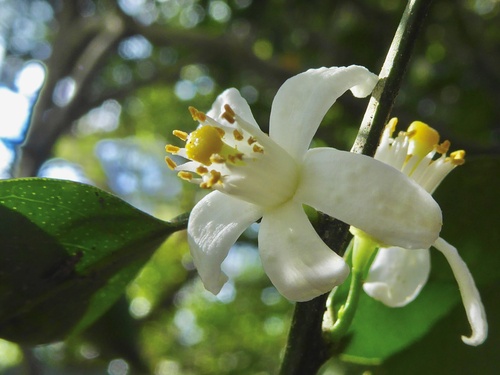
Glycosmis pentaphylla
(Retz.) DC.
Orangeberry, Pink Lime
iNaturalist· cc-by-nc-nd
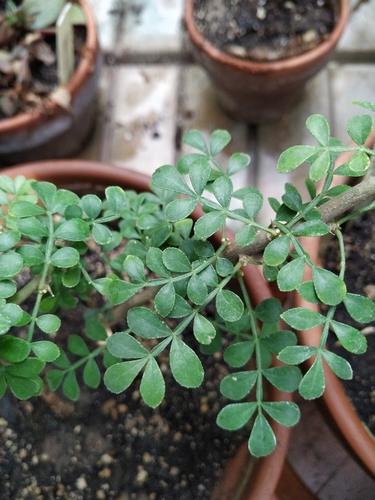
(c) Subhajit Roy, some rights reserved (CC BY-NC-ND), uploaded by Subhajit Roy
iNaturalist· cc-by-nc
(c) Nirma Buthsarani, some rights reserved (CC BY-NC)
iNaturalist· cc-by-nc
(c) Nirma Buthsarani, some rights reserved (CC BY-NC)
Summary
Source: WikipediaGlycosmis pentaphylla is a species of flowering plant in the family Rutaceae, known commonly as orangeberry and gin berry. It occurs in Southeast Asia and northern Australia. It is cultivated for its edible pink fruits. In temperate zones, it can be cultivated indoors as a houseplant.
Description
A spineless shrub or tree. It grows 2-6 m tall and spreads 1-3 m wide. The young shoots are bright green. The leaves are 10-18 cm long. The leaves are compound with 1 to 5 leaflets. The leaflets are 6-12 cm long by 3-4 cm wide. The edges are entire and they are arranged alternately. Leaflets taper to the tip. The flowers are small in short narrow irregular flower arrangements in the axils of leaves. The flowers are 0.6 cm wide and white. They have a scent. The fruit is round and fleshy and is a 1 to 3 seeded berry. The fruit is 0.8-1 cm wide. The fruit are edible.
Edible Uses
Fruit - raw. Sweet and fleshy. The small, translucent pink fruits have a juicy flesh and a sort of spicy, gin-like flavour. The reddish, sub-globose fruit is 8 - 10mm in diameter.
Traditional Uses
Asia, Australia, Bangladesh, Bhutan, Cambodia, Central America, China, Cuba, Himalayas, India, Indochina, Indonesia, Jamaica, Laos, Malaysia, Myanmar, Nepal, Northeastern India, Pacific, Pakistan, Philippines, SE Asia, Sri Lanka, Thailand, Vietnam, West Indies,
Medicinal Uses
Traditional uses are documented across Asia, Australia, and the Pacific regions.
Distribution
It is a tropical plant. Plants need a shady or protected position. They need a well drained soil. They occur in the Philippines from Palawan and also in Mindanao in secondary forests at low and medium altitudes. In China it grows between 600-1,200 m above sea level. Adelaide Botanical Gardens. In Yunnan.
Where It Grows
Hillside and valley woods at elevations of 600 - 1,200 metres in southwest China. Prefers relatively dry habitats at elevations from sea-level up to 1,000 metres, and is commonly encountered in secondary thickets.
Cultivation
It is a cultivated plant. The fruit are popular.
Propagation
Seed - Cuttings of half-ripe wood.
Other Uses
Alkaloid extracts of the roots have been shown to inhibit crown gall tumours produced by Agrobacterium tumefaciens in a potato disk bioassay. The roots have also been shown to inhibit the growth and survival of larvae of the citrus root weevil, Diaprepes abbreviatus, when incorporated in their diet. A petroleum ether extract of the root has been shown to be lethal to the larvae of Culex quinquefasciatus, Culex sitiens, Aedes aegypti and Anopheles stephensi. Leaf extracts have shown a high degree of nematicidal action against the adults and larvae of the nematode Radopholus similis; as well as larvicidal activity against the mosquito Culex quinquefasciatus.. The bio-active compound responsible for this activity was identified as the quinazolone alkaloid arborine. The pale wood is sometimes used for tool handles.
Production
A food plant of the Capaneus butterfly. There are about 60 Glycosmis species.
Nutrition
| Part | Moisture | kJ | kcal | Protein | Vit A | Vit C | Iron | Zinc |
|---|---|---|---|---|---|---|---|---|
| Fruit | 61.7 | — | — | 1.4 | — | 15.8 | 32.3 | 1.5 |
Synonyms
Also Known As
Anam, Arai bwlai, As-sera, Ash-sheora, Ashshoura, Ashvashakota, Ban-nimbu, Brem beri, Chauladhua, Chowaldua, Datmajani, Dieng-soh-sning, Girgitti, Golugu, Gongipadu, Gurodagida, Hengena-poka, Hengnapoka, Jamaica mandarin orange, Kirmira, Kula pannai, Kuttipanal, Linauin, Maik-talon, Manikyan, Matkhila, Mauk, Melaekulukki, Naranjita de cristal, Obok, Panal, Panam palam, Panchi, Panni-chedi, Pathalagarudi, Phlaing, Phleang, Potail, Rum beri, Taw-shauk, Vananimbuka
References (41)
- Ajesh, T. P., et al, 2012, Ethnobotanical Documentation of Wild Edible Fruits used by Muthuvan Tribes of Idukki, Kerala-India. International Journal of Pharma and Bio Sciences 3(3): 479-487
- Ambasta, S.P. (Ed.), 2000, The Useful Plants of India. CSIR India. p 240
- Arinathan, V., et al, 2007, Wild edibles used by Palliyars of the western Ghats, Tamil Nadu. Indian Journal of Traditional Knowledge. 6(1) pp 163-168
- Baishya, S. Kr., et al, 2013, Survey of Wild Edible Fruits of Dhubri District, Assam, India. Plant Archives Vol 13 (1): 155-158 (As Glycosmis arborea)
- Bohra, N., et al, 2017, Ethnobotany of wild edible plants traditionally used by the local people in the Ramnagar regions from Nainital District, Uttarakhand, India. Biolife 5(1): 12-19
Show all 41 references Hide references
- Binu, S., 2010, Wild edible plants by the tribals in Pathanamthitta district, Kerala. Indian Journal of Traditional Knowledge. 9(2): 309-312
- Cengel, D. J. & Dany, C., (Eds), 2016, Integrating Forest Biodiversity Resource Management and Sustainable Community Livelihood Development in the Preah Vihear Protected Forest. International Tropical Timber Organization p 121
- Deb, D., et al, 2013, Wild Edible Plants and Their Utilization in Traditional Recipes of Tripura, Northeast India. Advances in Biological Research 7(5):203-211 (As Glycosmis arborea)
- Dhyani, S.K., & Sharma, R.V., 1987, Exploration of Socio-economic plant resources of Vyasi Valley in Tehri Garwhal. J. Econ. Tax. Bot. Vol. 9 No. 2 pp 299-310
- Elliot, W.R., & Jones, D.L., 1992, Encyclopedia of Australian Plants suitable for cultivation. Vol 4. Lothian. p 372
- Facciola, S., 1998, Cornucopia 2: a Source Book of Edible Plants. Kampong Publications, p 221
- Hedrick, U.P., 1919, (Ed.), Sturtevant's edible plants of the world. p 330
- Hibbert, M., 2002, The Aussie Plant Finder 2002, Florilegium. p 112
- Jadhav, R., et al, 2015, Forest Foods of Northern Western Ghats: Mode of Consumption, Nutrition and Availability. Asian Agri-History Vol. 19, No. 4: 293-317
- Jeeva, S., 2009, Horticultural potential of wild edible fruits used by the Khasi tribes of Meghalaya. Journal or Horticulture and Forestry Vol. 1(9) pp. 182-192
- Jones D, L, 1986, Ornamental Rainforest Plants in Australia, Reed Books, p 111, 340
- Jose, D. T. & Sasidharan, N., 2016, Checklist of wild edible plants of Aralam Wildlife sanctuary, Kerala, India. South Indian Journal Of Biological Sciences 2016; 2(1); 141‐144
- Kiran, K. C., et al, 2019, Diversity and Seasonal Availability of Potential Wild Edible Plants from Vidarbha Region of Maharashtra State, India. Int.J.Curr.Microbiol.App.Sci (2019) 8(2): 1434-1446
- Lazarides, M. & Hince, B., 1993, Handbook of Economic Plants of Australia, CSIRO. p 122
- Mahapatra, A. K., et al, 2012, Nutrient Analysis of some selected wild edible fruits of deciduous forests of India. Advance Journal of Food Science and Technology 4(1):15-21
- Martin, F. W., et al, 1987, Perennial Edible Fruits of the Tropics. USDA Handbook 642 p 74
- Martin, M.A., 1971, Introduction L'Ethnobotanique du Cambodge. Centre National de la Recherche Scientifique. Paris.
- Miguel, E., et al, 1989, A checklist of the cultivated plants of Cuba. Kulturpflanze 37. 1989, 211-357
- Misra S. & Misra M., 2016, Ethnobotanical and Nutritional Evaluation of Some Edible Fruit Plants of Southern Odisha, India. International Journal of Advances in Agricultural Science and Technology, Vol.3 Issue.1, March- 2016, pg. 1-30
- Misra, S., 2020, Survey of edible plants for human consumption in south Odisha, India. Journal of Emerging Technologies and Innovative Research (JETIR) Vol. 7, Issue 12 p 278
- Monsalud, M.R., Tongacan, A.L., Lopez, F.R., & Lagrimas, M.Q., 1966, Edible Wild Plants in Philippine Forests. Philippine Journal of Science. p 540
- Pasha, M. K. & Uddin, S. B., 2019, Minor Edible Fruits of Bangladesh. Bangladesh J. Plant Taxon. 26(2): 299–313
- Patiri, B. & Borah, A., 2007, Wild Edible Plants of Assam. Geethaki Publishers. p 22 (As Glycosmis arborea (Roxb.) Corr.
- Prodr. 1:538. 1824
- PROSEA (Plant Resources of South East Asia) handbook, Volume 12 (2), 2001,
- Ramachandran, V. S., 2007, Wild edible plants of the Anamalais, Coimbatore district, western Ghats, Tamil Nadu. Indian Journal or Traditional Knowledge. 6(1) pp 173-176
- Rasingam, L., 2012, Ethnobotanical studies on the wild edible plants of Irula tribes of Pillur Valley, Coimbatore district, Tamil Nadu, India. Asian Pacific Journal of Tropical Biomedicine. (2012) S1493-S1497
- Recher, P, 2001, Fruit Spirit Botanical Gardens Plant Index. www.nrg.com.au/~recher/ seedlist.html p 2
- Sasi, R. & Rajendran, A., 2012, Diversity of Wild Fruits in Nilgiri Hills of the Southern Western Ghats - Ethnobotanical Aspects. IJABPT, 3(1) p 82-87
- Sawian, J. T., et al, 2007, Wild edible plants of Meghalaya, North-east India. Natural Product Radiance Vol. 6(5): p 417
- Sukarya, D. G., (Ed.) 2013, 3,500 Plant Species of the Botanic Gardens of Indonesia. LIPI p 634
- Tanaka, Y. & Van Ke, N., 2007, Edible Wild Plants of Vietnam. Orchid Press. p 131
- Townsend, K., 1994, Across the Top. Gardening with Australian Plants in the tropics. Society for Growing Australian Plants, Townsville Branch Inc. p 226
- Upreti, K., et al, 2010, Diversity and Distribution of Wild Edible Fruit Plants of Uttarakhand. Bioversity Potentials of the Himalaya. p 172 (As Glycosmis arborea)
- Valvi, S. R. & Rathod, 2011, Mineral composition of some wild edible fruits from Kolhapur District. International Journal or Applied Biology and Pharmaceutical Technology. 2(1): 392
- Williams, K.A.W., 1999, Native Plants of Queensland Volume 4. Keith A.W. Williams North Ipswich, Australia. p 204