Geranium solanderi
Carolin
Native carrot, Austral Crane’s Bill
iNaturalist· cc-by-nc
(c) goomburrup_aboriginal_corp, some rights reserved (CC BY-NC)
iNaturalist· cc0
no rights reserved, uploaded by Peter de Lange
iNaturalist· cc-by-nc
(c) James Bailey, some rights reserved (CC BY-NC), uploaded by James Bailey
Summary
Source: WikipediaGeranium solanderi (common names - native geranium, Australian cranesbill, Austral cranesbill, Cut-leaf cranesbill, native carrot, and hairy geranium) is a species of plant in the family Geraniaceae. It is native to Australia (New South Wales, Queensland, Victoria, South Australia, Western Australia, and Tasmania), and to New Zealand. It was first described in 1800 by Daniel Solander as Geranium pilosum, from a specimen found in New Zealand. However, the name was illegal (having already been used in 1787 by Antonio José Cavanilles) and it was renamed in 1965 by Roger Charles Carolin, with the species epithet, solanderi, honouring Solander.
Description
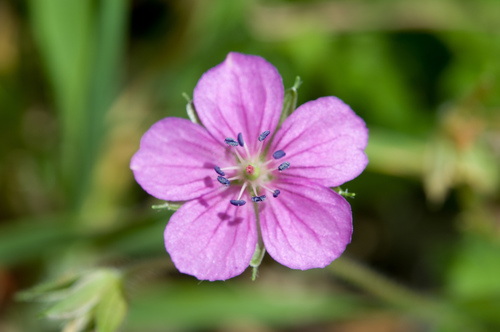
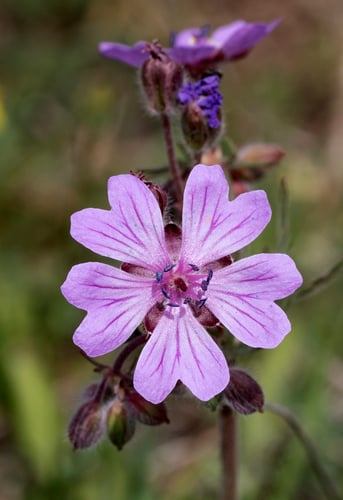
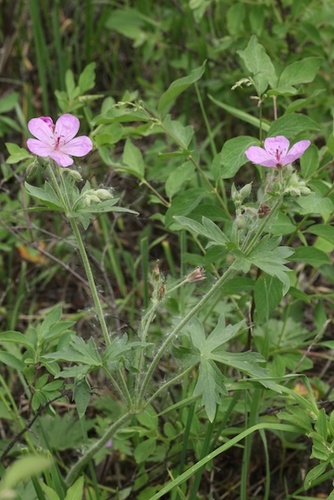
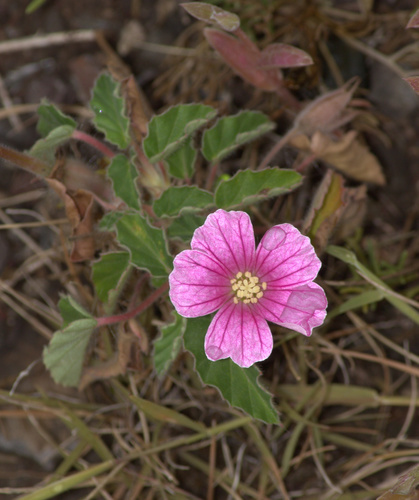
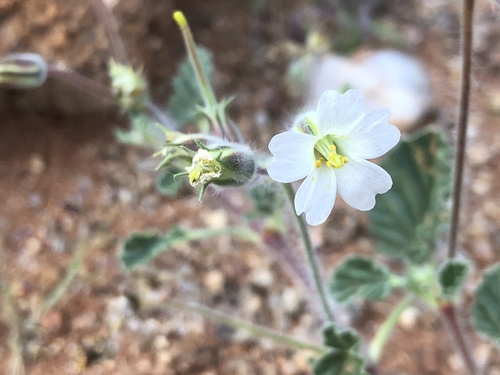
A herb which keeps growing from year to year. It can lie along the ground or be slightly upright. It can be 40 cm high. The stems are coarsely hairy. They are 50 cm long and arise from a swollen taproot. They can root at the nodes. The leaves are 1-3 cm long and 2-5 cm across. They are divided into 5-10 lobes. Each lobe is again divided or toothed near the tip. The leaves at the base are larger. The flowers are pink and spreading. They are 1.5 cm across. There are 5 overlapping petals and the centre is more pale. They occur in pairs on slender stalks 5 cm long. The fruit is beaked and 2.5 cm long.
Edible Uses
The carrot-shaped root can be eaten raw or cooked, but is starchy, slightly bitter, and not very palatable. A form with turnip-shaped roots exists and may prove more agreeable to eat.
Traditional Uses
The root is pounded and eaten after roasting.
This uses section is brief — help expand it
Medicinal Uses
None known
Distribution
It is a temperate plant. It grows in open grassland. It grows in drier situations. It will grow on most soils except alkaline soils. It becomes a problem in permanently moist soils. Tasmania Herbarium.
Where It Grows
Australia, New Zealand*, Norfolk Island, Tasmania,
Cultivation
We have almost no information on this species and do not know if it will be hardy in this country. The following comments are based on the general needs of the species. Succeeds in any moderately fertile retentive soil in a sunny position. Tolerates a wide range of soil types. Members of this genus are rarely if ever troubled by browsing deer or rabbits.
Propagation
Sow seed in spring in a cold frame. Once seedlings are large enough to handle, prick them out into individual pots and plant out during summer. Divide clumps in spring or autumn — larger clumps can go directly into permanent positions, but smaller ones are best potted up and grown on in a cold frame until well rooted, then planted out in spring.
Other Uses
None known
Notes
There are about 300-400 Geranium species. They are mostly temperate.
Nutrition
| Part | Moisture | kJ | kcal | Protein | Vit A | Vit C | Iron | Zinc |
|---|---|---|---|---|---|---|---|---|
| TapRoot | 80.8 | 99 | 24 | 0.7 | — | — | — | 0.7 |
Synonyms
Also Known As
Kawurn-kallumbarrant, Kullumkulkeetch, Matua-kumara, Terrat
References (26)
- Cherikoff V. & Isaacs, J., The Bush Food Handbook. How to gather, grow, process and cook Australian Wild Foods. Ti Tree Press, Australia p 195
- Cronin, L., 1989, The Concise Australian Flora. Reed. p 93
- Crowe, A., 1997, A Field Guide to the Native Edible Plants of New Zealand. Penguin. p 86
- Dashorst, G.R.M., and Jessop, J.P., 1998, Plants of the Adelaide Plains & Hills. Botanic Gardens of Adelaide and State Herbarium. p 92
- De Angelis, D., 2005, Aboriginal Plant Use of the Greater Melbourne Area. La Trobe University Environment Collective
Show all 26 references Hide references
- Elliot, W.R., & Jones, D.L., 1992, Encyclopedia of Australian Plants suitable for cultivation. Vol 4. Lothian. p 359 (Drawing)
- Flora of Australia Volume 49, Oceanic Islands 1, Australian Government Publishing Service, Canberra. (1994) p 259
- Gilfedder, L et al, 2003, The Nature of the Midlands. Midlands Bushweb. PO Box 156 Longford, Tasmania. p 110
- Gott, B & Conran, J., 1991, Victorian Koorie Plants. PO Box 666 Hamilton, Victoria 3300, Australia. p 23
- Greig, D., 1996, Flowering Natives for Home Gardens. Angus & Robertson. p 185
- Grieg, D., 2002, A photographic guide to Wildflowers of South-eastern Australia. New Holland. p 47
- Harris, S., Buchanan, A., Connolly, A., 2001, One Hundred Islands: The Flora of the Outer Furneaux. Tas Govt. p 160
- Hibbert, M., 2002, The Aussie Plant Finder 2002, Florilegium. p 110
- Hunter, J. T. & Sheringham, P., 2006, Vegetation and Floristics of Melville Range Nature Reserve. A Report to the New South Wales Parks and Wildlife Service. p 174
- Lazarides, M. & Hince, B., 1993, Handbook of Economic Plants of Australia, CSIRO. p 120
- Lim, T. K., 2015, Edible Medicinal and Non Medicinal Plants. Volume 9, Modified Stems, Roots, Bulbs. Springer p 44
- Morley, B.D., & Toelken, H.R., (Eds), 1983, Flowering Plants in Australia. Rigby. p 211
- Paczkowska, G. & Chapman, A.R., 2000, The Western Australian Flora. A Descriptive Catalogue. Western Australian Herbarium. p 252
- Plants for a Future database, The Field, Penpol, Lostwithiel, Cornwall, PL22 0NG, UK. http://www.scs.leeds.ac.uk/pfaf/
- Proc. Linn. Soc. New South Wales 89:350. 1965
- RIRDC, 2010, New Root Vegetables fo the Native Food Industry, Australian Government RIRDC Publication 9/161
- Ryan, M. (Ed.), 2003, Wild Plants of Greater Brisbane. Queensland Museum. p 200
- Tasmanian Herbarium Vascular Plants list p 34
- Williams A. & Sides, T., 2008, Wiradjuri Plant Use in the Murrumbidgee Catchment. Murrumbidgee Catchment Management Authority. Wagga Wagga, p 79
- Woolmore, E et al, 2002, King Island Flora: A Field Guide. p 52
- www.ceres.org.au/bushfoodcatalogue