Gaylussacia dumosa
(Andrews.) Torr. & A. Gray
Dwarf huckleberry
iNaturalist· cc-by-nc-sa
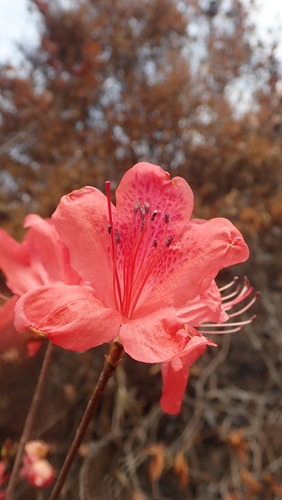
(c) Mary Keim, some rights reserved (CC BY-NC-SA)
iNaturalist· cc-by
(c) Jay Horn, some rights reserved (CC BY)
iNaturalist· cc-by
(c) Jay Horn, some rights reserved (CC BY)
Summary
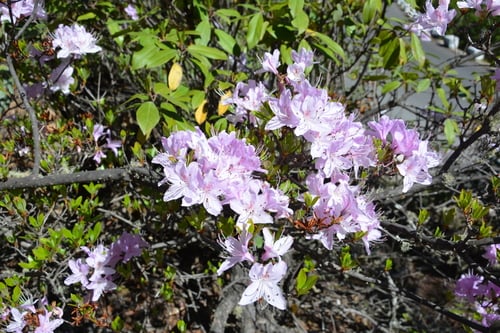
Source: WikipediaGaylussacia dumosa is a species of flowering plant in the heath family known by the common names dwarf huckleberry, bush huckleberry, and gopherberry. It is native to eastern North America from Newfoundland to Louisiana and Florida. It occurs along the coastal plain and in the mountains. This shrub branches from the base and grows erect to a maximum height around 75 centimeters (30 inches). It grows from a rhizome. The young twigs are coated in curly hairs. The deciduous leaves are oval, leathery, and glandular. The inflorescence is a raceme of bell-shaped flowers. The fruit is a berry. The plant reproduces by seed and by sprouting from the rhizome. It sprouts readily after episodes of wildfire. This plant grows in dry or moist habitat types. It can be found in forests, pine barrens, pine flatwoods, bogs, and bays. It grows alongside plants such as eastern red cedar (Juniperus virginiana), tamarack (Larix laricina), redbay (Persea borbonia), sweetbay (Magnolia virginiana), flowering dogwood (Cornus florida), dangleberry (Gaylussacia frondosa), yaupon (Ilex vomitoria), fetterbush (Leucothoe racemosa), and blueberry (Vaccinium spp.). The epithet 'dumosa' means bushy or shrubby.
Description
A dwarf suckering shrub. It is a low plant 30-50 cm high. The flowers are in long clusters and white. They contain both sexes but may be only partly self-fertile. For good fruit set it is best to plant more than one plant. The fruit are 5 mm across.
Edible Uses
The fruit can be eaten raw or cooked and used as a pie filling. It is described as juicy and deliciously spicy by some sources, though others consider it watery and insipid — it is commonly eaten but not especially valued. The fruit is about 8mm in diameter.
Traditional Uses
The fruit are spicy and eaten raw. They can be used for pie fillings and muffins.
This uses section is brief — help expand it
Medicinal Uses
None known.
Distribution
It is a temperate plant. It can tolerate wetter soils.
Where It Grows
North America*, USA,
Propagation
Seed is best sown in autumn in a cold frame. Stored seed requires 1 month of warm stratification followed by 2 months cold. Once large enough to handle, prick seedlings out into individual pots of lime-free compost and grow on in light shade in a greenhouse or cold frame for at least their first winter. Plant out into permanent positions in late spring or early summer when at least 15cm tall. Cuttings of half-ripe wood can be taken in July/August in a frame. Layering and division in spring are also suitable methods.
Other Uses
None known.
Notes
There are about 42 Gaylussacia species in tropical America.
Synonyms
References (9)
- Beckstrom-Sternberg, Stephen M., and James A. Duke. "The Foodplant Database." http://probe.nalusda.gov:8300/cgi-bin/browse/foodplantdb.(ACEDB version 4.0 - data version July 1994)
- Elias, T.S. & Dykeman P.A., 1990, Edible Wild Plants. A North American Field guide. Sterling, New York p 167
- Facciola, S., 1998, Cornucopia 2: a Source Book of Edible Plants. Kampong Publications, p 96
- Glowinski, L., 1999, The Complete Book of Fruit Growing in Australia. Lothian. p 166
- A. Gray, Manual 259. 1848
Show all 9 references Hide references
- John, L., & Stevenson, V., 1979, The Complete Book of Fruit. Angus & Robertson p 286
- Kermath, B. M., et al, 2014, Food Plants in the Americas: A survey of the domesticated, cultivated and wild plants used for Human food in North, Central and South America and the Caribbean. On line draft. p 386
- Lyle, S., 2006, Discovering fruit and nuts. Land Links. p 222
- Plants for a Future database, The Field, Penpol, Lostwithiel, Cornwall, PL22 0NG, UK. http://www.scs.leeds.ac.uk/pfaf/