Gaylussacia brachycera
(Michx.) A.Gray
Box huckleberry
iNaturalist· pd
Mason Brock (Masebrock), no known copyright restrictions (public domain)
iNaturalist· cc-by-nc
(c) Joey Thompson, some rights reserved (CC BY-NC)
iNaturalist· cc-by-nc
(c) Sydney Penner, some rights reserved (CC BY-NC), uploaded by Sydney Penner
Summary
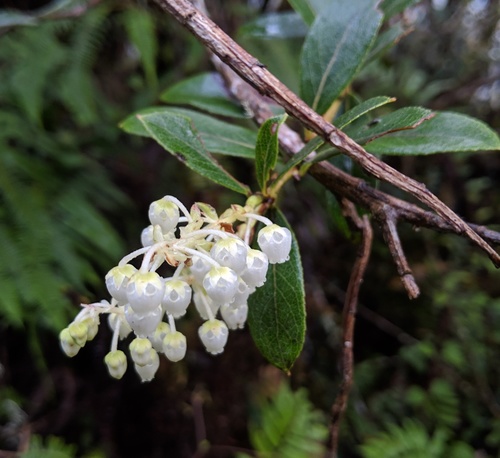
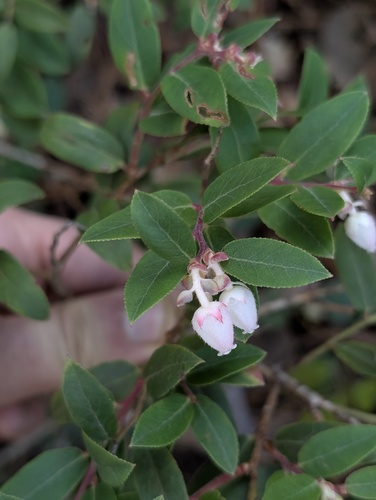
Source: WikipediaGaylussacia brachycera, commonly known as box huckleberry or box-leaved whortleberry, is a low North American shrub related to the blueberry and the other huckleberries. It is native to the east-central United States (Pennsylvania, Delaware, Maryland, Virginia, West Virginia, North Carolina, Kentucky, and Tennessee). Gaylussacia brachycera is easily distinguished from other members of its genus by its leaves: they resemble those of boxwood (hence its name) and lack the resin glands typical of huckleberries. Like its relatives, it bears white urn-shaped flowers in the early summer, which develop to blue, edible berries in late summer. It is mostly found in Appalachia; many of its stands there were known to natives, who picked and ate the berries, before botanists became aware of them in the 1920s. A relict species nearly exterminated by the last ice age, box huckleberry is self-sterile, and is found in isolated colonies which reproduce clonally by extending roots. One colony in Pennsylvania was once estimated to be as many as 13,000 years old; more recent estimates have an upper bound of about 8,000 years, which would make it the oldest woody plant east of the Rocky Mountains. Another colony in Pennsylvania, about 1,300 years old, has been protected by the Hoverter and Sholl Box Huckleberry Natural Area.
Description
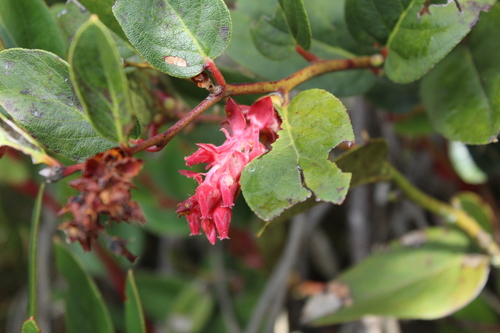
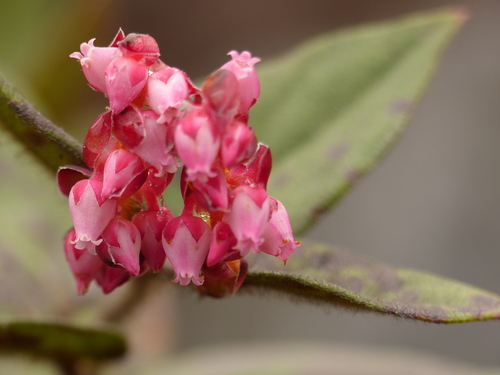
A small, spreading evergreen shrub. The branches often root along the ground. They form mounds and are 45 cm high but can spread very widely through the suckers. The leaves are leathery, oval and 25 mm long. They have shallow teeth. The flowers are urn shaped and are white with red tints. They are 6 mm long and hang in long clusters. The fruit are black and 12 mm wide.
Edible Uses
The fruit can be eaten raw or cooked, though it is not highly regarded — generally considered tasteless. The fruit is about 12mm in diameter.
Medicinal Uses
None known.
Distribution
It is a temperate plant. It suits hardiness zones 4-9.
Where It Grows
North America*, USA,
Propagation
Seed is best sown in autumn in a cold frame. Stored seed requires 1 month of warm stratification followed by 2 months cold. Once large enough to handle, prick seedlings out into individual pots of lime-free compost and grow on in light shade in a greenhouse or cold frame for at least their first winter. Plant out into permanent positions in late spring or early summer when at least 15cm tall. Cuttings of half-ripe wood can be taken in July/August in a frame. Layering and division in spring are also options.
Other Uses
This plant makes a good ground cover, spreading quite freely. Plants should be spaced about 30cm apart each way.
Production
It is slow growing. It can live for very long periods.
Notes
There are about 42 Gaylussacia species in tropical America.
References (8)
- Etherington, K., & Imwold, D., (Eds), 2001, Botanica's Trees & Shrubs. The illustrated A-Z of over 8500 trees and shrubs. Random House, Australia. p 344
- Glowinski, L., 1999, The Complete Book of Fruit Growing in Australia. Lothian. p 166
- Jackes, D. A., Edible Forest Gardens
- John, L., & Stevenson, V., 1979, The Complete Book of Fruit. Angus & Robertson p 286
- Kermath, B. M., et al, 2014, Food Plants in the Americas: A survey of the domesticated, cultivated and wild plants used for Human food in North, Central and South America and the Caribbean. On line draft. p 385
Show all 8 references Hide references
- Lyle, S., 2006, Discovering fruit and nuts. Land Links. p 222
- Mem. Amer. Acad. Arts ser. 2, 3:54. 1846
- Plants for a Future database, The Field, Penpol, Lostwithiel, Cornwall, PL22 0NG, UK. http://www.scs.leeds.ac.uk/pfaf/