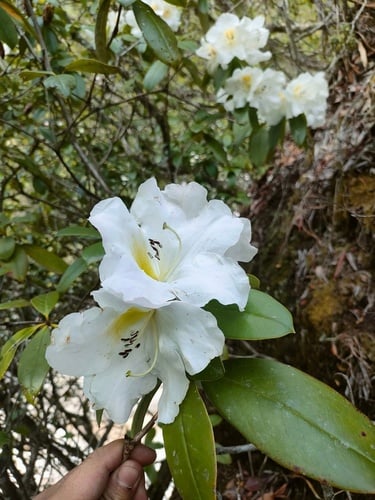
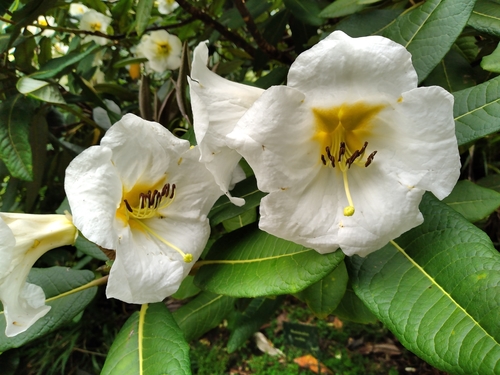
Gaultheria nummularioides
D. Don.
Coinwort snowberry
iNaturalist· cc-by-nc
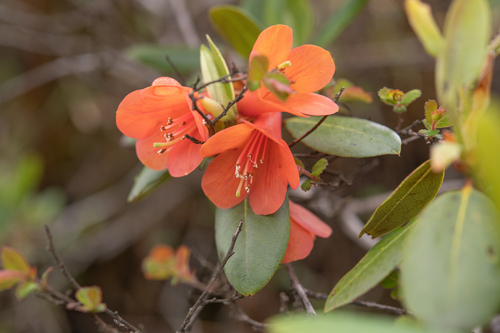
(c) Naufal Urfi Dhiya'ulhaq, some rights reserved (CC BY-NC), uploaded by Naufal Urfi Dhiya'ulhaq
iNaturalist· cc-by-nc
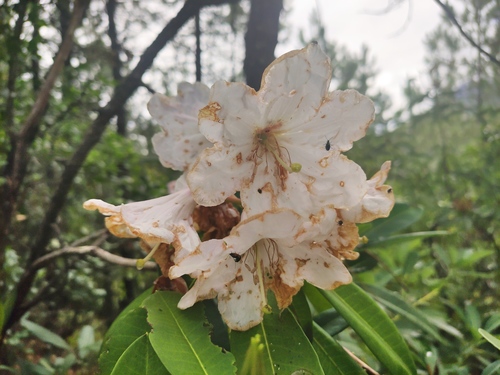
(c) Eva, some rights reserved (CC BY-NC)
iNaturalist· cc-by-nc
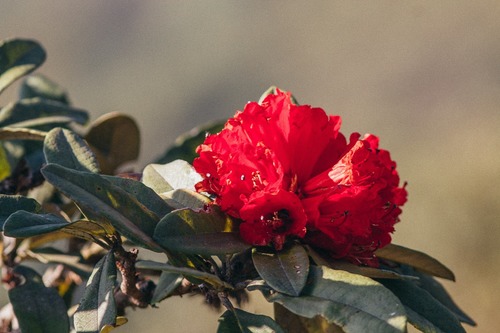
(c) Eva, some rights reserved (CC BY-NC)
Summary
Source: WikipediaGaultheria nummularioides is a species of plant in the family Ericaceae. It is distributed across India, Myanmar, Nepal, Bhutan, Indonesia, and Southwest China (Tibet, Yunnan, and Sichuan). The plant grows in areas between 1,700 and 3,000 m (5,600 and 9,800 ft) above sea level, and grows better on rocky mountainsides and weed tree forests. This species has been cultivated as an ornamental in Britain, the United States, and elsewhere for some decades.
Description
A shrub which lies along the ground. It develops into a hummock with its twigs woven together. It grows 5-40 cm long. The leaves have short stalks. They are alternate. They are 0.8-2 cm long by 0.5-2 cm wide. They are oval and with fine hairs underneath. The flowers occur singly. They are in the axils of leaves. Flowers are reddish or white. The fruit is blue-black and 6 mm long.
Edible Uses
The fruit can be eaten raw or cooked. It has a watery flavour and is quite tasty raw, though at about 8mm in diameter it is small and somewhat fiddly to harvest.
Traditional Uses
The ripe fruit are eaten raw. They are also dried for tea drinks.
This uses section is brief — help expand it
Medicinal Uses
None known.
Distribution
A tropical and subtropical plant. In Nepal they grow between 2100-4100 m altitude. It suits hardiness zones 9-10.
Where It Grows
Asia, Australia, Bangladesh, Bhutan, China, India, Himalayas, Indochina, Indonesia, Myanmar, Nepal, Northeastern India, Pakistan, SE Asia, Sikkim, Sri Lanka, Tibet,
Cultivation
Prefers a moist but not boggy humus rich soil in shade or semi-shade. A peat and moisture loving species, it requires a lime-free soil and a sheltered position. This species only tolerates light and short-lived frosts, so it is not very hardy in Britain. It can, however, be grown outdoors in the milder areas of the country. This species does not often fruit well in Britain. Our single plant flowered freely when less than 3 years old from seed, producing quite a few fruits. The bruised leaves have a distinct cedar-like aroma. The flowers are also aromatic. Plants in this genus are notably resistant to honey fungus.
Propagation
Seed requires cold stratification — pre-chill for 4–10 weeks, then surface sow in lime-free compost in a shady part of the greenhouse and keep moist. Germination is usually good, typically within 1–2 months at 20°C, but seedlings are prone to damping off. Water carefully, ensure good ventilation, and consider watering with a garlic infusion to reduce this risk. Prick out seedlings into individual pots when about 25mm tall and grow on in light shade in the greenhouse for at least their first winter. Plant out in late spring or early summer, providing frost protection in the first spring or two outdoors. Take cuttings of half-ripe wood 3–6cm long in July/August in a shaded frame; roots form in late summer or spring with a good success rate. For division, do so in spring just before new growth begins. 'Drop' plants 12 months earlier by digging them up and replanting deeper so branches are buried and can root — this works best in sandy soil. Pot up divisions and grow on in a lightly shaded greenhouse until established, then plant out in summer. Layering in September/October takes 12 months.
Other Uses
Makes a good ground cover for shady positions. This carpeting plant roots as it spreads and should be spaced about 60cm apart each way.
Production
In the Himalayas it flowers August to September and fruits October to February.
Notes
There are about 170 Gaultheria species.
Synonyms
Also Known As
Ban timala, Bhui ghangharu, Bibi phal, Kaali gedi, Kaligedi, Kalizar, MUssikane, Nobo, Phamanima, Pi-ga-la
References (11)
- Cundall, P., (ed.), 2004, Gardening Australia: flora: the gardener's bible. ABC Books. p 626
- Ding, X., 2021, Collection calendar: the diversity and local knowledge of wild edible plants used by Chenthang Sherpa people to treat seasonal food shortages in Tibet, China. Journal of Ethnobiology and Ethnomedicine 17:40
- Etherington, K., & Imwold, D., (Eds), 2001, Botanica's Trees & Shrubs. The illustrated A-Z of over 8500 trees and shrubs. Random House, Australia. p 343
- Panda, S., 2015, Diversity of the genus Gaultheria L. (Ericaceae) with special reference to the Eastern Himalayas of India, Nepal and Bhutan. In Hartmann, M. & J. Weipert: Biodiversität & Naturausstattung im Himalaya, Bd. V
- Plants for a Future database, The Field, Penpol, Lostwithiel, Cornwall, PL22 0NG, UK. http://www.scs.leeds.ac.uk/pfaf/
Show all 11 references Hide references
- Prodr. fl. nepal. 150. 1825
- Rawat, G.S., & Pangtey, Y.P.S., 1987, A Contribution to the Ethnobotany of Alpine Regions of Kumaon. J. Econ. Tax. Bot. Vol. 11 No. 1 pp 139-147
- Sleumer, 1967, Ericaceae, Flora Malesiana, Ser. 1 Vol. 6 (8) p 684
- Slocum, P.D. & Robinson, P., 1999, Water Gardening. Water Lilies and Lotuses. Timber Press. p 119
- Upreti, K., et al, 2010, Diversity and Distribution of Wild Edible Fruit Plants of Uttarakhand. Bioversity Potentials of the Himalaya. p 172
- World Checklist of Useful Plant Species 2020. Royal Botanic Gardens, Kew