Garuga pinnata
Roxb.
Garuga
iNaturalist· cc-by-sa
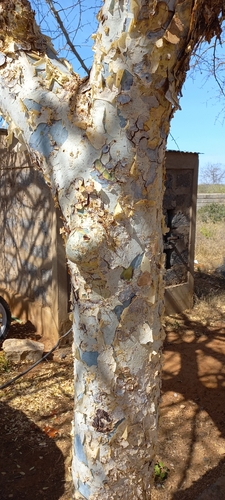
(c) J.M.Garg, some rights reserved (CC BY-SA)
iNaturalist· cc-by-sa
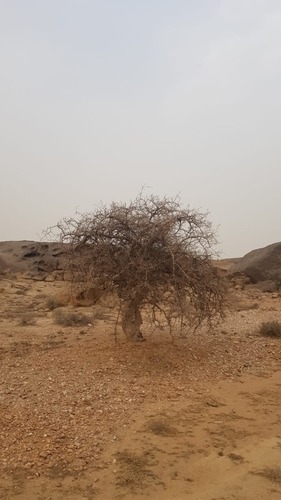
(c) J.M.Garg, some rights reserved (CC BY-SA)
iNaturalist· cc-by-nc
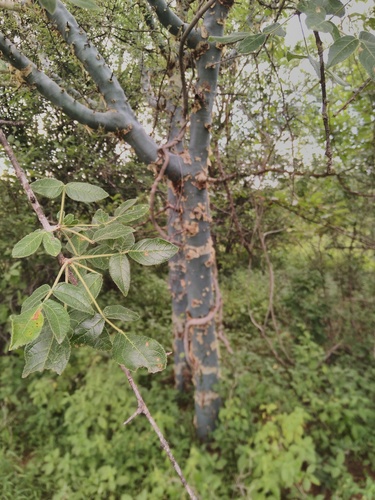
(c) Jugal Patel, some rights reserved (CC BY-NC)
Summary
Source: WikipediaGaruga pinnata is a deciduous tree species from the family Burseraceae. It occurs in Asia: from the Indian sub-continent, southern China and Indo-China; in Vietnam it may be called dầu heo. No subspecies are listed in the Catalogue of Life.
Description
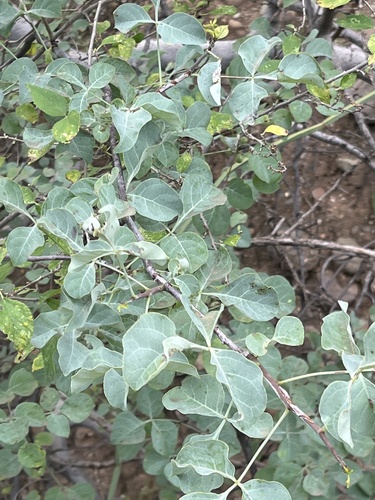
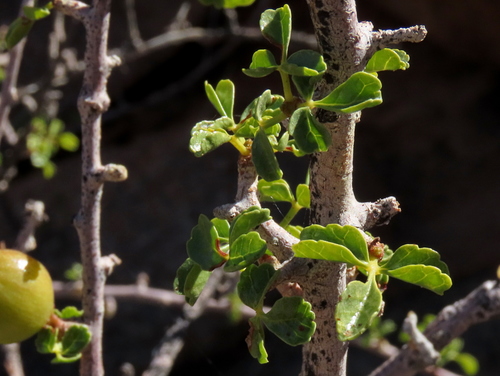
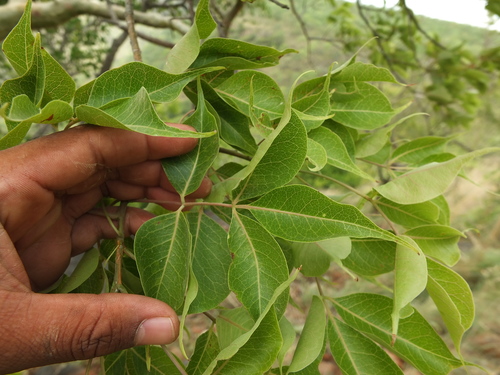
A tree which loses its leaves during the year. It grows 20-35 m tall. The trunk can be 60-180 cm across. It can have small buttresses. The leaves have leaflets along the stalk. There are 5-9 pairs of leaflets and an odd one. They are 5-15 cm long by 3-6.5 cm wide. They are oval to sword shaped. There are shallow round teeth along the edge. They are slightly hairy. The flowers are yellow in large loose flower clusters at the ends of branches. The fruit is fleshy with a hard covering around the seed. It is round and black. It is sour and edible.
Edible Uses
The ripe fruit are eaten fresh, cooked, or pickled, and are used in fish curries. The leaves are also edible.
Traditional Uses
The ripe fruit are edible but acid. They are eaten fresh, cooked or pickled. They are used in fish curries.
This uses section is brief — help expand it
Distribution
It is a tropical plant. It grows in dense forests. It is a light demanding tree. In Nepal it grows . In India it grows in many parts of the lower hills and plains. In Sikkim it grows between 300-900 m above sea level. In Sichuan and Yunnan.
Where It Grows
Asia, Bangladesh, Bhutan, Cambodia, China, Himalayas, India, Indochina, Indonesia, Laos, Malaysia, Myanmar, Nepal, Northeastern India, Pacific, Pakistan, Philippines, SE Asia, Sikkim, Thailand, Vietnam,
Cultivation
It can be grown from cuttings of large branches. It can also be grown from seed.
Propagation
Seed - Cuttings root readily.
Other Uses
The tree yields a copious clear gum, but it is of little value. The clear, greenish-yellow exudation of this tree, called 'curvambu', contains a small proportion of resin and some oil ; it has a terebinthiaceous odour and taste. The bark is a source of tannins. The sapwood is white, the heartwood reddish-brown. The wood is moderately hard, even-grained. Wood from large trees is rather handsome, the heartwood being used for the manufacture of furniture. Wood from smaller trees is almost all sapwood and of poor quality. It makes a poor fuel. The tree is used as a support for growing pepper plants (Piper nigrum).
Production
It is fast growing. In north India plants flower and fruit March to October.
Notes
There are 4 Garuga species.
Also Known As
Annakkara, Armu daru, Armu, Arnelli, Arunelli, Aule dabadabe, Bombok, Bung-bu-tuai-ram, Bungbutuairam, Chinyok, Chokka gota, Dabdabe, Dabdabey, Dieng-khiang, Engla, Garugudu, Gendeli poma, Ghogar, Godda, Halabalagi, Jum, Kaikar, Kakad, Kakaro, Kaked, Kakkad, Kandwer, Karre vembu, Karur, Kattu-kalinjan, Kharpat, Khusimb, Kosramba, Kudak, Kuruk, Mai-kham, Mohi, Mokot, Neura, Nil bhadi, Rohimala, Sarota, Sarupatri, Sinyok, Sompotri, Taesap, Thotmola, Toom, Tram mao, Tum kharpat
References (30)
- Ambasta, S.P. (Ed.), 2000, The Useful Plants of India. CSIR India. p 232
- Anderson, E. F., 1993, Plants and people of the Golden Triangle. Dioscorides Press. p 212
- Bajpai, O., et al, 2015, Tree species of the Himalayan Terai region of Uttar Pradesh, India: a checklist. Check List 11(4): 1718
- Bohra, N., et al, 2017, Ethnobotany of wild edible plants traditionally used by the local people in the Ramnagar regions from Nainital District, Uttarakhand, India. Biolife 5(1): 12-19
- Bole, P.V., & Yaghani, Y., 1985, Field Guide to the Common Trees of India. OUP p 47
Show all 30 references Hide references
- Burkill, I.H., 1966, A Dictionary of the Economic Products of the Malay Peninsula. Ministry of Agriculture and Cooperatives, Kuala Lumpur, Malaysia. Vol 1 (A-H) p 1078
- Chandrashekara, U. M., 2009, Tree species yielding edible fruit in the coffee-based homegardens of Kerala, India: their diversity, uses and management. Food Sec. 1:361-370
- Chaudhary, L. B., et al, 2014, Tree Resources of Katerniaghat Wildlife Sanctuary, Uttar Pradesh, India with especial emphasis on Conservation Status, Phenology and Economic Values. International Journal of Environment. 3(1)
- Chauhan, S. H., et al, 2018, Consumption patterns of wild edibles by the Vasavas: a case study from Gujarat, India. Journal of Ethnobiology and Ethnomedicine (2018) 14:5
- Flora of Pakistan.
- Forest Inventory and Planning Institute, 1996, Vietnam Forest Trees. Agriculture Publishing House p 87
- GAMMIE,
- Gardner, S., et al, 2000, A Field Guide to Forest Trees of Northern Thailand, Kobfai Publishing Project. p 112
- Hedrick, U.P., 1919, (Ed.), Sturtevant's edible plants of the world. p 325
- Hort. Bengal. 33. 1814
- Jadhav, R., et al, 2015, Forest Foods of Northern Western Ghats: Mode of Consumption, Nutrition and Availability. Asian Agri-History Vol. 19, No. 4: 293-317
- Kar, A., et al, 2013, Wild Edible Plant Resources used by the Mizos of Mizoram, India. Kathmandu University Journal of Science, Engineering and Technology. Vol. 9, No. 1, July, 2013, 106-126
- Khan, D. & Shaukat, S.S., 2006, The Fruits of Pakistan: Diversity, Distribution, Trends of Production and Use. Int. J. Biol. Biotech., 3(3):463-499
- Lalfakzuala, R., 2007, Ethnobotanical usages of plants in western Mizoram. Indian Journal of Traditional Knowledge. Vol 6(3) pp 480-493
- Majumdar, K and Datta, N., 2009, Traditional wild edible fruits for the forest dwellers of Tripura, India. Pleione 3(2) 167-178
- Manandhar, N.P., 2002, Plants and People of Nepal. Timber Press. Portland, Oregon. p 241
- Misra S. & Misra M., 2016, Ethnobotanical and Nutritional Evaluation of Some Edible Fruit Plants of Southern Odisha, India. International Journal of Advances in Agricultural Science and Technology, Vol.3 Issue.1, March- 2016, pg. 1-30
- Reddy, K. N. et al, 2007, Traditional knowledge on wild food plants in Andhra Pradesh. Indian Journal of Traditional Knowledge. Vol. 6(1): 223-229
- Savita, et al, 2006, Studies on wild edible plants of ethnic people in east Sikkim. Asian J. of Bio Sci. (2006) Vol. 1 No. 2 : 117-125
- Shah, G.L., 1984, Some economically important plant of Salsette Island near Bombay. J. Econ. Tax. Bot. Vol. 5 No. 4 pp 753-765
- Singh, H.B., Arora R.K.,1978, Wild edible Plants of India. Indian Council of Agricultural Research, New Delhi. p 61
- Sundriyal, M., et al, 1998, Wild edibles and other useful plants from the Sikkim Himalaya, India. Oecologia Montana 7:43-54
- Sundriyal, M., et al, 2004, Dietary Use of Wild Plant Resources in the Sikkim Himalaya, India. Economic Botany 58(4) pp 626-638
- Wiersema, J. H. & Leon, B., 2013, World Economic Plants. A Standard Reference CRC Press. 2nd Ed. p 318
- World Checklist of Useful Plant Species 2020. Royal Botanic Gardens, Kew