Garcinia kola
Heckel
Bitter Kola, False Kola
iNaturalist· cc-by-nc
(c) paullatham36, some rights reserved (CC BY-NC)
iNaturalist· cc-by-nc
(c) nolithaqumba, some rights reserved (CC BY-NC)
wikimedia· cc-by-sa
Wikimedia Commons - Roger Culos
Summary
Source: WikipediaGarcinia kola (bitter kola, a name sometimes also used for G. afzelii) is a species of flowering plant belonging to the Mangosteen genus Garcinia of the family Clusiaceae (a.k.a. Guttiferae). It is found in Benin, Cameroon, The Gambia, Democratic Republic of the Congo, Ivory Coast, Guinea, Mali, Gabon, Ghana, Liberia, Nigeria, Senegal and Sierra Leone. Its natural habitat is subtropical or tropical moist lowland forests. The fruit, seeds ("bitter kola nuts") and bark of the plant have been used for centuries in folk medicine to treat ailments from coughs to fever. According to a report from the Center For International Forestry Research, Garcinia kola trade is still important to the indigenous communities and villages in Nigeria. Cola acuminata, source of the true kola nut, is not related to Garcinia kola belonging not to Clusiaceae but to a subfamily of the mallow family Malvaceae.
Description
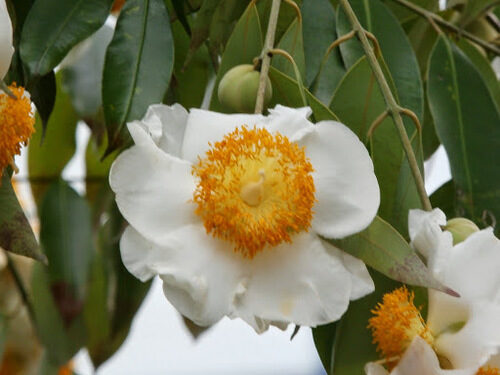
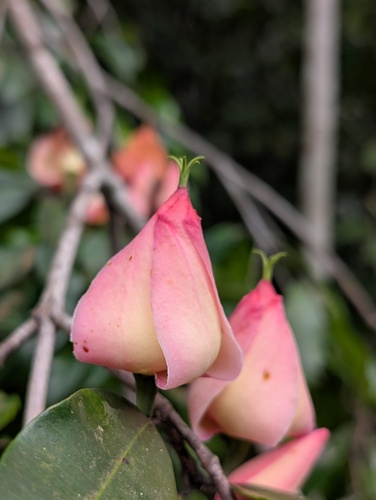
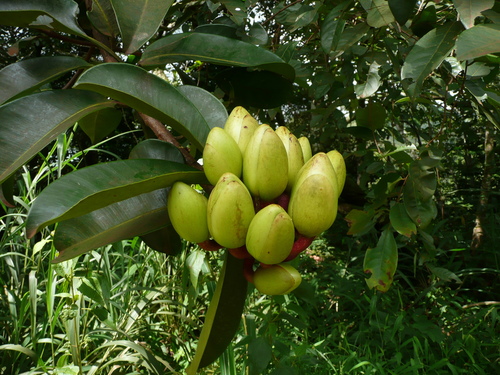
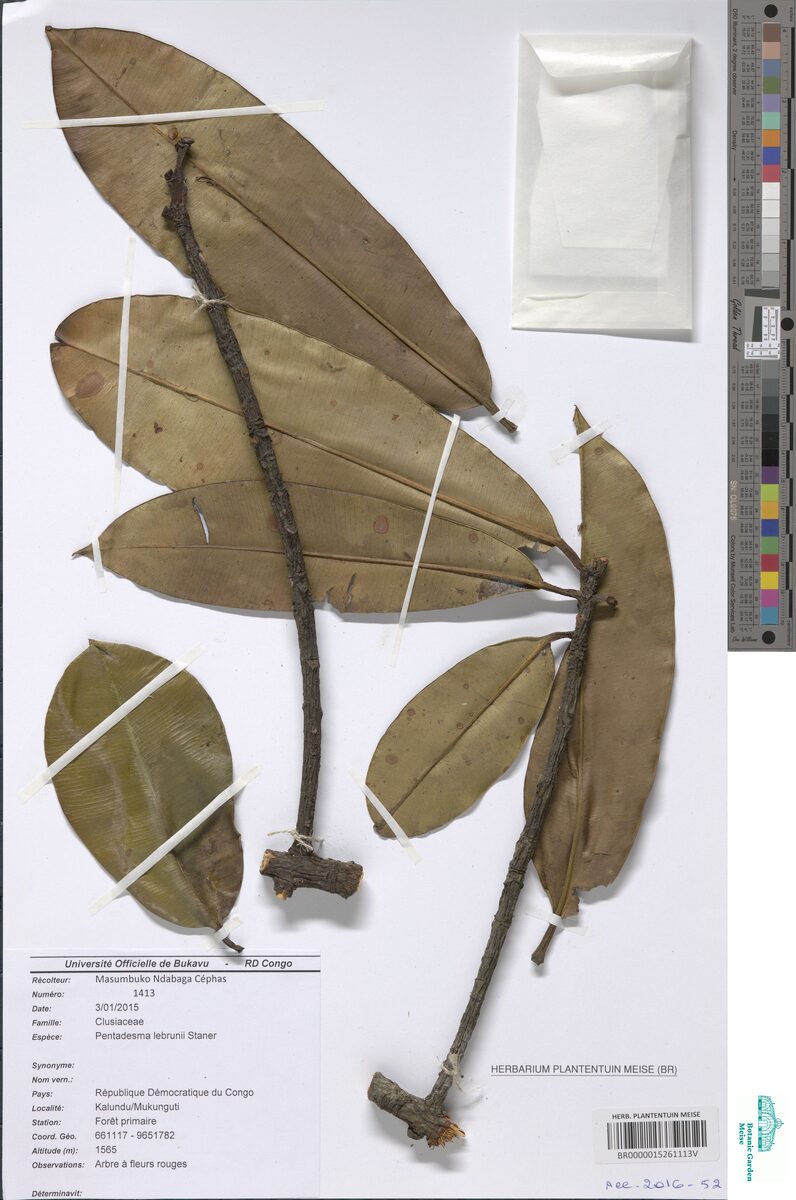
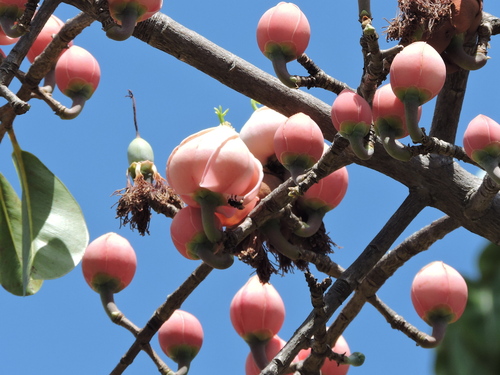
A medium sized tree. It grows to 12 m high. It can reach 28 m high. The crown is spreading. The trunk is straight. The bark is brown. The branches droop. The leaves are 3.5-14 cm long and 2.5-6 cm wide. They are leathery. The leaf stalk is stout and about 6 mm long. The flowers are greenish-white. The flowers contain both sexes but there are also male flowers. The flowers have fine hairs. The fruit are reddish-yellow. They are 6 cm across. They contain 2-4 brown seeds. These are in an orange coloured pulp. Both the pulp and seed are edible.
Edible Uses
The seeds are eaten raw, with a bitter, astringent, aromatic flavour somewhat like a raw coffee bean, followed by a slight sweetness or lingering pepperiness. They are chewed together with the seeds of true cola (Cola spp.), and are thought to enhance enjoyment of the cola and allow larger quantities to be consumed without indisposition. The fruits are extremely sour but are sometimes eaten; they are orange-sized and contain a yellow pulp surrounding four seeds.
Traditional Uses
The fruit are chewed as a stimulant. They are chewed with Cola nuts. The fruit are very sour but are sometimes eaten. The seed or nut is chewed raw but is bitter. The bark is used as a flavouring in an alcoholic drink. Caution: Alcohol is a cause of cancer.
Medicinal Uses
Bitter kola is widely used in traditional African medicine, with most parts of the plant employed across a broad range of ailments. The bark contains tannins, a reducing sugar, traces of an alkaloid, and flavonoids, and is extremely bitter, resinous, and astringent. Stem, root, and seed extracts have demonstrated strong anti-hepatotoxic and hepatotropic activity. Petroleum ether and acetone extracts show marked antimicrobial properties. The bark also contains an abundant sticky resinous gum taken internally to treat gonorrhoea, and applied externally to skin infections and fresh wounds. The bark is considered aphrodisiac and galactagogue. A decoction is used to treat female sterility and ease childbirth, taken daily until conception is certain and then at half quantity throughout the term; it is also used to induce expulsion of a dead foetus. Powdered bark is applied externally to malignant tumours and cancers. A tea combining the bark with the bark of Sarcocephalus latifolius is well regarded as a diuretic, urinary decongestant, and treatment for chronic urethral discharge. The bark combined with Piper guineense and plantain stalk sap (Musa sp.) is used to embricate the breast for mastitis. The seed and bark are taken together for stomach pains. Leaves and bark are used for pulmonary and gastrointestinal complaints. The root and bark serve as a tonic for men. A leaf infusion is purgative. The fruits are eaten in Nigeria as a remedy for general aches in the head and back, and as a vermifuge. The seeds are considered antidote, antitussive, aphrodisiac, astringent, and vermifuge; chewing them is said to relieve coughs, hoarseness, and bronchial and throat complaints. Taken dry, they are used against dysentery and as an antidote to Strophanthus poisoning. Caffeine, present in true kola, is absent here. A trace alkaloid has been reported in Nigerian material but not in all samples. Tannins are present which may carry the antibacterial compounds morellin and guttiferin, and unidentified resins may also contribute to the activity.
Distribution
It is a tropical plant. It grows in the understorey in the forest.
Where It Grows
Africa, Angola, Benin, Cameroon, Central Africa, Central African Republic, CAR, Congo DR, Congo R, Côte d'Ivoire, Equatorial Guinea, Gabon, Ghana, Guinea, Guinée, Ivory Coast, Liberia, Niger, Nigeria, Sahel, Senegal, Sierra Leone, Togo, West Africa,
Cultivation
Seeds are difficult to germinate. They can be harvested fresh and then incubated in a banana stem for 3 weeks. Alternatively a poly-ethylene bag is used.
Propagation
Seed has short viability and should be sown as soon as possible. Fresh, mature seeds are dormant but viable, making rapid and uniform germination within a seed lot difficult. Although the thin leathery seed coat is not a barrier to water penetration, de-coating or soaking in 70% ethanol solution for 1–2 hours can raise germination to more than 90% after about 5 months. Intact fresh seeds germinate at approximately 50%, beginning after about 3 months at ambient temperature (25–28°C), with most seeds having germinated 7–8 months after sowing in river sand. In nursery trials, seeds continued to germinate for 18 months, reaching a final germination level of 75%.
Other Uses
The tree provides shade in cocoa plantations. Its bark contains an abundant sticky resinous gum with waterproofing properties, historically used to protect powder in the priming pans of flintlock guns from rain. The gum is incendiary, causing the twigs to burn brightly; they are used as tapers. The bark is used in tanning and has at times been exported as a tanning material. The bitter leaves are used as a flea deterrent. The sapwood is creamy white and the heartwood yellow, darkening to brown at the centre; it is hard, close-grained, finishes smoothly, takes a good polish, is durable, and fairly resistant to termites. The wood's principal use is for chew-sticks, which are believed to whiten teeth and clean the mouth and are widely used in West Africa. Smaller trees are commonly felled specifically for this purpose, the wood being cut and split into pencil-sized pieces. The roots are also used as chew-sticks, sometimes in preference to the wood, and are believed to prevent dental caries, though tests have shown no antibiotic activity.
Production
It takes 8 years to grow to 12 m tall.
Other Information
It is a cultivated plant. It is an important fruit tree in Nigeria. Seeds are sold in local markets. The bark is also sold in local markets.
Notes
There are about 300 Garcinia species.
Synonyms
Also Known As
Adi, Agambo, Agbilu, Akara, Akbatuwe, Akilu, Aki ilu, Angudia, Aouolie, Bolele, Ebon gagnagne, Edun, Efiat, Goro, Gworo, Heckel, Ibi-aku, Igoligo, Mbongo, Mmiale, Mpkom, Namijin, Ngadiadia, Ngadidi, Ngadjadja, Ngbwel, Oge, Okogon, Onale, Ondale, Onie, Onye, Orogba, Orogbo, Oyale, Tchapiah, Tchiouape, Toagbebiho, Tweapea, Umbongo, Ziede
References (49)
- Abbiw, D.K., 1990, Useful Plants of Ghana. West African uses of wild and cultivated plants. Intermediate Technology Publications and the Royal Botanic Gardens, Kew. p 46
- Aniama, S. O., et al, 2016, Ethnobotanical documentaton of some plants among Igala people of Kogi State (Nigeria). The International Journal Of Engineering And Science (IJES). 5(4) pp 33-42
- Assogbadjo, A. E. et al, 2013, Specific Richness and Cultural Importance of Wild Edible Trees in Benin. Acta Hort. 979, ISHS 2013
- Atato, A., et al, 2010, Diversity of Edible Wild Fruit Tree Species of Togo. Global Science Books.
- Billong Fils, P. E., et al, 2020, Ethnobotanical survey of wild edible plants used by Baka people in southeastern Cameroon. Journal or Ethnobiology and Ethnomedicine. 16:64 p 8
Show all 49 references Hide references
- Boateng, S. K., et al, 2007, Wet Season of Edible Wild Fruits in Three Regions of Ghana. Journal of Plant Sciences 2(3): 353-357
- Burkill, H. M., 1985, The useful plants of west tropical Africa, Vol. 2. Kew.
- Burkill, I.H., 1966, A Dictionary of the Economic Products of the Malay Peninsula. Ministry of Agriculture and Cooperatives, Kuala Lumpur, Malaysia. Vol 1 (A-H) p 1069
- Busson, 1965,
- Dalziel, J. M., 1937, The Useful plants of west tropical Africa. Crown Agents for the Colonies London.
- Danforth, R.M., & Boren, P.D., 1997, Congo Native fruits. Twenty-five of the best. Privately published. p 68 (As Garcinia cola)
- Dibong, S. D., et al, 2011, Inventory and Biodiversity of species edible wild fruits sold in the markets of Douala, Cameroon. International Journal of Applied Biology and Pharmaceutical Technology. 2(3).
- Diop, A. l., et al, 2021, Cultural importance of wild edible plants in three sympatric communities: Agni, Akyé and Gwa in the Department of Alépé (Southeast of Côte d’Ivoire). Ethnobotany Research and Applications 22:35. p 6
- Dosunmu, M. I., and Johnson, E. C., 1995, Chemical evaluation of the nutritive value and changes in ascorbic acid content during storage of the fruit of 'bitter kola' (Garcinia kola). Food Chemistry 54: 67-71
- Egbe, E. A., et al, 2012, Ethnobotany and Prioritization of Some Selected Tree Species in South-western Cameroon. Ethnobotany Research & Applications 10:235-246
- Facciola, S., 1998, Cornucopia 2: a Source Book of Edible Plants. Kampong Publications, p 79
- Focho, D. A., et al, 2009, Ethnobotanical survey of Trees in Fundong, Northwest Region, Cameroon. Journal of Ethnobiology and Ethnomedicine, 5:17
- Fongnzossie Fedoung, E., et al, 2020, Wild edible plants and mushrooms of the Bamenda Highlands in Cameroon: ethnobotanical assessment and potentials for enhancing food security. Journal of Ethnobiology and Ethnomedicine 16:12
- Food Composition Tables for use in Africa FAO http://www.fao.org/infoods/directory No. 953
- Gallois, S., et al, 2020, Methodological priorities in assessing wild edible plant knowledge and use – a case study among the Baka in Cameroon.
- Hoare A. L., 2007, The Use of Non-timber Forest Products in the Congo Basin. Constraints and Opportunities. Rainforest Foundation. p 11
- Hwang, L. C., et al, 2020, Traditional Botanical Uses of Non-Timber Forest Products (NTFP) in Seven Counties in Liberia. ACS Symposium Series; American Chemical Society: Washington, DC, 2020.
- Ingram, V. & Schure, J. 2010, Review of Non Timber Forest Products (NTFPs) in Central Africa, Cameroon. Center for International Forestry Research (CIFR). p 34
- Jardin, C., 1970, List of Foods Used In Africa, FAO Nutrition Information Document Series No 2.p 43, 139 (Also as Garcinia giadidi)
- J. Pharm. Chim. 8:88. 1883
- Jusu, A. & Cuni-Sanchez, A., 2017, Priority indigenous fruit trees in the African rainforest zone: insights from Sierra Leone. Genet Resour Crop Evol (2017) 64:745–760
- Kanmegne, G. & Omokolo, N. D., 2008, Germination of Garcinia kola (Heckel) seeds in response to different hormone treatments. Fruits, Vol. 63, p 155-161
- Keay, R.W.J., 1989, Trees of Nigeria. Clarendon Press, Oxford. p 108
- Latham, P., 2004, Useful Plants of Bas-Congo province. Salvation Army & DFID p 136
- Leakey, R. R. B., 1999, Potential for novel food products from agroforestry trees: A review. Food Chemistry. 66:1-14
- Liengola, I. B., 2001, A contribution to the study of native edible plants by the Turumbu and Lokele of the Tshopo District, Province Orientale, D. R. Congo. Syst. Geogr. Pl. 71:687-698
- Menninger, E.A., 1977, Edible Nuts of the World. Horticultural Books. Florida p 46
- Meregini, O. A., 2005, Some endangered plants producing edible fruits and seeds in Southeastern Nigeria. Fruits, Vol. 60 pp 211-220
- Mosango, M., Szafranski, F., 1985, Plantes sauvages à fruits comestibles dans les environs de Kisangani (Zaïre). In: Journal d'agriculture traditionnelle et de botanique appliquée, 32e année, pp. 177-190
- Nkeoua, G. & Boundzanga, G. C., 1999, Donnees sur les produits forestieres non ligneux en Republique du Congo. FAO. p 27
- Okafor, J. C., 1978, Development of Forest Tree crops for Food Supplies in Nigeria. Forest Ecology and Management 1:235-247
- Peters, C. R., O'Brien, E. M., and Drummond, R.B., 1992, Edible Wild plants of Sub-saharan Africa. Kew. p 84
- Savill, P. S. & Fox, J. E. D., Trees of Sierra Leone. p 132
- Termote, C., et al, 2011, Eating from the wild: Turumbu, Mbole and Bali traditional knowledge of non-cultivated edible plants, District Tshopo, DRCongo, Gen Resourc Crop Evol. 58:585-618
- Termote, C., et al, 2012, Wild Edible Plant Markets in Kisangani, Democratic Republic of Congo. Human Ecology 40:269-285
- The Digital Flora of Central Africa, 2013, (Democratic Republic of Congo, Rwanda & Burundi) Botanical Garden Meise
- Uphof,
- van Wyk, B., 2005, Food Plants of the World. An illustrated guide. Timber press. p 199
- Vivien, J. & Faure, J.J., 1985, Abres des forets dense d'Afrique Centrale. Agence de Cooperation Culturelle et Technique. Paris. p 214
- Vivien, J., & Faure, J.J., 1996, Fruitiers Sauvages d'Afrique. Especes du Cameroun. CTA p 123
- Wickens, G.E., 1995, Edible Nuts. FAO Non-wood forest products. FAO, Rome. p 131
- Wiersema, J. H. & Leon, B., 2013, World Economic Plants. A Standard Reference CRC Press. 2nd Ed. p 317
- World Checklist of Useful Plant Species 2020. Royal Botanic Gardens, Kew
- Zapfack, L., et al, 2001, Ethnobotanical Survey of the Takamanda Forest Reserve. Consultancy Report PROFA, Cameroon. p 23