Harungana madagascariensis
Lam. ex Poiret
Orange-milk tree
iNaturalist· cc-by-nc
(c) Jean-Philippe BASUYAUX, some rights reserved (CC BY-NC), uploaded by Jean-Philippe BASUYAUX
iNaturalist· cc-by-nc
(c) David Rabehevitra, some rights reserved (CC BY-NC)
iNaturalist· cc-by-nc
(c) David Rabehevitra, some rights reserved (CC BY-NC)
Summary
Source: WikipediaHarungana madagascariensis is a flowering plant found in Madagascar that is commonly known as the dragon's blood tree, orange-milk tree or haronga.
Description
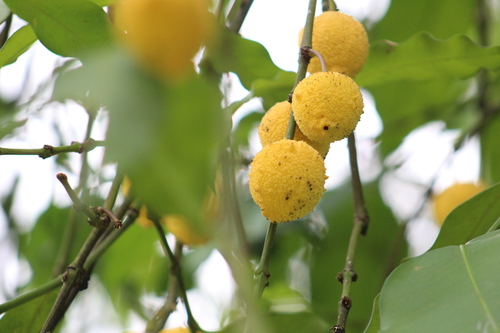
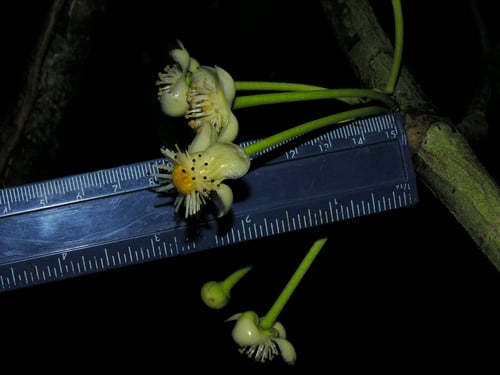
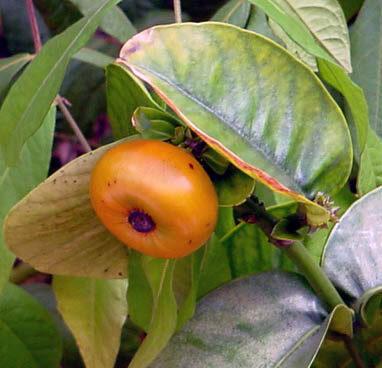
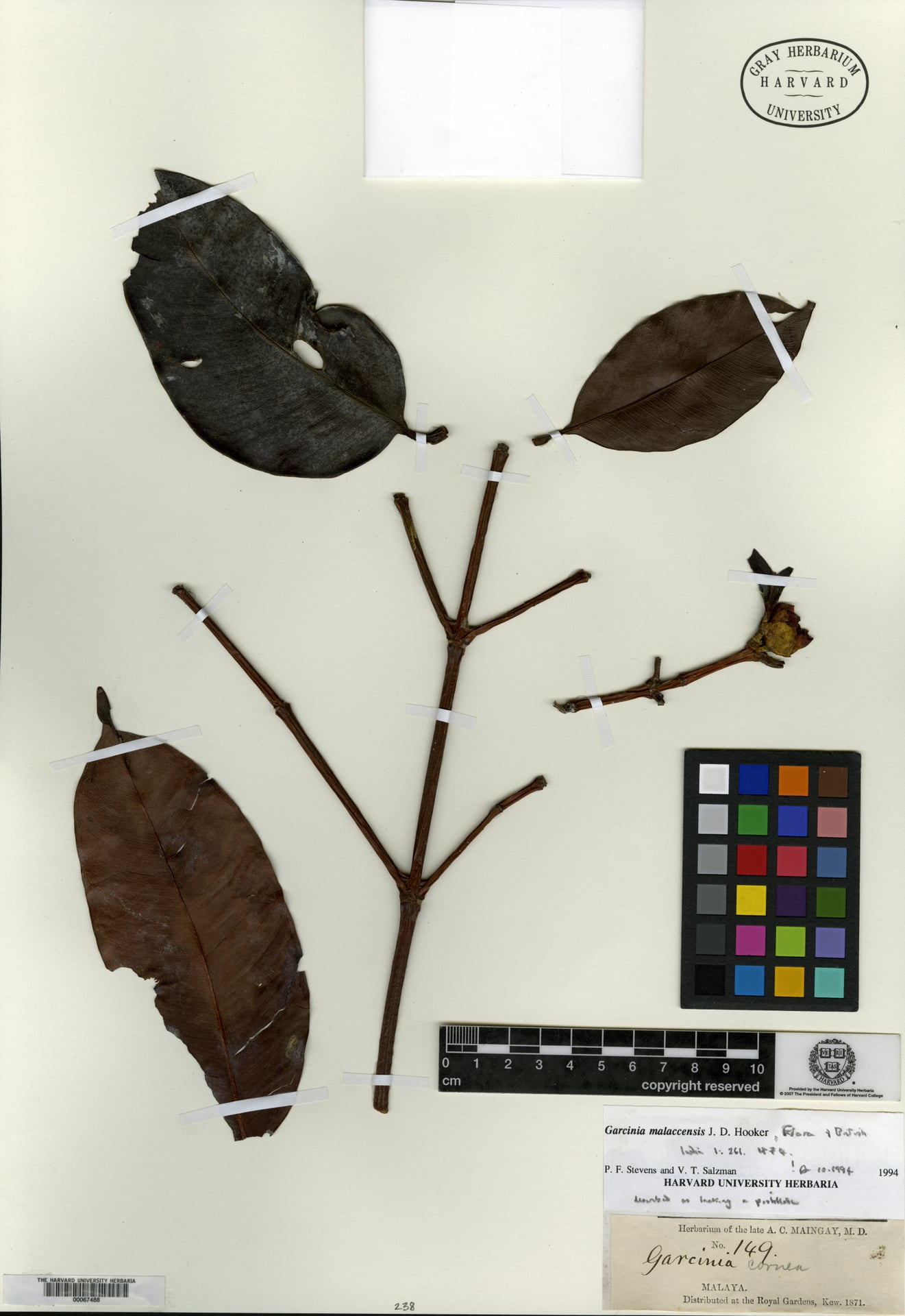
A small to medium sized bushy tree. It grows 4-7 m tall but can be 10-15 m tall. The bark is brown and scaly. It has bright orange paint-like sap. The leaves are opposite and simple. The are oval and 6-20 cm long by 3-10 cm wide. They are glossy dark green above and with rusty red hairs underneath. The young leaves at the tip of the branches keep tightly pressed together. The leaf stalk is 3 cm long. The flowers are cream and 5 mm across. They have a sweet almond scent. They occur in many flowered flat heads. These are 8-20 cm across. The stalks are covered with rusty red hairs. The fruit is berry-like. It is 2-4 mm across. They are greenish-orange becoming deep red. They occur in dense heads up to 25-30 cm across.
Edible Uses
Fruit - raw. A sweet flavour, they are eaten as a snack, especially by children. The fruits are edible, though they are also stomachic and mildly laxative, and in excess emetic. They are used in local cooking and are fermented to produce a sort of cider which taken on an empty stomach may sometimes cause vomiting. The yellow to orange-brown fruits are very small, 3 - 4mm in diameter, but carried in large, massed heads 25 - 30cm across. The sap of the bark is added to fermented beverages as a colouring.
Traditional Uses
Africa, Angola, Australia, Burkina Faso, Cameroon, Central Africa, Central African Republic, CAR, Congo DR, Côte d'Ivoire, East Africa, Gabon, Gambia, Ghana, Guinea, Guinée, Guinea-Bissau, Ivory Coast, Kenya, Liberia, Madagascar, Malawi, Mauritius, Mozambique, Nigeria, Rwanda, Sao Tome and Principe, Senegal, Sierra Leone, Southern Africa, Sudan, Tanzania, Uganda, West Africa, Zambia, Zimbabwe,
Medicinal Uses
This plant has been used as a treatment for several diseases such as jaundice typhoid fever, anemia, along with some skin and heart problems. They correlate with different pharmacological tests involved with different plant extracts and can be identified as antioxidants and antitrichomonal.
Distribution
It is a tropical plant. It grows at medium to low altitudes in evergreen forest and along stream banks. It cannot tolerate shade. In tropical Queensland it grows from sea level to 600 m altitude. In Tanzania it grows between sea level and 1,800 m above sea level. It grows in areas with a rainfall between 1,100-1,800 mm. It is often near termite mounds.
Where It Grows
Lowland and upland rain forest from sea level to elevations of 1,800 metres. Rain-forest (and remnants) in clearings; fringing forest in savannah formations; locally abundant in recent secondary forest regrowth.
Cultivation
The fruit are eaten especially by children.
Propagation
Seed - it has a short viability and is best kept in sealed containers and sown within two months of harvest.
Other Uses
The bark is easily peeled off in long strips. It is rather wet and turgid. The main inner part yields a brilliant orange gum which turns red on exposure, but the innermost layer of bark and the outer layers of the wood yield a yellow sap from which a more delicate dye or stain is obtained which is used for dying velvet. The gummy latex is used in all areas to furnish a yellow dye also for use on cloths, matting and many other articles, the usual practice being to chop up pieces of the bark which are boiled in water with the thing to be dyed. The latex is also used as a yellow paint. The exudate thickens and a balsam has been recovered from it. It makes a good stain for wood and has been used as a sealing-wax. The yellow dye can be made brown by mixing in powdered camwood. The inner bark is boiled in water and the resultant yellow liquid is added to pounded cassava to form a stiff, gluey paste. This is applied to newly fired pots while they are still hot as a sort of finish. The significance of this is not clear, but one result is to stain them a dark yellow. The bark is sufficiently fibrous to be used sometimes in Ghana for tying roofs. The bark and roots are chewed as a substitute for toothpaste and are also used as a lipstick. The wood is orange-red to yellow, and is particularly attractive. It works well and finishes easily, but unfortunately timber in sufficiently large enough pieces is not commonly available. The wood is light in weight and durable in contact with the ground, though in exposed positions it is liable to insect-attack. It is nevertheless widely used in hut-construction for poles, roof-joists, planks etc. The branches diverge at an angle of 60 - 80° from the main stem, and suitable pieces have been cut for use as hockey-sticks. The wood is used for fuel and to make charcoal. Giving out a lot of heat, it is useful as a fuel in local metallurgy for softening metals. The plant is a vigorous coloniser. It is amongst the first pioneers to occupy savannah land after destruction of the vegetation by bush fires, thus affording protection and cover for the soil. It also invades grassland thereby accelerating reversion to secondary bush-savannah. In Sierra Leone, at least, the tree is often ant-infested. It can possibly be used as a pioneer species in the first stage of restoring woodland cover.
Production
There is only one Harungana species. It has medicinal uses. It has also been put in the family Hypericaceae.
Synonyms
Also Known As
Acanjongra, Alillibar rafi, Binhanhauque, Canho, Chepsebil, Chungala, Elepo, Haronga, Harungana, Kumamaji, Marincazia, Mbura, Mdamudamu, Mgondogondo, Mitchele, Mkekundu, Mkuntu, Mtunu, Mufifi, Muitasoa, Mumyamwe, Muntungulu, Murrumo, Musaki, Musira, Namasahi, Nibale, Okosoa, Po-di-faia, Sumbala, Sungala, Ulieli, Ulielo, Umpate, Umushaayishaatyi, Uomnhe, Utehia, Varnaropa
References (23)
- Abbiw, D.K., 1990, Useful Plants of Ghana. West African uses of wild and cultivated plants. Intermediate Technology Publications and the Royal Botanic Gardens, Kew. p 47
- Burkill, H. M., 1985, The useful plants of west tropical Africa, Vol. 2. Kew.
- Chapman, J. D. & Chapman, H. M., 2001, The Forest Flora of Taraba and Andamawa States, Nigeria. WWF & University of Canterbury. p 175
- Cooper, W. and Cooper, W., 2004, Fruits of the Australian Tropical Rainforest. Nokomis Editions, Victoria, Australia. p 124
- Dale, I. R. and Greenway, P. J., 1961, Kenya Trees and Shrubs. Nairobi. p 234
Show all 23 references Hide references
- Dalziel, J. M., 1937, The Useful plants of west tropical Africa. Crown Agents for the Colonies London.
- Encycl. 6:314. 1804
- Fowler, D. G., 2007, Zambian Plants: Their Vernacular Names and Uses. Kew. p 18
- Fox, F. W. & Young, M. E. N., 1982, Food from the Veld. Delta Books. p 157
- Grivetti, L. E., 1980, Agricultural development: present and potential role of edible wild plants. Part 2: Sub-Saharan Africa, Report to the Department of State Agency for International Development. p 47
- Jardin, C., 1970, List of Foods Used In Africa, FAO Nutrition Information Document Series No 2.p 43, 141
- Keay, R.W.J., 1989, Trees of Nigeria. Clarendon Press, Oxford. p 110
- Latham, P., 2004, Useful Plants of Bas-Congo province. Salvation Army & DFID p 144
- Malaisse, F., 1997, Se nourrir en floret claire africaine. Approche ecologique et nutritionnelle. CTA., p 91.
- Mpasiwakomu, R. A., 2017, The Diversity and Utilization of Wild Edible and Medicinal Plant Species found in Uvinza Miombo Woodlands, Tanzania. M. Sc. thesis University of Tanzania.
- Mutie, F. M., et al, 2023, Important Medicinal and Food Taxa (Orders and Families) in Kenya, Based on Three Quantitative Approaches. Plants 2023, 12, 1145
- Palgrave, K.C., 1996, Trees of Southern Africa. Struik Publishers. p 612
- Peters, C. R., O'Brien, E. M., and Drummond, R.B., 1992, Edible Wild plants of Sub-saharan Africa. Kew. p 84
- Ruffo, C. K., Birnie, A. & Tengnas, B., 2002, Edible Wild Plants of Tanzania. RELMA p 364
- Terashima, H., et al, 1992, Ethnobotany of the Lega in the Tropical Rainforest of Eastern Zaire (Congo): Part Two, Zone de Walikale, African Study Monographs, Suppl. 19:1-60
- White, F., Dowsett-Lemaire, F. and Chapman, J. D., 2001, Evergreen Forest Flora of Malawi. Kew. p 285
- Williamson, J., 2005, Useful Plants of Malawi. 3rd. Edition. Mdadzi Book Trust. p 129
- World Checklist of Useful Plant Species 2020. Royal Botanic Gardens, Kew