Fritillaria camschatcensis
(L.) Ker Gawl.
Black sarana, Kamchatka lily
iNaturalist· cc-by-nc
(c) hillanddale, some rights reserved (CC BY-NC)
iNaturalist· cc-by-nc
(c) hillanddale, some rights reserved (CC BY-NC)
iNaturalist· cc-by-nc
(c) hillanddale, some rights reserved (CC BY-NC)
Summary
Source: WikipediaFritillaria camschatcensis is a species of flowering plant native to northeastern Asia and northwestern North America, including northern Oregon, Washington, British Columbia, Alaska, northern Japan, and the Russian Far East (Amur, Kamchatka, Khabarovsk, Magadan, Primorye, Sakhalin and the Kuril Islands). It has many common names, including Kamchatka fritillary and Kamchatka lily. It is also called rice lily, northern rice-root, or (misleadingly) Indian rice or wild rice, because of the rice-like bulblets that form around its roots.
Description
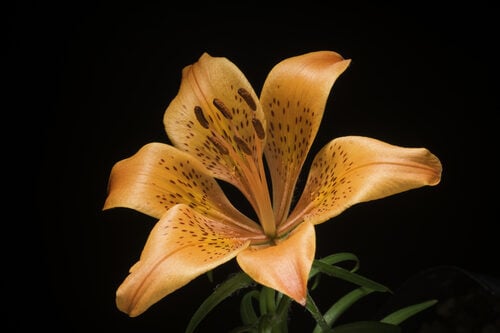
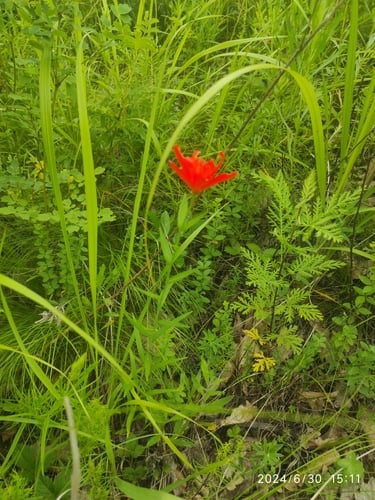
A bulb plant. It grows 25-40 cm high and 10-15 cm wide. The leaves are arranged in rings or whorls around the stems. The leaves are glossy green. They are sword shaped. The flowers occur as 2 or 3 on a stem. The flowers are bell-shaped and nearly black purple.
Edible Uses
The bulb can be eaten raw, cooked, or dried for later use. It is a staple food in areas where the plant grows wild; when cooked, it tastes like baked chestnuts, though one source notes a slightly bitter taste even after cooking. The finest-tasting bulbs are said to come from coastal areas where plants are occasionally washed by salt water. Harvested in autumn, the bulb resembles a cluster of cooked rice grains. It can also be dried and ground into a flour or starch for use in breads and soups. A pudding is made by combining the bulbs with the fruit of Empetrum nigrum. The green seedpods can be eaten raw or cooked, though they are somewhat bitter.
Traditional Uses
The roots or bulbs are roasted and eaten. They are also eaten raw. They can be boiled or dried for later use. They are used for puddings mixed with Empetrum nigrum. They can be used for starch used in bread or soup. Caution: Most fritillarias are poisonous if eaten.
Medicinal Uses
None known.
Distribution
It is a temperate plant. It is frost hardy. It can grow in light shade. It needs moist rich soil. In Canada they grow from sea levels to 600 m altitude. It suits hardiness zones 4-9.
Where It Grows
Alaska, Asia, Australia, Kodiak Is., Canada, Himalayas, Japan, North America, Russia, Siberia, USA,
Propagation
Seed is best sown as soon as ripe in a cold frame, where it should germinate in spring. Protect from frost. Stored seed should be sown as soon as possible and may take a year or more to germinate. Sow thinly to avoid the need to prick out seedlings. After germination, give occasional liquid feeds to prevent mineral deficiency. When plants die down at the end of their second growing season, divide the small bulbs and plant 2–3 per 8cm deep pot. Grow on for at least another year in light shade in the greenhouse before planting out while dormant. Divide offsets in August — larger bulbs can go directly into permanent positions, while smaller ones are best potted and grown on in a cold frame for a year before autumn planting. Propagation by bulb scales is also possible.
Other Uses
None known.
Other Information
It is a significant food.
Notes
There are about 100 Fritillaria species.
Nutrition
| Part | Moisture | kJ | kcal | Protein | Vit A | Vit C | Iron | Zinc |
|---|---|---|---|---|---|---|---|---|
| Bulb | 74 | 411 | 100 | 2.9 | 0.3 | 29 | 2.2 | 0.7 |
Also Known As
Black lily, Chocolate lily, Eskimo potatoes, Indian rice, Kamchatka fritillary, Kamchatka Missionbells, Koch, Northern rice-root, Rice-of-the-earth, Rice root
References (23)
- Altschul, S.V.R., 1973, Drugs and Foods from Little-known Plants. Notes in Harvard University Herbaria. Harvard Univ. Press. Massachusetts. no. 288
- Beckstrom-Sternberg, Stephen M., and James A. Duke. "The Foodplant Database." http://probe.nalusda.gov:8300/cgi-bin/browse/foodplantdb.(ACEDB version 4.0 - data version July 1994) (As Fritillaria kamschatensis)
- Bot. Mag. 30: sub t. 1216. 1809
- Brickell, C. (Ed.), 1999, The Royal Horticultural Society A-Z Encyclopedia of Garden Plants. Convent Garden Books. p 447 (As Fritillaria kamschatensis)
- Bowser, M., 2017, Handout on Edible Plants of the Kenai Peninsula. USFWS Kenai National Wildlife Refuge p 14
Show all 23 references Hide references
- Cundall, P., (ed.), 2004, Gardening Australia: flora: the gardener's bible. ABC Books. p 614
- Facciola, S., 1998, Cornucopia 2: a Source Book of Edible Plants. Kampong Publications, p 143
- Heller, C. A., 1962, Wild Edible and Poisonous Plants of Alaska. Univ. of Alaska Extension Service. p 56
- Hibbert, M., 2002, The Aussie Plant Finder 2002, Florilegium. p 103
- Hu, Shiu-ying, 2005, Food Plants of China. The Chinese University Press. p 317
- Jackes, D. A., Edible Forest Gardens
- Joyce, D., 1998, The Garden Plant Selector. Ryland, Peters and Small. p 291
- Kuhnlein, H. V., et al, 2009, Indigenous Peoples' food systems. FAO Rome p 33
- Lim, T. K., 2015, Edible Medicinal and Non Medicinal Plants. Volume 9, Modified Stems, Roots, Bulbs. Springer p 43
- MacKinnon, A., et al, 2009, Edible & Medicinal Plants of Canada. Lone Pine. p 196
- Moerman, D. F., 2010, Native American Ethnobotany. Timber Press. p 240
- Plants for a Future database, The Field, Penpol, Lostwithiel, Cornwall, PL22 0NG, UK. http://www.scs.leeds.ac.uk/pfaf/
- Plants for a Future, The Field, Penpol, Lostwithiel, Cornwall, PL22 0NG, UK. http://www.scs.leeds.ac.uk/pfaf/ (As Fritillaria kamschatensis)
- Tanaka,
- Turner, N., 1995, Food Plants of Coastal First Peoples. Royal BC Museum Handbook p 46
- Turner, N. J. et al, 2011, Edible and Tended Wild Plants, Traditional Ecological Knowledge and Agroecology. Critical Reviews in Plant Sciences, 30:198-225
- Uphof,
- World Checklist of Useful Plant Species 2020. Royal Botanic Gardens, Kew