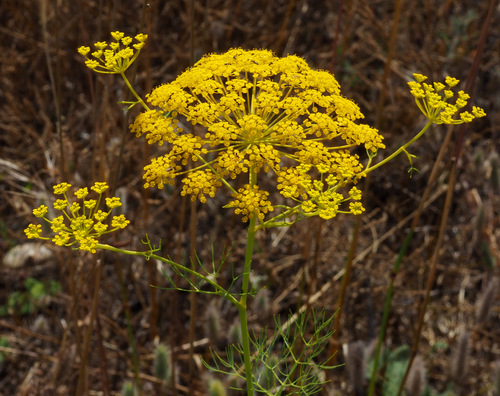
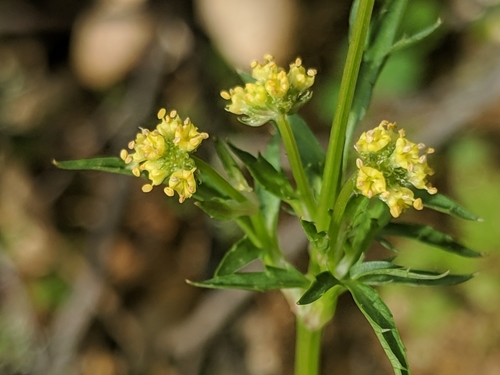
Foeniculum vulgare var. dulce
(Mill.) Batt.
Sweet fennel, Finocchio
iNaturalist· cc-by-nc
(c) sstudebaker, some rights reserved (CC BY-NC)
Description
A herb. It grows over two years or can keep growing from year to year. It grows about 60 cm tall. There are 4 or 5 smooth stalks. They are hollow or with a white pith. The leaves are feathery and finely divided. The leaf stalks clasp the stem. The leaf base is enlarged and oval. The flowers are in large flat groups. They are yellow. The seeds are grey-brown.
Edible Uses
The bulb, foliage, and fruits of the fennel plant are used in many of the culinary traditions of the world. The small flowers of wild fennel (known as fennel "pollen") are the most potent form of fennel, but also the most expensive. Dried fennel fruit is an aromatic, anise-flavored spice, brown or green when fresh, slowly turning a dull grey as the fruit ages. For cooking, green fruits are optimal. The leaves are delicately flavored and similar in shape to dill. The bulb is a crisp vegetable that can be sautéed, stewed, braised, grilled, roasted or eaten raw. Tender young leaves are used for garnishes, as a salad, to add flavor to salads, to flavor sauces to be served with puddings, and in soups and fish sauce. Both the inflated leaf bases and the tender young shoots can be eaten like celery. Fennel fruits are sometimes confused with those of anise, which are similar in taste and appearance, though smaller. Fennel is also a flavoring in some natural toothpastes. The fruits are used in cookery and sweet desserts. Many cultures in South Asia, Afghanistan, and West Asia use fennel fruits in cooking. In many parts of India, fennel fruits; called saunf, are consumed raw or roasted as mukhwas; an after-meal digestive and breath freshener or candied as comfit. In Iraq, fennel seeds are used as an ingredient in nigella-flavored breads. It is one of the most important spices in Kashmiri cuisine and Gujarati cooking. In Indian cuisine, whole fennel seeds and fennel powder are used as a spice in various sweet and savory dishes. It is an essential ingredient in the Assamese/Bengali/Oriya spice mixture panch phoron and in Chinese five-spice powders. Fennel seeds are also often used as an ingredient in paan, a breath freshener most popularly consumed in India. In China, fennel stem and leaves are often ingredients in the stuffings of jiaozi, baozi, or pies, as well in cold dishes as a green vegetable. Fennel fruits are present in well-known mixed spices such as the five-spice powder or thirteen-spice powder. Fennel leaves are used in some parts of India as leafy green vegetables either by themselves or mixed with other vegetables, cooked to be served and consumed as part of a meal. In Syria and Lebanon, the young leaves are used to make a special kind of egg omelette (along with onions and flour) called ijjeh. Many egg, fish, and other dishes employ fresh or dried fennel leaves. Florence fennel is a key ingredient in some Italian salads, or it can be braised and served as a warm side dish. It may be blanched or marinated, or cooked in risotto. Fennel fruits are the primary flavor component in Italian sausage. In Spain, the stems of the fennel plant are used in the preparation of pickled eggplants, berenjenas de Almagro. A herbal tea or tisane can also be made from fennel. On account of its aromatic properties, fennel fruit forms one of the ingredients of the well-known compound licorice powder.
Traditional Uses
The leaf base can be eaten raw or cooked. The chopped leaves can be eaten on fish and in salads. The seeds can be used as a spice.
This uses section is brief — help expand it
Distribution
It is a temperate plant.
Where It Grows
Africa, Algeria, Australia, Balkans, East Africa, Europe, Germany, Italy, Macedonia, Mediterranean, Mozambique, North Africa, Tasmania,
Cultivation
Seed are sown direclty where they are to grow. They are planted 15 cm apart in rows 30 cm apart. Plants are then thinned out to 25 cm apart. The soil is mounded up to blanch the bases.
Other Information
It is a commercially cultivated vegetable.
Notes
There is only one Foeniculum species.
Dangerous Lookalikes
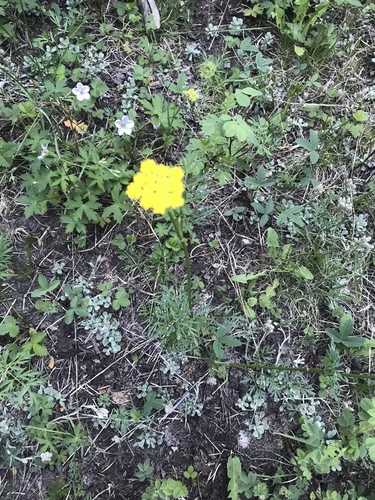
This plant can be confused with the following toxic species. Always verify identification carefully before consuming any wild plant.
Poison Hemlock
Conium maculatum
MPF
Sweet fennel
Foeniculum vulgare var. dulce
(c) sstudebaker, some rights reserved (CC BY-NC)
Poison Hemlock: Foul musty smell, white flowers, smooth stems with purple/red blotches.
Sweet fennel: Strong licorice/anise smell, yellow flowers, no purple blotches on stem.
Nutrition
| Part | Moisture | kJ | kcal | Protein | Vit A | Vit C | Iron | Zinc |
|---|---|---|---|---|---|---|---|---|
| Leaves | 86 | 97 | 23 | 2.4 | — | 93 | 2.7 | 0.3 |
Synonyms
Also Known As
Florence fennel
References (11)
- Bianchini, F., Corbetta, F., and Pistoia, M., 1975, Fruits of the Earth. Cassell. p 102
- Biscotti, N. et al, 2018, The traditional food use of wild vegetables in Apulia (Italy) in the light of Italian ethnobotanical literature. Italian Botanist 5:1-24
- Bremness, L., 1994, Herbs. Collins Eyewitness Handbooks. Harper Collins. p 171
- Brown, D., 2002, The Royal Horticultural Society encyclopedia of Herbs and their uses. DK Books. p 213
- Fl. Algerie 1(1):382. 1889
Show all 11 references Hide references
- Gouldstone, S., 1983, Growing your own Food-bearing Plants in Australia. Macmillan p 168
- Kays, S. J., and Dias, J. C. S., 1995, Common Names of Commercially Cultivated Vegetables of the World in 15 languages. Economic Botany, Vol. 49, No. 2, pp. 115-152
- Plants for a Future database, The Field, Penpol, Lostwithiel, Cornwall, PL22 0NG, UK. http://www.scs.leeds.ac.uk/pfaf/
- Schneider, E., 2001, Vegetables from Amaranth to Zucchini: The essential reference. HarperCollins. p 280
- Seidemann J., 2005, World Spice Plants. Economic Usage, Botany, Taxonomy. Springer. p 158
- Zeven, A. C. & de West, J. M. J., 1982, Dictionary of cultivated plants and their regions of diversity. Wageningen. p 119