Apium graveolens var. dulce
L., (Mill.) D.C.
Celery, Stalk celery
gbif· cc-by-nc
d4njam4n
gbif· cc-by-nc
d4njam4n
gbif· cc-by
Meer Planten
Summary
Source: WikipediaApium graveolens, known in English as celery, is an Old World species of flowering plant in the family Apiaceae. It was first described by Carl Linnaeus in 1753. The species is widely naturalised outside of its natural range and is used as a vegetable; modern cultivars have been selected for their leaf stalks (celery), a large bulb-like hypocotyl (celeriac), and their leaves (leaf celery).
Description
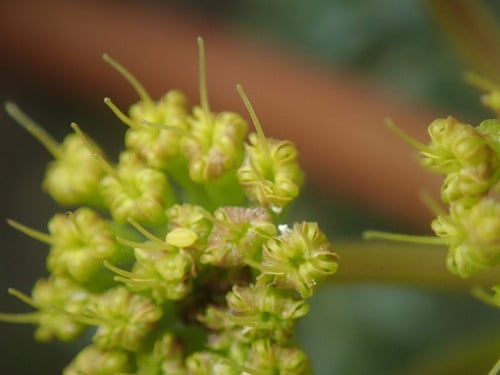
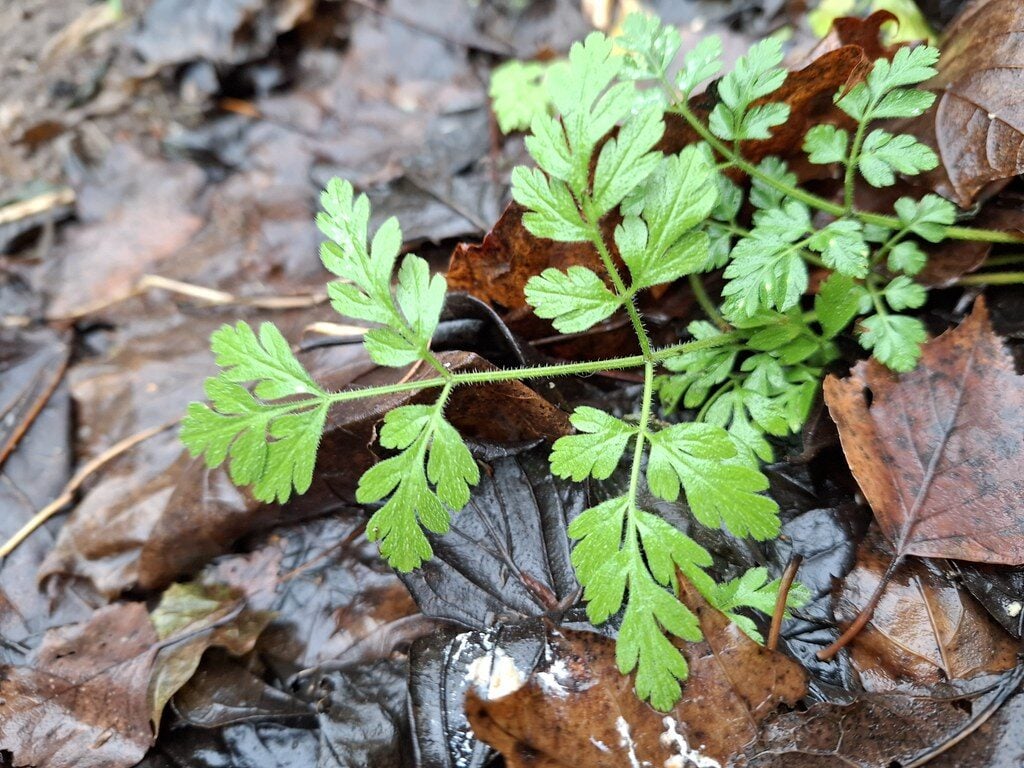
A herb up to 1 m high. It has leaf stalks with ridges and they are like a half circle when cut across. The plant is strong smelling. The plant is smooth and hairless. The leaves are divided into a compound leaf. The wild plant has leaves in tufts from the base or spread along creeping stems. The flowers are white and in small compound arrangements where each flower is on a stalk from the same point.
Edible Uses
Wild celery was used for its medical properties and as a condiment by the Ancient Egyptians, Greeks and Romans, and also in China. The species was later developed as a vegetable, particularly in Italy from the 16th century. Modern cultivars have been selected for different uses, falling into three groups according to the part that is mainly eaten: Celery (Apium graveolens Dulce Group; syn. Apium graveolens var. dulce), is used for its leaf stalks, which may be eaten raw or cooked. Celeriac (Apium graveolens Rapaceum Group; syn. Apium graveolens var. rapaceum), is used for its swollen bulb-like hypocotyl. Leaf celery or smallage (Apium graveolens Secalinum Group; syn. Apium graveolens var. secalinum), has larger leaves; both the leaves and stems are eaten.
Traditional Uses
The leaf stalks are eaten raw or used to flavour foods. The leaves can also be used for flavouring. The dry ripe fruit can be used for flavouring. e.g. in salt. The juice is blended with other vegetable juices. Caution: It is not recommended in large amounts during pregnancy.
Distribution
It is a warm temperate plant. It is mainly grown in the highlands in the tropics. It grows up to about 2100 m altitude. It is damaged by frost. It often grows naturally in swampy conditions. In the tropical lowlands it grows as a small leafy plant but can be used for flavouring. Seed germination is best at 14-21°C. It requires a rich sandy loam soil. Because celery has shallow roots it needs plenty of moisture and does best in humus rich soils. It does best with temperatures below 26°C. It needs a pH between 5.8-7.0. It suits plant hardiness zones 5-10.
Where It Grows
Africa, Algeria, Asia, Australia, Balkans, Britain, Cambodia, Cameroon, Caucasus, Central Africa, Chad, China, Cook Islands, Côte d'Ivoire, East Africa, East Timor, Egypt, Eritrea, Ethiopia, Europe*, Fiji, France, Hawaii, Himalayas, Hungary,India, Indochina, Indonesia, Iran, Iraq, Ivory Coast, Japan, Kenya, Kyrgyzstan, Laos, Macedonia, Malawi, Malaysia, Mediterranean, Middle East, Mozambique, Nepal, Netherlands, New Zealand, Niger, Nigeria, North Africa, Pacific, Papua New Guinea, PNG, Philippines, Sahel, Scandinavia, SE Asia, Serbia, Singapore, Slovenia, South Africa, Southern Africa, Sri Lanka, Sweden, Switzerland, Tanzania, Thailand, Timor-Leste, Tonga, Turkey, Türkiye, Tuvalu, USA, West Africa, Zambia, Zimbabwe,
Cultivation
Plants are mostly grown from seed and transplanted. Seedlings are spaced at 10-25 cm apart. To produce white stalks, the plant is wrapped up or soil is mounded up around the plant. Newer varieties will naturally form whiter stalks. Plants should be grown close together to keep sunlight off the stalks. This applies especially for the naturally whitening (blanching) varieties. The stalks are cut before the plant flowers.
Production
Leaf stalks take about 9 months from seed until harvest.
Other Information
It is a commercially cultivated vegetable. Plants are fairly commonly seen in highland markets in Papua New Guinea.
Notes
There are about 20 Apium species.
Synonyms
Also Known As
Hon k'an, Seledri
References (44)
- Bernholt, H. et al, 2009, Plant species richness and diversity in urban and peri-urban gardens of Niamey, Niger. Agroforestry Systems 77:159-179
- Bianchini, F., Corbetta, F., and Pistoia, M., 1975, Fruits of the Earth. Cassell. p 98
- Blamey, M and Grey-Wilson, C., 2005, Wild flowers of the Mediterranean. A & C Black London. p 160
- Burkill, H. M., 1985, The useful plants of west tropical Africa, Vol. 2. Kew.
- Burnie, G & Fenton-Smith, J., 1999, A Grower's Guide to Herbs. Murdoch Books. p 20
Show all 44 references Hide references
- Cheifetz, A., (ed), 1999, 500 popular vegetables, herbs, fruits and nuts for Australian Gardeners. Random House p 33
- Chin, H. F., 1999, Malaysian Vegetables in Colour. Tropical Press. p 69
- Cundall, P., (ed.), 2004, Gardening Australia: flora: the gardener's bible. ABC Books. p 164
- Esperanca, M. J., 1988. Surviving in the wild. A glance at the wild plants and their uses. Vol. 1. p 201
- Facciola, S., 1998, Cornucopia 2: a Source Book of Edible Plants. Kampong Publications, p 15
- Flora of China. www.eFloras.org
- Foo, J.T.S.(ed), 1996, A Guide to Common Vegetables. Singapore Science Foundation. p
- French, B., 1986, Food Plants of Papua New Guinea, Asia Pacific Science Foundation p 129
- French, B.R., 2010, Food Plants of Solomon Islands. A Compendium. Food Plants International Inc. p 150
- Hadfield, J., 2001, The A-Z of Vegetable Gardening in South Africa. Struik p 102
- http://palaeoworks.anu.edu.au/Nuno_PhD/04.pdf re Timor
- Hu, Shiu-ying, 2005, Food Plants of China. The Chinese University Press. p 592
- Kays, S. J., and Dias, J. C. S., 1995, Common Names of Commercially Cultivated Vegetables of the World in 15 languages. Economic Botany, Vol. 49, No. 2, pp. 115-152
- Kiple, K.F. & Ornelas, K.C., (eds), 2000, The Cambridge World History of Food. CUP p 1748
- Kybal, J., 1980, Herbs and Spices, A Hamlyn Colour Guide, Hamlyn Sydney p 38
- Macmillan, H.F. (Revised Barlow, H.S., et al), 1991, Tropical Planting and Gardening. Sixth edition. Malayan Nature Society. Kuala Lumpur. p 362
- Martin, F.W. & Ruberte, R.M., 1979, Edible Leaves of the Tropics. Antillian College Press, Mayaguez, Puerto Rico. p 121
- Molla, A., Ethiopian Plant Names. http://www.ethiopic.com/aplants.htm
- Mulherin, J., 1994, Spices and natural flavourings. Tiger Books, London. p 33
- Niwano, Y. et al., 2009, Extensive Screening for Plant Foodstuffs in Okinawa, Japan with Anti-Obese Activity on Adipocytes, in vitro. Plant Foods in Human Nutrition 64:6-10
- Ochse, J. J. et al, 1931, Vegetables of the Dutch East Indies. Asher reprint. p 699
- Phon, P., 2000, Plants used in Cambodia. © Pauline Dy Phon, Phnom Penh, Cambodia. p 42
- Plants for a Future database, The Field, Penpol, Lostwithiel, Cornwall, PL22 0NG, UK. http://www.scs.leeds.ac.uk/pfaf/
- Purseglove, J.W., 1968, Tropical Crops Dicotyledons, Longmans. p 648
- Rukmana, R., 1995, Bertanam Seledri. Penerbit Kanisius.
- Seidemann J., 2005, World Spice Plants. Economic Usage, Botany, Taxonomy. Springer. p 45
- Shah, S. K., 2014, Dietary contribution of underutilized minor crops and indigenous plants collected from uncultivated lands and forests in Nepal. in Promotion of Underutilized Indigenous Food Resources for Food Security and Nutrition in Asia and Pacific. FAO. Bangkok p 64
- Sharma, B.B., 2005, Growing fruits and vegetables. Publications Division. Ministry of Information and broadcasting. India. p 216
- Solomon, C., 2001, Encyclopedia of Asian Food. New Holland. p 71
- Sukenti, K., et al, 2016, Ethnobotanical study on local cuisine of the Sasak tribe in Lombok Island, Indonesia. Journal of Ethnic Foods. 3 (2016) 189-200 p 198
- Syn. pl. 1:320. 1805
- Thaman, R.R., 1976, The Tongan Agricultural System, University of the South Pacific, Suva, Fiji. p 381
- Thaman, R. R, 2016, The flora of Tuvalu. Atoll Research Bulletin No. 611. Smithsonian Institute p 63
- Tindall, H.D., 1983, Vegetables in the Tropics, Macmillan p 399
- Tyagi, R. K., et al, 2004, Conservation of Spices Germplasm in India. Indian J. Plant Genet. Resour. 17(3): 163-174
- USDA, ARS, National Genetic Resources Program. Germplasm Resources Information Network - (GRIN). [Online Database] National Germplasm Resources Laboratory, Beltsville, Maryland. Available: www.ars-grin.gov/cgi-bin/npgs/html/econ.pl (10 April 2000)
- van Wyk, B., 2005, Food Plants of the World. An illustrated guide. Timber press. p 64
- Wiersema, J. H. & Leon, B., 2013, World Economic Plants. A Standard Reference CRC Press. 2nd Ed. p 60
- Zeven, A. C. & de West, J. M. J., 1982, Dictionary of cultivated plants and their regions of diversity. Wageningen. p 118