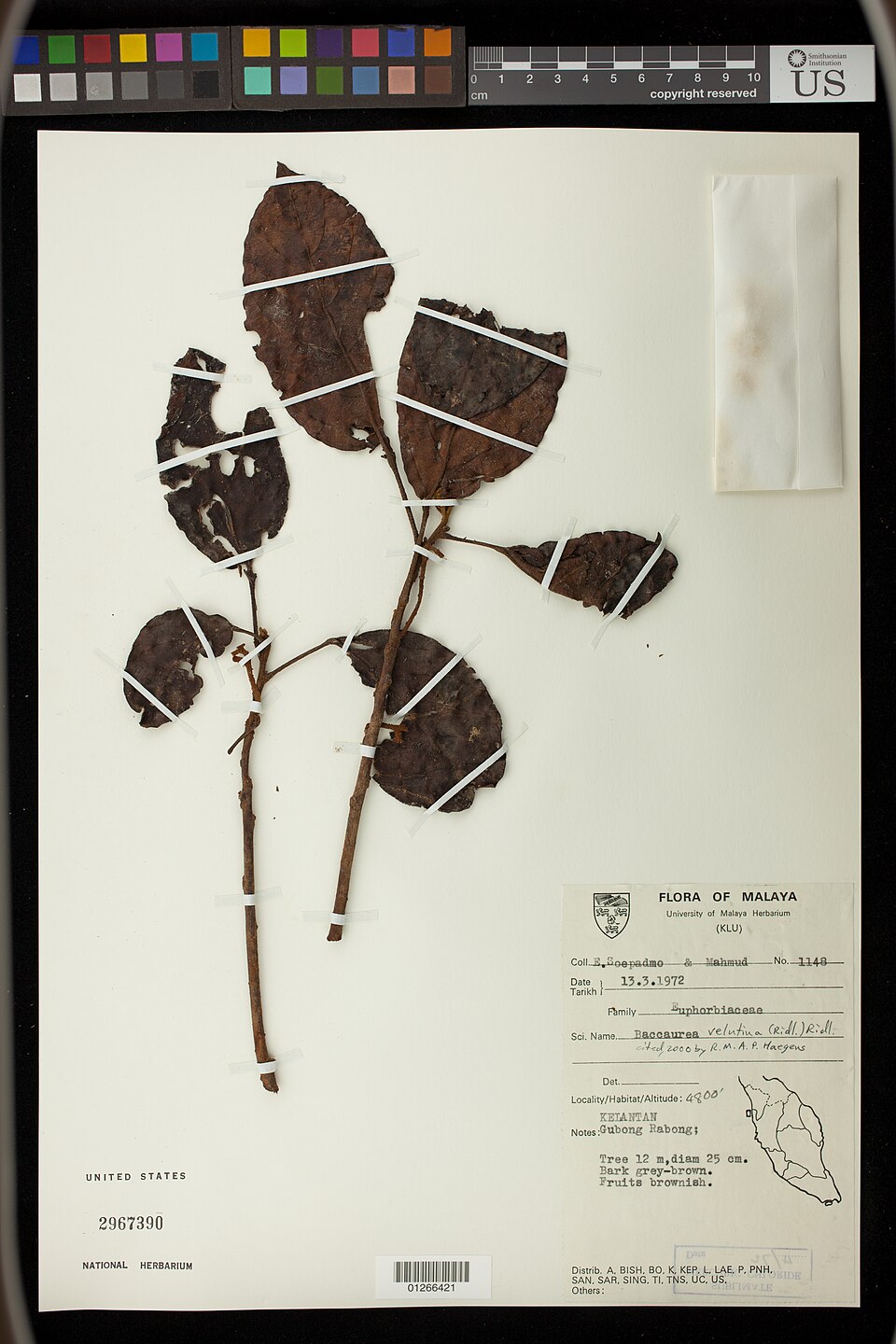
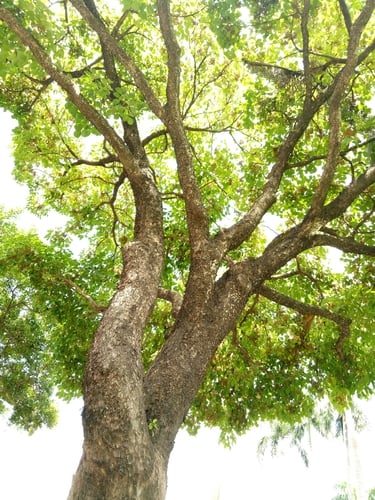
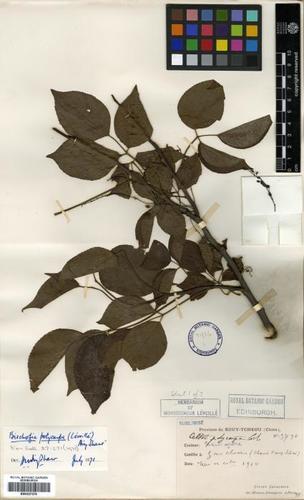
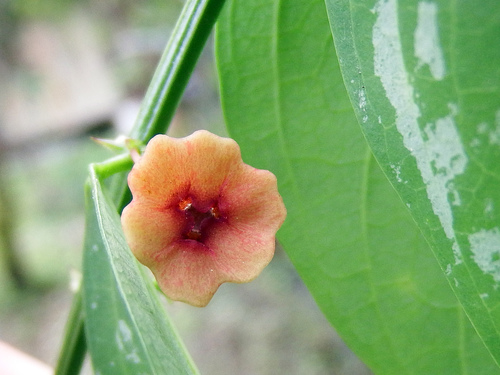
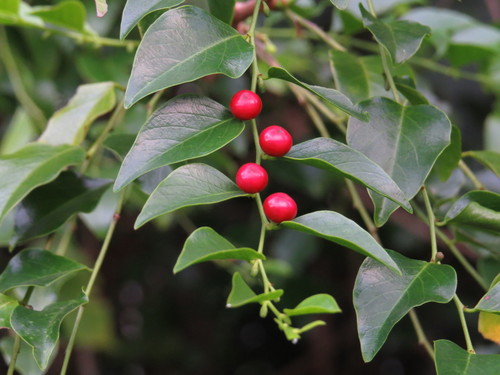
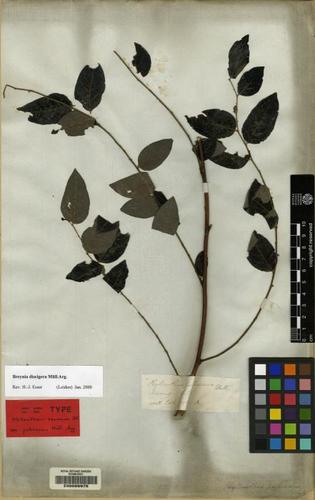
Flueggea virosa
(Roxb. ex Willd.) Royle
White Raisin, White Currant Bush
iNaturalist· cc0
no rights reserved, uploaded by 葉子
iNaturalist· cc0
no rights reserved, uploaded by 葉子
iNaturalist· cc-by
(c) Cheng-Tao Lin, some rights reserved (CC BY), uploaded by Cheng-Tao Lin
Description
A small shrub. It normally has many stems. The bark is reddish-brown. It grows 2-6 m high and spreads 1-2 m wide. It loses its leaves during the dry season. The branches are angular and sometimes have spines. The leaves are in 2 rows arranged alternately. The leaves are oval and vary in size. The blade is 3.5-8.5 cm long by 2.5-5.5 cm wide. They are light green above and paler underneath. The veins form a network and are prominent underneath the leaf. The tip is pointed. The flowers are tiny and cream with male and female flowers on separate trees. They are 0.1-0.2 cm long and in clusters in the axils of leaves. There are more male flowers than female. The fruit is a round fleshy berry. It is 0.5-0.8 cm across. The fruit are white when ripe and contain 3-4 small seeds. The fruit is edible.
Edible Uses
The ripe fruit is eaten raw and is especially popular with children. The leaves are cooked and eaten as a vegetable.
Traditional Uses
The ripe fruit is eaten raw. Caution: The fruit should probably not be eaten in large amounts due to alkaloids. CAUTION: The bark and probably the leaves contain poisonous alkaloids. The leaves are cooked and eaten as a vegetable.
Medicinal Uses
The plant is widely used in traditional medicine, being employed in the treatment of many different conditions. All parts of the plant are used, but the root is considered the most active part. A range of medically active compounds have been identified in the plant including tannins and several alkaloids. Securine is the main alkaloid present, and as many as ten alkaloids closely related to it have been determined present in the plant. The alkaloids, viroallosecurinine, virosecurinine and virosine, have been recorded from the leaves. Ethanol and chloroform extracts of the plant have shown significant antimicrobial activities, and moderate antioxidant and free-radical scavenging activities. A methanol extract of the dried fruit pulp and the ethanolic root extract have shown significant antifungal activities against Trichytum mentagrophytes and Candida albicans. Methanol and water extracts of the leaves have shown strong antimalarial activity, significantly inhibiting the growth of Plasmodium falciparumin vitro in a dose-dependent manner. Bergenin has shown an inhibitory effect on the growth of the bloodstream form of Trypanosoma brucei. It has also shown significant anti-arrhythmic activity in rats and has good potential for treating cardiac arrhythmias. Bergenin has also shown a significant lipid-lowering and atherogenic index decrease in hyperlipidaemic rats. Bergenin is also extracted from other plant species; in Asia especially it is used for many pharmacological purposes, several of which are in line with traditional uses of this species in Africa. Oral administration of bergenin has shown significant protection against pylorus-ligated and aspirin-induced gastric ulcers in rats and cold restraint stress-induced gastric ulcers in rats and guinea pigs. Alcoholic leaf extracts showed significant cytotoxicity in different tumourcell lines in vitro. Virosecurinine was primarily responsible for the cytotoxicity; viroallosecurinine was only cytotoxic to one of the cell lines. A root bark extract and a total alkaloid preparation caused a transient fall in arterial blood pressure in dogs. Extracts of roots and root bark had a slightly depressive action on the isolated intestine of rabbits, which rapidly normalized. The extracts showed weak haemolytic activity. An aqueous root extract showed a slight activity in the oral glucose tolerance test in rabbits, but did not lower blood glucose below fasting levels in either the fed or fasted state. The root is the most commonly used and most pharmacologically active part of the plant. It is seen as analgesic, astringent, ophthalmic, purgative, sedative and soporific. It is used by itself or in conjunction with other plants, often to provide synergistic effect for liver, bile, kidney and urino-genital complaints, diuresis, renal stone, schistosomiasis, rheumatism, venereal diseases, orchitis, dysmenorrhoea, frigidity, sterility, arthritis, etc. Water in which the roots have been boiled is taken as a treatment for schistosomiasis, stomach aches, dysmenorrhoea, and is given to nursing mothers whose milk is unsuited for the child, or whose baby is sickly at birth or to mothers who have still-born babies; it is also used for treating infestation of intestinal worms and for infected ears. Combined with Anacardium occidentale it is seen as an aphrodisiac and an elixir of longevity. The root-sap, combined with fat, is a recognised soothing ointment. The powdered charcoal is used as a cicatrizant on wounds. All parts of the plant are used in China to treat eczema, rheumatoid arthritis etc. The leaves are considered aphrodisiac and laxative. They are used to treat fevers, venereal disease and constipation. A leaf-macerate is added to baths and applied in massage as a stimulant in the treatment of fatigue and stiffness. A leaf-decoction is used in draughts or baths for treating fevers. A warm paste made from the leaves is an excellent wound-healer. The leaf-sap is used in the treatment of epilepsy and, combined with other plants, is used as a tranquilliser in cases of insanity. The leaf-sap, or the leaf mashed into a paste with tobacco, is applied externally to destroy worms in sores. A two hour hot water infusion of the whole plant is said to be stimulant when taken as a broth. A decoction of the plant is used as a lotion to impart strength. The bark is astringent. In some areas it is considered too poisonous to use medicinally, whilst in others it is used even in children’s medicine. The fruit, mixed with pulses, is eaten to relieve digestive disorders. Women are said to eat the fruit in order to promote fertility.
Known Hazards
The fruit should probably not be eaten in large amounts due to alkaloids. The bark and probably the leaves contain poisonous alkaloids.
Distribution
A tropical plant. It suits tropical or subtropical places. It grows in coastal monsoon vine thickets. It is usually on sandy soil. It grows in dryland areas. It grows in the Sahel. It occurs in deciduous woodland and on rocky outcrops. It does best in well-drained soils but will grow in sandy and dry soils. It can tolerate drought. It is best in neutral or alkaline soils. It can tolerate salty conditions. It is sensitive to frost. It grows on river flats and well drained rocky slopes. It can grow in hot arid places. It needs an annual rainfall above 150 mm. It needs a sunny position. In Ethiopia it grows between 400-2,050 m altitude. It can grow in arid places. In Yunnan.
Where It Grows
Africa, Angola, Arabia, Asia, Australia, Benin, Bhutan, Botswana, Burkina Faso, Burundi, Cambodia, Cameroon, Central Africa, Central African Republic, CAR, Chad, China, Comoros, Congo, Côte d'Ivoire, East Africa, East Timor, Egypt, Eswatini, Ethiopia, Gabon, Gambia, Ghana, Guinea, Guinée, Guinea-Bissau, Himalayas, India, Indochina, Indonesia, Ivory Coast, Japan, Kenya, Laos, Liberia, Madagascar, Malawi, Malaysia, Mali, Mauritania, Middle East, Mozambique, Myanmar, Namibia, Nepal, Niger, Nigeria, North Africa, North America, Northeastern India, Pacific, Papua New Guinea, PNG, Philippines, Polynesia, Reunion, Rwanda, Sahel, Saudi Arabia, SE Asia, Senegal, Sierra Leone, Somalia, South Africa, Southern Africa, South Sudan, Sri Lanka, Sudan, Swaziland, Taiwan, Tanzania, Thailand, Timor-Leste, Togo, Uganda, West Africa, Yemen, Zambia, Zimbabwe,
Cultivation
Plants can be grown from seed. These should have the pulp washed off. Plants can develop a suckering habit if subject to constant fires. Plants should be spaced 2-3 m apart. If they are used for a hedge a spacing of 50 cm is suitable.
Other Uses
Twigs are cut and used as toothbrushes. The bark contains up to 8.9% tannins. A black dye obtained from the bark is used for dyeing matting. A black dye obtained from the leaves is used to dye palm-fibres. It is considered of low quality as it gives an irregular colour. A red dye is obtained by pounding the fruit in a little hot water. The dye can be used as red ink[299. 332]. The wood-ash is used to clean milk-containers. A gum is obtained from the stems which has been used for sealing envelopes. The pounded leaves are used as an insect repellent. The tough virgate stems are commonly used to make beds, fishing-stakes, wicker-traps, walking sticks, for part of roof-structures of Fula huts, to reinforce granaries, etc. They are woven into 'shelves' and also split for use in basketry. The reddish-yellow wood is fine-textured, close-grained, hard, strong, elastic and is said to be durable. The wood, especially from plants in W. Africa, is usually too small to be of much use apart from fuel, but when large enough it is used to make items such as chair-legs and kitchen utensils, or as poles for huts. The wood is a good fuel and is also used to make charcoal. With its attractive foliage and white waxy berries, the bushy nature of the plant ideally lends itself to use as an ornamental hedge. Where growing wild, the plant is seen as an indicator of ground water.
Production
It is fast growing.
Other Information
The fruit are popular. The ripe fruit are eaten especially by children.
Notes
Flueggea virosa subsp. melanthesoides is now recognised as an accepted name.
Nutrition
| Part | Moisture | kJ | kcal | Protein | Vit A | Vit C | Iron | Zinc |
|---|---|---|---|---|---|---|---|---|
| Fruit | 75.9 | 476 | 114 | 1.4 | — | 1 | 8.9 | 0.3 |
| Fruit raw | 83.3 | 112 | 27 | 1.3 | — | 40 | 0.9 | — |
| Fruit stewed | 85.7 | 96 | 23 | 1.1 | — | 31 | 0.8 | — |
Synonyms
Also Known As
Akano, Anbamar, Aramia, Awagino, Bakarcha, Bhubhubhu, Bilihooli, Changaume, Chong belut, Dalme, Dieng-krong-wait-lam, Dumikron, Hepata, Horte, Ikelebuki, Iktibi, Imer, Irubulai, Janjingi, Kagena, Kago, Kamemena, Kang pla, Kanilehya, Kau kara, Kecacule, Kodarsi, Kon-chinya, Kottagom, Kudjung, Latian, Mai-kang-pa, Mantel-kung, Maparangasa, Mavhelematshema, Mekarayi, Mkwamba, Mkwambakwamba, Mkwamba dume, M'palo, Mkwamba, Mkwambekwambe, Monwana, Motatana, Motatang, Motlhalabu, Mpombona, Mserechete, Muchagauwe, Mudyambuzi, Mugurumhanda, mu-Kuuru, Mukuluu, Mukururu, Mukwamba, Muruturu, Musangaoma, Mushagahuwe, Mushikiti, Musosoti, Mutangauma, Muzurumbu, Nkanaa, N'tiele, Nundhiki, Panbiri, Pangharphali, Parntirringa, Paropo, Patala, Perinklavu, Petuni, Phalame, Pisrungi, Pithondi, Pithoni, Pomboma, Prembilutan, Qatchechelo, Remrehorte, Rithoul, Sai-sek, Sai-siak, Sefamaeba, Shasha, Shikuri, Shinwi, Sigar jalak, Sisian, Snowberry, Snowberry tree, Sugane, Sulamunta, Tella pulcheri, Thumri, Tingroi, Tokphal, Trembilutan, Umhagawuwe, Umklankomo, Vellaippula, Vellapula, Wak, Waradhula, Wart-stem, White-berry bush, Ye-chinya, Ye-gyin-ya
References (126)
- Abbiw, D.K., 1990, Useful Plants of Ghana. West African uses of wild and cultivated plants. Intermediate Technology Publications and the Royal Botanic Gardens, Kew. p 48 (As Securinega virosa)
- Adansonia 6:334. 1866 - [As (Roxb. ex Willd.) Baill.] (As Securinega virosa)
- Ambasta, S.P. (Ed.), 2000, The Useful Plants of India. CSIR India. p 226, 564 (As Securinega virosa)
- Anderson, E. F., 1993, Plants and people of the Golden Triangle. Dioscorides Press. p 220 (As Securinega virosa)
- Asfaw, Z. and Tadesse, M., 2001, Prospects for Sustainable Use and Development of Wild Food Plants in Ethiopia. Economic Botany, Vol. 55, No. 1, pp. 47-62
Show all 126 references Hide references
- Ashagre, M., et al, 2016, Ethnobotanical study of wild edible plants in Burji District, Segan Area Zone of Southern Nations, Nationalities and Peoples Region (SNNPR), Ethiopia. Journal of Ethnobiology and Ethnomedicine (2016) 12:32
- Awas, T., 1997, A Study on the Ecology and Ethnobotany of Non-cultivated Food Plants and Wild Relatives of Cultivated crops in Gambella Region, Southwestern Ethiopia. Addis Ababa University. p 49
- Bandyopadhyay, S., et al, 2012, A Census of Wild Edible Plants from Howrah District, West Bengal, India. Proceedings of UGC sponsored National Seminar 2012
- Beasley, J., 2011, Plants of Tropical North Queensland - the compact guide. Footloose publications. p 66
- Bekele-Tesemma A., Birnie, A., & Tengnas, B., 1993, Useful Trees and Shrubs for Ethiopia. Regional Soil Conservation Unit. Technical Handbook No 5. p 254 (As Securinega virosa)
- Bonou, A., et al, 2013, Valeur economique des Produits Forestiers Non Ligneux (PFNL) au Benin. Editions Universitaires Europeennes p 92
- Brock, J., 1993, Native Plants of Northern Australia, Reed. p 191 (As Securinega virosa)
- BROKENSHA & RILEY, (As Securinega virosa)
- Burkill, I.H., 1966, A Dictionary of the Economic Products of the Malay Peninsula. Ministry of Agriculture and Cooperatives, Kuala Lumpur, Malaysia. Vol 1 (A-H) p 1044 (As Securinega virosa)
- Burkill, H. M., 1985, The useful plants of west tropical Africa, Vol. 2. Kew.
- Calvert, G., 2010, The Burdekin Delta Tree Guide. Lower Burdekin Landcare Association., Inc., Ayr p 89
- Cancilla, D., 2018, Ethnobotanical and Ethnozoological Values Desktop Assessment - Eliwana Project. p 42
- Chakraborty, S. & Chaturbedi, H. P., 2014, Some Wild Edible Fruits of Tripura- A Survey. Indian Journal of Applied research. (4) 9
- Cherikoff V. & Isaacs, J., The Bush Food Handbook. How to gather, grow, process and cook Australian Wild Foods. Ti Tree Press, Australia p 200 (As Securinega virosa)
- Cherikoff V. & Isaacs, J., The Bush Food Handbook. How to gather, grow, process and cook Australian Wild Foods. Ti Tree Press, Australia p 190 (As Securinega virosa)
- Crawford, I. M., 1982, Traditional Aboriginal Plant Resources in the Kalumburu Area: Aspects in Ethno-economics. Records of the Western Australian Museum Supplement No. 15 (As Securinega virosa subsp. melanthesoides)
- Cribb, A.B. & J.W., 1976, Wild Food in Australia, Fontana. p 75 (As Securinega virosa)
- Dale, I. R. and Greenway, P. J., 1961, Kenya Trees and Shrubs. Nairobi. p 220 (As Securinega virosa)
- Dalziel, J. M., 1937, The Useful plants of west tropical Africa. Crown Agents for the Colonies London.
- Dangol, D. R. et al, 2017, Wild Edible Plants in Nepal. Proceedings of 2nd National Workshop on CUAOGR, 2017
- Diarra, N. et al, 2016, Etude ethnobotanique des plantes alimentaires utilisées en période de soudure dans les régions Sud du Mali. Int. J. Biol. Chem. Sci. 10(1): 184-197
- Dobriyal, M. J. R. & Dobriyal, R., 2014, Non Wood Forest Produce an Option for Ethnic Food and Nutritional Security in India. Int. J. of Usuf. Mngt. 15(1):17-37 (As Securinega virosa)
- Ethiopia: Famine Food Field Guide. http://www.africa.upenn.edu/faminefood/category3.htm
- Schatz, G.E., 2001, Generic Tree Flora of Madagascar. Royal Botanical Gardens, Kew and Missouri Botanical Garden. p 155 (As Flueggea virosa)
- Elliot, W.R., & Jones, D.L., 1992, Encyclopedia of Australian Plants suitable for cultivation. Vol 4. Lothian. p 308 (Drawing) (As Securinega virosa)
- Feyssa, D. H., et al, 2011, Seasonal availability an consumption of wild edible plants in semiarid Ethiopia; Implications to food security and climate change adaptation. Journal of Horticulture and Forestry 3(5): 138-149
- Flora of Pakistan. www.eFloras.org
- Fowler, D. G., 2007, Zambian Plants: Their Vernacular Names and Uses. Kew. p 26
- Fox, F. W. & Young, M. E. N., 1982, Food from the Veld. Delta Books. p 195 (As Securinega virosa)
- Gallagher, D. E., 2010, Farming beyond the escarpment: Society, Environment, and Mobility in Precolonial Southeastern Burkina Faso. PhD University of Michigan. (As Securinega virosa)
- Gautam, R. S., et al, 2020, Wild Edible Fruits of Nepal. Int. J. Appl. Sci. Biotechnol. Vol 8(3): 289-304
- Grivetti, L. E., 1980, Agricultural development: present and potential role of edible wild plants. Part 2: Sub-Saharan Africa, Report to the Department of State Agency for International Development. p 47 (As Securinega virosa)
- Guite, C., 2016, Study of wild edible plants associated with the Paite Tribe of Manipur, India. International Journal of Current Research. Vol. 8, Issue 11, pp. 40927-40932 (As Securinega virosa)
- Hardwick, G., 2001, Economically Useful Plants for Northern Australia: Master Species List. Crusader eBooks.
- Hedrick, U.P., 1919, (Ed.), Sturtevant's edible plants of the world. p 311 (As Flueggea microcarpa)
- Henty, E.E., 1980, Harmful Plants in Papua New Guinea. Botany Bulletin No 12. Division Botany, Lae, Papua New Guinea. p 62, Pl. 23 (As Securinega virosa)
- Heyne, K., 1927, p 902 (As Securinega virosa)
- Hiddins, L., 1999, Explore Wild Australia with the Bush Tucker Man. Penguin Books/ABC Books. p 159 (As Securinega virosa)
- Ichikawa, M., 1980, The Utilization of Wild Food Plants by the Suiei Dorobo in Northern Kenya. J. Anthrop. Soc. Nippon. 88(1): 25-48 (As Securinega virosa)
- INFOODS:FAO/INFOODS Databases (As Securinega virosa)
- Jackes, B.R., 2001, Plants of the Tropics. Rainforest to Heath. An Identification Guide. James Cook University. p 52 (As Securinega virosa)
- Jadhav, R., et al, 2015, Forest Foods of Northern Western Ghats: Mode of Consumption, Nutrition and Availability. Asian Agri-History Vol. 19, No. 4: 293-317
- Jardin, C., 1970, List of Foods Used In Africa, FAO Nutrition Information Document Series No 2.p 161(As Securinega virosa)
- Johns, T., and Kokwaro, J.O., 1991, Food Plants of the Luo of Siayo District, Kenya. Economic Botany 45(1), pp 103-113 (As Securinega virosa)
- JSTOR Global Plants edible (As Securinega virosa)
- Kar, A., et al, 2013, Wild Edible Plant Resources used by the Mizos of Mizoram, India. Kathmandu University Journal of Science, Engineering and Technology. Vol. 9, No. 1, July, 2013, 106-126 (As Securinega virosa)
- Kebebew, M. & Leta, G., 2016, Wild Edible Plant Bio-diversity and Utilization System in Nech Sar National Park, Ethiopia. International Journal of Bio-resource and Stress Management 2016, 7(4):885-896
- Kenneally, K.E., Edinger, D. C., and Willing T., 1996, Broome and Beyond, Plants and People of the Dampier Peninsula, Kimberley, Western Australia. Department of Conservation and Land Management. p 103 (As Securinega virosa)
- Kuhnlein, H. V., et al, 2009, Indigenous Peoples' food systems. FAO Rome p 176
- Kuo, W. H. J., (Ed.) Taiwan's Ethnobotanical Database (1900-2000), http://tk.agron.ntu.edu.tw/ethnobot/DB1.htm (As Securinega virosa)
- Lands, M., 1987, Mayi: Some Bush fruits of Dampierland. Magabala Books, Broome West Australia. p 9 (As Securinega virosa)
- Lazarides, M. & Hince, B., 1993, Handbook of Economic Plants of Australia, CSIRO. p 116 (As Securinega virosa)
- Lazarides, M. & Hince, B., 1993, Handbook of Economic Plants of Australia, CSIRO. p 215 (As Securinega melanthesoides)
- Le Houerou, H. N., (Ed.), 1980, Browse in Africa. The current state of knowledge. International Livestock Centre for Africa, Ethiopia. p 162 (As Securinega virosa)
- Levitt, D., 1981, Plants and people. Aboriginal uses of plants on Groote Eylandt. Australian Institute of Aboriginal Studies, Canberra. p 96 (As Securinega virosa)
- Long, C., 2005, Swaziland's Flora - siSwati names and Uses http://www.sntc.org.sz/flora/
- Low, T., 1991, Wild Food Plants of Australia. Australian Nature FieldGuide, Angus & Robertson. p 146 (As Securinega virosa)
- Luoga, E. J., et al, 2000, Differential Utilization and Ethnobotany of Trees in Kitulanghalo Forest Reserve and Surrounding Communal Lands, Eastern Tanzania. Economic Botany, Vol. 54, No. 3, pp. 328-343
- Lyle, S., 2006, Discovering fruit and nuts. Land Links. p 210
- Magwede, K., van Wyk, B.-E., & van Wyk, A. E., 2019, An inventory of Vhavenḓa useful plants. South African Journal of Botany 122 (2019) 57–89
- Majumdar, K and Datta, N., 2009, Traditional wild edible fruits for the forest dwellers of Tripura, India. Pleione 3(2) 167-178 (As Securinega virosa)
- Malaisse, F., 1997, Se nourrir en floret claire africaine. Approche ecologique et nutritionnelle. CTA., p 91.
- Manandhar, N.P., 2002, Plants and People of Nepal. Timber Press. Portland, Oregon. p 421 (As Securinega virosa)
- Mannheimer, C. A. & Curtis. B.A. (eds), 2009, Le Roux and Muller's Field Guide to the Trees and Shrubs of Namibia. Windhoek: Macmillan Education Namibia. p 248
- Maroyi, A., 2011, The Gathering and Consumption of Wild Edible Plants in Nhema Communal Area, Midlands Province, Zimbabwe. Ecology of Food and Nutrition 50:6, 506-525
- Maroyi, A. & Cheikhyoussef, A., 2017, Traditional knowledge of wild edible fruit in southern Africa: A comparative use patterns in Namibia and Zimbabwe. Indian Journal of Traditional Knowledge. 16(3): 385-392
- Mashile, S. P., et al, 2019, Indigenous fruit plants species of the Mapulana of Ehlanzeni district in Mpumalanga province, South Africa. South African Journal of Botany 122 (2019) 180–183
- Maundu, P. et al, 1999, Traditional Food Plants of Kenya. National Museum of Kenya. 288p
- Maydell, H. von, 1990, Trees and shrubs of the Sahel: their characteristics and uses. Margraf. p 375 (As Securinega virosa)
- Mengistu, F. & Hager, H., 2008, Wild Edible Fruit Species Cultural Domain, Informant Species Competence and Preference in Three Districts of Amhara Region, Ethiopia. Ethnobotany Research & Applications 6:487-502
- Milson. J., 2000, Trees and Shrubs of north-west Queensland. DPI p 66 (As Securinega virosa)
- Morley, B.D., & Toelken, H.R., (Eds), 1983, Flowering Plants in Australia. Rigby. p 135 (As Securinega obovata)
- Msuya, T. S., et al, 2010, Availability, Preference and Consumption of Indigenous Foods in the Eastern Arc Mountains, Tanzania, Ecology of Food and Nutrition, 49:3, 208-227
- Mutie, F. G., 2020, Conservation of Wild Food Plants and Their Potential for Combatting Food Insecurity in Kenya as Exemplified by the Drylands of Kitui County. Plants 2020, 9, 1017
- Mutie, F. M., et al, 2023, Important Medicinal and Food Taxa (Orders and Families) in Kenya, Based on Three Quantitative Approaches. Plants 2023, 12, 1145
- Newman, 1970,
- Norrington, L., & Campbell, C., 2001, Tropical Food Gardens. Bloomings Books. p 88 (As Securinega virosa)
- Oryema, C., et al, 2013, Edible wild fruit species of Gulu District, Uganda. International Journal of Biology and Biological Sciences Vol 2(4) pp 068-082 (Also as Securinega virosa)
- Palgrave, K.C., 1996, Trees of Southern Africa. Struik Publishers. p 396 (As Securinega virosa)
- Palmer & Pitman, 1972,
- Peters, C. R., O'Brien, E. M., and Drummond, R.B., 1992, Edible Wild plants of Sub-saharan Africa. Kew. p 110
- Prachi, K., et al, 2012, Underutilized wild fruits of North Maharashtra. Journal of Research in Plant Sciences. (2012) 1:071-076 (As Securinega virosa)
- PROSEA No. 3
- Ramachandran, V. S., 2007, Wild edible plants of the Anamalais, Coimbatore district, western Ghats, Tamil Nadu. Indian Journal or Traditional Knowledge. 6(1) pp 173-176
- RILEY & BROKENSHA,
- Rogers, A., 2007, Karrwa Plants and their Uses. draft. p 4
- Roodt, V., 1998, Trees & Shrubs of the Okavango Delta. Medicinal Uses and Nutritional value. The Shell Field Guide Series: Part 1. Shell Botswana. p 193
- Roth, W.E., 1901, (As Securinega obovata)
- Royal Botanic Gardens, Kew (1999). Survey of Economic Plants for Arid and Semi-Arid Lands (SEPASAL) database. Published on the Internet; http://www.rbgkew.org.uk/ceb/sepasal/internet [Accessed 16th April 2011]
- Ruffo, C. K., Birnie, A. & Tengnas, B., 2002, Edible Wild Plants of Tanzania. RELMA p 334
- Ruiters-Welcome, A. K., 2019, Food plants of southern Africa. Ph.D. thesis. Univ. of Johannesburg p 86
- Shumsky, S., et al, 2014, Institutional factors affecting wild edible plant (WEP) harvest and consumption in semi-arid Kenya. Land Use Policy 38(2014) 48-69
- Singh, H.B., Arora R.K.,1978, Wild edible Plants of India. Indian Council of Agricultural Research, New Delhi. p 72 (As Securinega virosa)
- Smith, N and Wightman, G.M., 1990, Ethnobotanical Notes from Belyuen Northern Territory Australia. Northern Territory Botanical Bulletin No 10. Parks and Wildlife Commission of the Northern Territory. p 14, 15 (As Securinega virosa)
- Smith, N. M., 1991, Ethnobotanical Field Notes from the Northern Territory, Australia, J. Adelaide Bot. Gard. 14(1): 1-65
- Smith, Nicholas et al. 1993, Ngarinyman Ethnobotany: Aboriginal Plant Use from the Victoria River Area Northern Australia. Northern Territory Botanical Bulletin No 16. Parks and Wildlife Commission of the Northern Territory. p 28, 27 (As Securinega virosa)
- Specht, R.L. 1958, (As Securinega obovata)
- Swaziland's Flora Database http://www.sntc.org.sz/flora
- Tabuti, J.R.S., 2007. Flueggea virosa (Roxb. ex Willd.) Voigt. [Internet] Record from Protabase. Schmelzer, G.H. & Gurib-Fakim, A. (Editors). PROTA (Plant Resources of Tropical Africa), Wageningen, Netherlands. < http://database.prota.org/search.htm>. Accessed 16 October 2009.
- Tebkew, M., 2015 Wild and semi-wild edible plants in Chilga District, Northwestern Ethiopia: Implication for food security and climate change adaptation. Global Journal of Wood Science, Forestry and Wildlife. Vol. 3 (3), pp. 072-082
- Tiwi Plants and Animals. 2001, Aboriginal flora and fauna knowledge from Bathurst and Melville Islands, northern Australia. Northern Territory Botanical Bulletin; No. 24 p 55
- Townsend, K., 1994, Across the Top. Gardening with Australian Plants in the tropics. Society for Growing Australian Plants, Townsville Branch Inc. p 219 (As Securinega virosa)
- Townsend, K., 1999, Field Guide to Plants of the Dry Tropics. Society for Growing Australian Plants, Townsville Branch Inc. p 109
- Tredgold, M.H., 1986, Food Plants of Zimbabwe. Mambo Press. p 122 (As Securinega virosa)
- Upreti, K., et al, 2010, Diversity and Distribution of Wild Edible Fruit Plants of Uttarakhand. Bioversity Potentials of the Himalaya. p 185 (As Securinega virosa)
- Walsh, M., 2009, The Use of Wild and Cultivated Plants as famine Foods on Pemba Island, Zanzibar. Études océan Indien. 42-43
- Wehmeyer, A. S, 1986, Edible Wild Plants of Southern Africa. Data on the Nutrient Contents of over 300 species (As Securinega virosa)
- Welcome, A. K. & Van Wyk, B.-E., 2019, An inventory and analysis of the food plants of southern Africa. South African Journal of Botany 122 (2019) 136–179
- Wheeler, J.R.(ed.), 1992, Flora of the Kimberley Region. CALM, Western Australian Herbarium, p 612 (As Securinega virosa)
- White, F., Dowsett-Lemaire, F. and Chapman, J. D., 2001, Evergreen Forest Flora of Malawi. Kew. p 261 (As Securinega virosa)
- Wightman, Glenn et al. 1991.Alawa Ethnobotany: Aboriginal Plant Use from Minyerri, Northern Australia. Northern Territory Botanical Bulletin No 11. Parks and Wildlife Commission of the Northern Territory. p 17 (As Securinega virosa)
- Wightman, G. & Andrews, M., 1991, Bush Tucker Identikit. Common Native Food Plants of Australia’s top end. Conservation Commission Northern Territory. p 42 (As Securinega virosa)
- Wightman, G. M. & Andrews, M.R., 1989, Plants of Northern Territory Monsoon Vine Forests (Vol 1). Conservation Commission of Northern Territory. p 106 (As Securinega virosa)
- Wightman, Glenn et al. 1992. Mudburra Ethnobotany: Aboriginal Plant Use from Kulumindini (Elliott) Northern Australia. Northern Territory Botanical Bulletin No 14. Parks and Wildlife Commission of the Northern Territory. p 22, 21 (As Securinega virosa)
- Wightman, Glenn et al. 1992, Mangarrayi Ethnobotany: Aboriginal Plant Use from the Elsey Area Northern Australia. Northern Territory Botanical Bulletin No 15. Parks and Wildlife Commission of the Northern Territory. p 28, 27 (As Securinega virosa)
- Wightman, Glenn et al. 1994, Gurindji Ethnobotany: Aboriginal Plant Use from Daguragu Northern Australia. Northern Territory Botanical Bulletin No 18. Parks and Wildlife Commission of the Northern Territory. p 30, 28 (As Securinega virosa)
- Wightman, G. & Brown, J., 1994, Jawoyn Plant Identikit, Common Useful Plants in the Katherine Area of Northern Australia. Conservation Commission Northern Territory. p 46 (As Securinega virosa)
- Wild, 1975,
- World Checklist of Useful Plant Species 2020. Royal Botanic Gardens, Kew
- www.zimbabweflora.co.zw 2011
- Yunupinu Banjgul, Laklak Yunupinu-Marika, et al. 1995, Rirratjinu Ethnobotany: Aboriginal Plant Use from Yirrkala, Arnhem Land, Australia. Northern Territory Botanical Bulletin No 21. Parks and Wildlife Commission of the Northern Territory. p 43 (As Securinega virosa)