Bischofia javanica
Blume
Java cedar
iNaturalist· cc-by-nc
(c) ying_h, some rights reserved (CC BY-NC), uploaded by ying_h
iNaturalist· cc0
no rights reserved, uploaded by 葉子
iNaturalist· cc-by-nc
(c) beingplace, some rights reserved (CC BY-NC), uploaded by beingplace
Summary
Source: WikipediaBischofia javanica, or bishop wood, is a plant species of the family Phyllanthaceae. It and the related Bischofia polycarpa are the only two members of genus Bischofia and tribe Bischofieae. These species are distributed throughout southern and southeast Asia to Australia and Polynesia also in North America (brought to North America as a decorative plant but now considered to be an invasive species). The tree is commonly used by tigers to scratch-mark territory in the jungles of Assam where it is locally called uriam. They also occur in southwestern, central, eastern, and southern China, and also Taiwan, where the indigenous people consider it a sacred tree.
Description
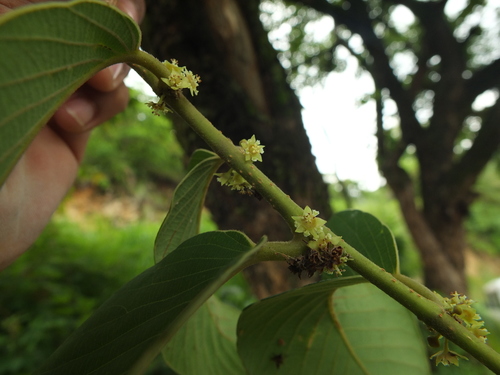
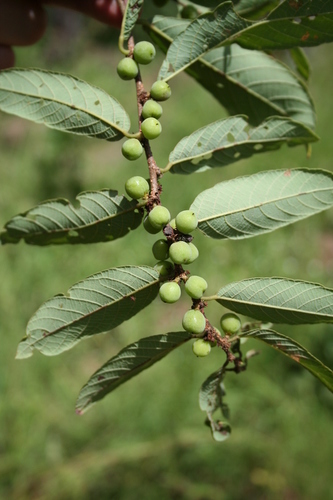
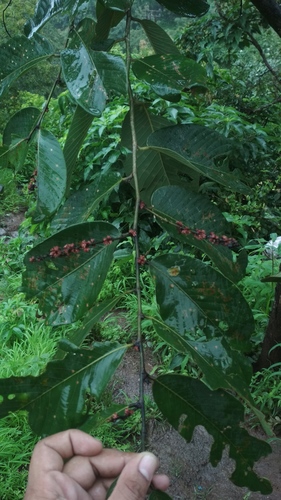
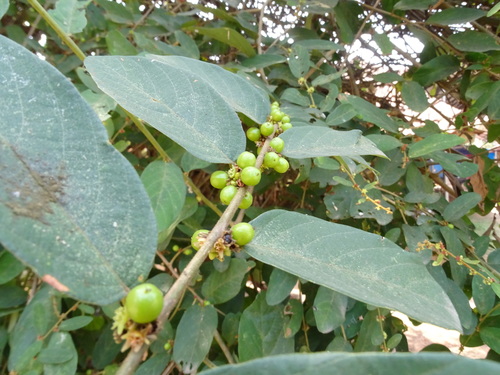
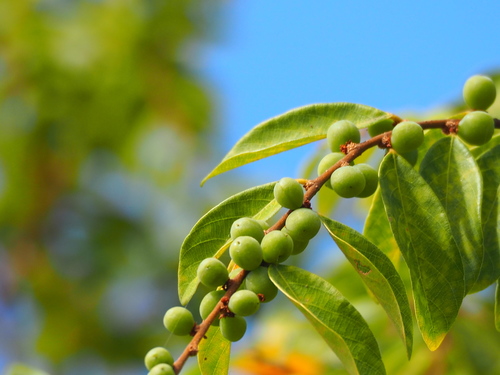
A large stocky tree. It grows up to 40 m tall. It can range from 5 to 30 m tall. The trunk is 1 m across, and straight. The trunk is covered with dull brown scaly bark. It is 2 cm thick and peels off in irregular flakes. The bark gives a red exudate when cut. The branches are numerous and form a dense rounded crown. The leaves are alternate, and with 3 leaflets. The leaf has a long leaf stalk. The leaflets are oval and tapering towards the tip. The edges of the leaflets are toothed. The leaves are dark green and glossy on the upper surface and light green and smooth underneath. The flowering branch has many branches. The individual flowers are small numerous and yellow-green. Trees have male and female flowers on separate plants. The fruit are rounded and fleshy. They have 3 to 4 cells and are reddish brown. They are 3 mm across. They contain 6 small seeds.
Edible Uses
The dark red, dense wood is used as a building material for items ranging from furniture to bridges; it is durable but is difficult to air-dry. It is also ideal as firewood. The fruits are used in making wine. The seeds, which are edible, contain 30–54% oil, which is used as a lubricant. The bark has a high tannin content and is used as a source of red dye to stain rattan baskets and colour tapa cloth. The roots are used medicinally. The leaves are eaten in Southern Laos dipped into chili sauce.
Medicinal Uses
The plant has been shown has been shown to have antiulcer, anthelmintic and antidysenteric activities. The fresh bark is used to treat aching stomachs. The sap of the bark, mixed with lime, is used to treat sore feet. The leaves and the young shoots are an effective treatment for leucorrhoea. vulvovaginitis due to Trichomonas vaginalis. boils and impetigo. An extract is used as unguent and a decoction is prescribed for external application. A decoction of the dried leaves is an efective treatment for diarrhoea. in a dose of 20 to 40g per day, it is also used in the treatment of gingivitis. toothache. cough and sore throat. The crushed leaves are rubbed onto an aching stomach.
Distribution
A tropical plant. It grows in the lowland and lower mountain zones. It grows from sea level to 900 m in Fiji. In Nepal it grows to about 1000 m altitude. It is often in disturbed forest or old garden land. They occur throughout the Philippines in dry open places. It can tolerate some shade and light frost but is best in full sun. It needs fertile, well drained soil. It suits hardiness zones 9-12. In XTBG Yunnan. In Sichuan.
Where It Grows
American Samoa, Andamans, Asia, Australia, Bangladesh, Bhutan, Cambodia, China, East Timor, Fiji, Hawaii, Himalayas, India, Indochina, Indonesia, Japan, Laos, Malaysia, Myanmar, Nepal, New Caledonia, Niue, Northeastern India, Pacific, Papua New Guinea, PNG, Philippines, Samoa, SE Asia, Sikkim, Solomon Islands, Sri Lanka, Taiwan, Thailand, Timor-Leste, Tonga, USA, Vanuatu, Vietnam, Wallis and Futuna,
Cultivation
Java cedar grows mainly in areas of the tropics and subtropics with a distinct dry season, being found at elevations from sea level to 1,800 metres. Prefers a position in full sun, though seedlings and young trees are more shade tolerant. Prefers deep loose soils, such as sandy, rocky or loamy soils, with sufficient water content. Established plants are moderately drought tolerant. Plants are moderately tolerant of salt-laden winds. The plant has escaped from cultivation in southern USA, where it has become a weed. Plants commence flowering annually from around the age of 8 years. Although generally only flowering once a year, the fruits can hang well and, in some areas, can be available all year round. Trees respond well to coppicing and pollarding. The tree generally survives forest fires. The plant does have rather brittle wood, which can break off in windy conditions. A dioecious species, both male and female forms need to be grown if seed is required.
Propagation
Seed may be sown under shade or in full sunlight, provided water is adequate. Young plants need plenty of water, therefore direct sowing in the field is not appropriate. Germination starts 1 - 3 weeks after sowing and after 5 - 6 weeks about 70 % of the seed have germinated. Seed storage behaviour is uncertain, viability has been maintained for 3 months in open storage at room temperature, after which it is reduced. Seed may be collected in large quantities and can be stored for up to 6 months. Stem cuttings.
Other Uses
A red dye obtained from the bark is used to stain rattan baskets. A brown dye obtained from the inner bark is used to colour tapa bark cloth. The bark contains about 16 % tannin that is employed in the toughening of nets and ropes. The heartwood is purplish-brown to reddish-brown and is sharply differentiated from the narrow, pale brown to pale reddish-brown sapwood. The wood is medium-weight and moderately hard. The grain is generally interlocked; texture moderately fine to rather coarse and even; wood surface dull to slightly glossy. Fresh wood smells of vinegar. The wood is susceptible to Lyctus and dry-wood termite attack, longhorn and ambrosia beetles as well as wood-rotting fungi. The wood is used for general construction (beams, posts), bridges, decking, sleepers, mining props, flooring, interior finish, veneer, plywood, implements, carving etc. The tree is a potential source of long fibres for pulp and paper production. Although the wood is not suitable as a fuel wood, it is used for charcoal production. The tree is used for reforestation and is often intercropped in traditional agriculture. In India, it is considered to be an excellent shade tree in coffee and cardamom plantations. The tree is planted as a pioneer species in northern Thailand in reforestation projects to restore native woodland - it is planted in degraded woodland and open areas in a mix with various other species that all have the ability to grow fast; produce dense, weed-suppressing crowns; and attract seed-dispersing wildlife, particularly birds and bats.
Other Information
It is not known if it is used for food in Papua New Guinea. The fruit are often eaten by children.
Notes
There is only one (2) Bischofia species. It can become invasive.
Synonyms
Also Known As
Akagi, Aukkyu, Aukkywe, Batang bintang, Bhillar, Bishop wood, Boke, Cok, Gao, Ge ben jian, Gobranerale, Hka-shatawi, Ighogha, Kaen, Kaijal, Kain, Kainjal, Kainjalo, Kanji, Khuang-thli, Khungthi, Koka, Koka damu, Kywe-tho, Mafia, Nalupumushti, Nhoi, Nira, 'O'a, Paniala, Panisemla, Pankain, Phang put, Po-gaungsa, Pohon gintungan, Shengpo, Sintir, Si pu ge lie, Tag schein, Taiso, Takkir, Tayok-the, Thaijilit, Thaiso, Thirippu, Thondi, Tiger tree, Togotogo, Tongotongo, Toog, Tuai, Tuer, Tuwwo, Tuwwol, Uriana, Urium, Uthum naraobi, Yae-pa-done, Yepaduk, Ye-padauk, Yepadon
References (64)
- Ambasta S.P. (Ed.), 2000, The Useful Plants of India. CSIR India. p 74
- Baishya, S. Kr., et al, 2013, Survey of Wild Edible Fruits of Dhubri District, Assam, India. Plant Archives Vol 13 (1): 155-158
- Barwick, M., 2004, Tropical and Subtropical Trees. A Worldwide Encyclopedic Guide. Thames and Hudson p 51
- Basu, P., and Mitra, B., 1991, A note of the less known plant Bischofia javanica Blume (Bischofiaceae) in Sikkim. J. Econ. Tax. Bot. Vol. 15 No. 3 pp 703-704
- Bijdr. 17:1168. 1826-1827
Show all 64 references Hide references
- Bircher, A. G. & Bircher, W. H., 2000, Encyclopedia of Fruit Trees and Edible Flowering Plants in Egypt and the Subtropics. AUC Press. p 59
- Bohra, N., et al, 2017, Ethnobotany of wild edible plants traditionally used by the local people in the Ramnagar regions from Nainital District, Uttarakhand, India. Biolife 5(1): 12-19
- Brahma, S., et al, 2013, Wild edible fruits of Kokrajhar district of Assam, North-East India, Asian Journal of Plant Science and Research 3(6):95-100
- Cabalion, P. and Morat, P., 1983, Introduction le vegetation, la flore et aux noms vernaculaires de l'ile de Pentcoste (Vanuatu), In: Journal d'agriculture traditionnelle et de botanique appliquee JATBA Vol. 30, 3-4
- Cao, Y., et al, 2020, Ethnobotanical study on wild edible plants used by three trans-boundary ethnic groups in Jiangcheng County, Pu’er, Southwest China. Journal of Ethnobiology and Ethnomedicine (2020) 16:66
- Carig, Elizabeth T., 2020, Guidebook on Native Trees within the Quirino Forest Landscape. Plaridel, Bulacan, St. Andrew Publishing House. p 109
- Clarke, W.C. & Thaman, R.R., 1993, Agroforestry in the Pacific Islands: Systems for sustainability. United Nations University Press. New York. p 225
- Cooper, W. and Cooper, W., 2004, Fruits of the Australian Tropical Rainforest. Nokomis Editions, Victoria, Australia. p 174
- Cundall, P., (ed.), 2004, Gardening Australia: flora: the gardener's bible. ABC Books. p 239
- Delang, C. O., 2007, Ecological Succession of Usable Plants in an Eleven-Year Fallow Cycle in North Lao P.D.R., Ethnobotany Research and Applications. Vol. 5:331-350
- Dobriyal, M. J. R. & Dobriyal, R., 2014, Non Wood Forest Produce an Option for Ethnic Food and Nutritional Security in India. Int. J. of Usuf. Mngt. 15(1):17-37
- Etherington, K., & Imwold, D., (Eds), 2001, Botanica's Trees & Shrubs. The illustrated A-Z of over 8500 trees and shrubs. Random House, Australia. p 132
- Facciola, S., 1998, Cornucopia 2: a Source Book of Edible Plants. Kampong Publications, p 50
- Franklin, J., Keppel, G., & Whistler, W., 2008, The vegetation and flora of Lakeba, Nayau and Aiwa Islands, Central Lau Group, Fiji. Micronesica 40(1/2): 169–225, 2008
- GTZ 1996, A Guide to some Indigenous Fijian Trees. GTZ Suva. p 107
- Hani Medicine of Xishuangbanna, 1999, p 663
- Hariyadi, B., 2008, The Entwined Tree: Traditional Natural Resource Management of Serampas, Jambi, Indonesia. Ph. D thesis. Univ. or Hawaii. p 401
- Havel, J.J., 1975, Forest Botany, Volume 3 Part 2 Botanical taxonomy. Papua New Guinea Department of Forests, p 142
- Hoare, A., 2003, Food use of the Lundayeh SW Sabah. Borneo Research Council.
- Hu, Shiu-ying, 2005, Food Plants of China. The Chinese University Press. p 509
- Jackes, B.R., 2001, Plants of the Tropics. Rainforest to Heath. An Identification Guide. James Cook University. p 52
- Johns, R.J., 1976, Common Forest Trees of Papua New Guinea. Part 5 Angiospermae, Forestry College Bulolo, PNG p 222
- Kar, A., & Borthakur, S. K., 2008, Wild edible fruits of Karbi's of Karbi Anglong district of Assam, India, Pleione 2(2): 175-181
- Kar, A., et al, 2013, Wild Edible Plant Resources used by the Mizos of Mizoram, India. Kathmandu University Journal of Science, Engineering and Technology. Vol. 9, No. 1, July, 2013, 106-126
- Krishen P., 2006, Trees of Delhi, A Field Guide. DK Books. p 197
- Kuo, W. H. J., (Ed.) Taiwan's Ethnobotanical Database (1900-2000), http://tk.agron.ntu.edu.tw/ethnobot/DB1.htm
- Liefting, A., et al, Samoan plant names. http://en.wikipedia.org
- Majumdar, K and Datta, N., 2009, Traditional wild edible fruits for the forest dwellers of Tripura, India. Pleione 3(2) 167-178
- Manandhar, N.P., 2002, Plants and People of Nepal. Timber Press. Portland, Oregon. p 112
- Marinelli, J. (Ed), 2004, Plant. DK. p 446
- Meitei, L. R., et al, 2022, An ethnobotanical study on the wild edible plants used by forest dwellers in Yangoupokpi Lokchao Wildlife Sanctuary, Manipur, India. Ethnobotany Research and Application 23:15
- Monsalud, M.R., Tongacan, A.L., Lopez, F.R., & Lagrimas, M.Q., 1966, Edible Wild Plants in Philippine Forests. Philippine Journal of Science. p 469
- Morley, B.D., & Toelken, H.R., (Eds), 1983, Flowering Plants in Australia. Rigby. p 134
- Mot So Rau Dai an Duoc O Vietnam. Wild edible Vegetables. Ha Noi 1994, p 120 (As Bischofia trifoliata)
- Mozhui, R., et al, 2011, Wild edible fruits used by the tribals of Dimapur district of Nagaland, India. Pleione 5(1): 56 - 64.
- Mukhia, P.K., et al, 2013, Wild plants as Non Wood Forest Products used by the rural community of Dagana, a southern foothill district of Bhutan, SAARC Journal, 27 pages
- Murtem, G. & Chaudhrey, P., 2016, An ethnobotanical note on wild edible plants of Upper Eastern Himalaya, India. Brazilian Journal of Biological Sciences, 2016, v. 3, no. 5, p. 63-81
- Parham, B. E. V., 1972, Plants of Samoa. New Zealand Department of Scientific and Industrial Research. Information Series. No. 85 p 92
- Patiri, B. & Borah, A., 2007, Wild Edible Plants of Assam. Geethaki Publishers. p 126
- Pegu, R., et al, 2013, Ethnobotanical study of Wild Edible Plants in Poba Reserved Forest, Assam, India. Research Journal of Agriculture and Forestry Sciences 1(3):1-10
- Sahni, K.C., 2000, The Book of Indian Trees. Bombay Natural History Society. Oxford. p 148
- Sarma, H., et al, 2010, Updated Estimates of Wild Edible and Threatened Plants of Assam: A Meta-analysis. International Journal of Botany 6(4): 414-423
- Shin, T., et al, 2018, Traditional knowledge of wild edible plants with special emphasis on medicinal uses in Southern Shan State, Myanmar. Journal of Ethnobiology and Ethnomedicine (2018) 14:48
- Smith, A.C., 1981, Flora Vitiensis Nova: A New flora of Fiji, Hawai Botanical Gardens, USA Vol 2 p 495
- Staples, G.W. and Herbst, D.R., 2005, A tropical Garden Flora. Bishop Museum Press, Honolulu, Hawaii. p 295
- Sukarya, D. G., (Ed.) 2013, 3,500 Plant Species of the Botanic Gardens of Indonesia. LIPI p 157
- Suwardi, A. B., et al, 2020, Ethnobotany and conservation of indigenous edible fruit plants in South Aceh, Indonesia. Biodiversitas Vol. 21, No. 5, pp 1850-1860
- Swaminathan, M.S., and Kochnar, S.L., 2007, An Atlas of major Flowering Trees in India. Macmillan. p 238
- Tanaka,
- Thaman, R.R., 1976, The Tongan Agricultural System, University of the South Pacific, Suva, Fiji. p 383
- Thaman, R. and W. Clarke, Paper on Agroforestry on Aneityum and Tanna, Vanuatu from Internet
- Upreti, K., et al, 2010, Diversity and Distribution of Wild Edible Fruit Plants of Uttarakhand. Bioversity Potentials of the Himalaya. p 162
- Van Sam, H. et al, 2004, Trees of Laos and Vietnam: A Field Guide to 100 Economically or Ecologically Important Species. Blumea 29 (2004) 201-349
- Van Sam, H. et al, 2008, Uses and Conservation of Plant Species in a National Park. A case study of Ben En, Vietnam. Economic Botany 62:574-593
- Whistler, W.A., 2004, Rainforest Trees of Samoa. Isle Botanica Honolulu, Hawaii. p 60
- www.nationalherbarium.nl/thaueuph/ Flora of Thailand.
- www.worldagroforestrycentre.org/treedb/
- Xu, You-Kai, et al, 2004, Wild Vegetable Resources and Market Survey in Xishuangbanna, Southwest China. Economic Botany. 58(4): 647-667.
- Yuncker, T.G., 1959, Plants of Tonga, Bernice P. Bishop Museum, Hawaii, Bulletin 220. p 161