Flacourtia inermis
Roxb.
Lovi-lovi, Thornless rukam
iNaturalist· cc0
no rights reserved
iNaturalist· cc0
no rights reserved
iNaturalist· cc0
no rights reserved
Summary
Source: WikipediaFlacourtia inermis, known commonly as lovi-lovi, or batoko plum, is a species of flowering plant native to the Philippines and Indonesia, but which has naturalized around the edges of tropical Asia and Africa. Common names in Indonesia include tome-tome (Ternate, North Maluku), tomi-tomi (Ambon, Maluku), lovi-lovi, and lobi-lobi.
Description
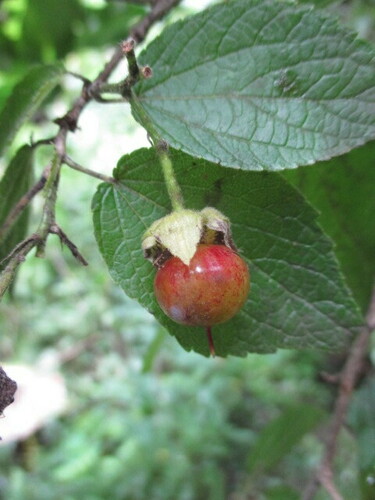
It is a small tree. It grows up to 5-15 m high. It is without spines on the trunk. The trunk is often crooked. Leaves are 10-20 cm long and 5-9 cm wide. New leaves are deep red. Flowers have both sexes. The fruit is round, green when young and dark red when ripe. It is about 2-3 cm across. It has 5 seeds inside.
Edible Uses
The fruits are edible raw or cooked but usually not eaten fresh, instead being used in jams, preserves, and syrups.
Traditional Uses
Many kinds have sour fruit so they are often cooked or used for jam, jellies, syrups and preserves. The seeds are removed.
This uses section is brief — help expand it
Distribution
A tropical plant. It suits the hot humid tropical lowlands. Trees occur in New Britain in Papua New Guinea and some other coastal areas. They grow from sea level up to about 1300 m. They can grown on a variety of soils.
Where It Grows
Africa, Asia, Bangladesh, Bougainville, China, Cuba, East Africa, Fiji, India, Indonesia, Malaysia, Martinique, Myanmar, Pacific, Papua New Guinea, PNG, Philippines, Puerto Rico, SE Asia, Solomon Islands, Sri Lanka, West Indies,
Cultivation
Trees are mostly grown from seed. It is better to grow them by air layering or budding. Seedlings take up to 18 months to be ready to plant out. A spacing of 12-16 m apart is needed. Seeds are small.
Propagation
Seed - Air-layering. Budding
Production
Trees last for about 20 years. Fruit is mostly ready about May to July in the Southern hemisphere. Fruit matures in 60 days. A well maintained tree can yield 250 kg of fruit.
Other Information
Trees occur occasionally in coastal areas of Papua New Guinea.
Notes
There are about 17 Flacourtia species. Also put in the Flacourtiaceae family.
Also Known As
Koorkup, Loai, Lobeh-lobeh, Lobi-lobi, Looy-looy, Lubi-lubi, Martinique plum, Rukam masam, Saradan kayu, Tomi-tomi
References (39)
- Lovi lovi references Flacourtia inermis
- Ambasta, S.P. (Ed.), 2000, The Useful Plants of India. CSIR India. p 225
- Ashton, M. S., et al 1997, A Field Guide to the Common Trees and Shrubs of Sri Lanka. WHT Publications Ltd. pdf p 213
- Backer, 1907, Fl. Bat. 1, 68
- Backer & Bakh. f. 1963-1968. Flora of Java.
Show all 39 references Hide references
- Barwick, M., 2004, Tropical and Subtropical Trees. A Worldwide Encyclopedic Guide. Thames and Hudson p 190
- Borrell, O.W., 1989, An Annotated Checklist of the Flora of Kairiru Island, New Guinea. Marcellin College, Victoria Australia. p 80
- Burkill, I.H., 1935, A Dictionary of the Economic Products of the Malay Peninsula. p. 1039
- Clos, 1857, Ann. Sc. Nat. 1V, 8, 216
- Corner, E.J.H., 1940, Wayside Trees of Malaya. p 307
- Coronel, R.E., 1982, Fruit Collections in the Philippines. IBPGR Newsletter p 10
- Darley, J.J., 1993, Know and Enjoy Tropical Fruit. P & S Publishers. p 131
- Etoh, T. & Sundaresan, 1985, Food Plants in Fiji and Their Utilization. Kagoshima Univ. Res. Center S. Pac, Occasional Papers, No. 5. p. 145-164.
- Facciola, S., 1998, Cornucopia 2: a Source Book of Edible Plants. Kampong Publications, p 117
- French, B.R., 1986, Food Plants of Papua New Guinea, A Compendium. Asia Pacific Science Foundation p 246
- French, B.R., 2010, Food Plants of Solomon Islands. A Compendium. Food Plants International Inc. p 241
- Gilg., 1918, Bot. Jahrb. 55, 282
- Hedrick, U.P., 1919, (Ed.), Sturtevant's edible plants of the world. p 310
- Heyne, K., 1927, Nutt. Plant. Ned. Ind. p 1140
- Hook. f. Flora of British India. 1872-1897
- Hu, Shiu-ying, 2005, Food Plants of China. The Chinese University Press. p 564
- Jack, W., 1820, Descriptions of Malayan Plants. p 25. 1977 reprint Boerhaav. Press, Leiden.
- Kiple, K.F. & Ornelas, K.C., (eds), 2000, The Cambridge World History of Food. CUP p 1869
- Lembaga Biologi Nasional, 1977, Buah-Buahan, Balai Pustaka, Jakarta. p 84
- Little, E. L., et al, 1974, Trees of Puerto Rico and the Virgin Islands. USDA Handbook 449. Forestry Service. p 580
- Macmillan, H.F. (Revised Barlow, H.S., et al) 1991, Tropical Planting and Gardening. Sixth edition. Malayan Nature Society. Kuala Lumpur. p 300
- Martin, F. W., et al, 1987, Perennial Edible Fruits of the Tropics. USDA Handbook 642 p 28
- Miguel, E., et al, 1989, A checklist of the cultivated plants of Cuba. Kulturpflanze 37. 1989, 211-357
- Morton, J. F., 1987, Fruits of Warm Climates. Wipf & Stock Publishers p 317
- Ochse,J.J., Dijkman,M.J., Soule, M.J.& Wehlburg,C., 1961, Tropical and Subtropical Agriculture. p 604-606.
- Perera, A. H. and Rajapakse, R. M. N., 1991, A baseline study of Kandyan Forest Gardens of Sri Lanka: Structure, composition and utilization. Forest Ecology and Management, 45:269-280
- Pl. Coromandel 3:16, t. 222. 1811
- Kunkel, G., Plants for human consumption
- Sleumer, H., 1954, Flacourtiaceae in Flora Malesiana, Ser 1 Vol 5(1) p 71
- Steenis, ed. 1948-. Flora malesiana.
- Sukarya, D. G., (Ed.) 2013, 3,500 Plant Species of the Botanic Gardens of Indonesia. LIPI p 295
- Terrell et al. 1986. Agric. Handb. no. 505.
- USDA, ARS, National Genetic Resources Program. Germplasm Resources Information Network - (GRIN). [Online Database] National Germplasm Resources Laboratory, Beltsville, Maryland. Available: www.ars-grin.gov/cgi-bin/npgs/html/econ.pl (10 April 2000)
- Wiersema, J. H. & Leon, B., 2013, World Economic Plants. A Standard Reference CRC Press. 2nd Ed. p 307