Ficus virens
Aiton ex Dryander
White Fig, Banyan, Deciduous Fig
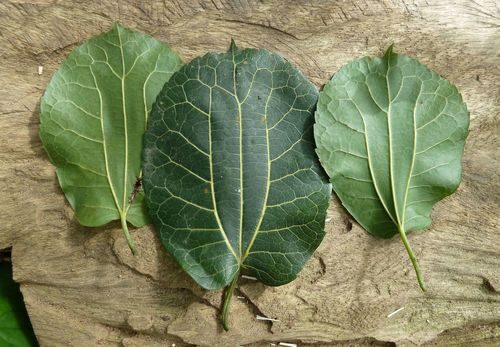
iNaturalist· cc-by-nc
(c) Shiwalee Samant, some rights reserved (CC BY-NC)
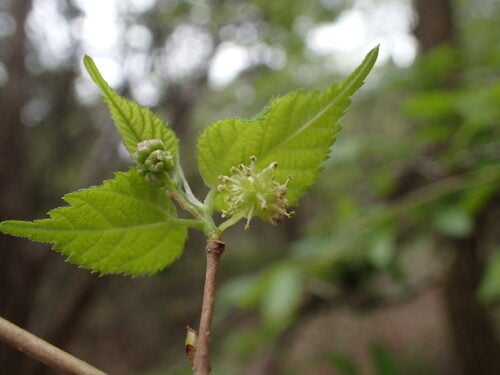
iNaturalist· cc-by-nc
(c) Radha Veach, some rights reserved (CC BY-NC), uploaded by Radha Veach
Summary
Source: WikipediaFicus virens is a semi-deciduous plant of the genus Ficus found in Pakistan, India, east and Southeast Asia, through Malaysia and into Northern Australia. Its common name is white fig; it is locally known as pilkhan and in the Kunwinjku language it is called manbornde. Like many figs, its fruits are edible. One of the most famous specimens of this tree is the Curtain Fig Tree of the Atherton Tableland, near Cairns, a popular tourist attraction. Another famous example is the Tree of Knowledge in Darwin. Ficus virens var. sublanceolata occurs the subtropical rainforest of northeastern New South Wales, and south eastern Queensland in Australia.
Description
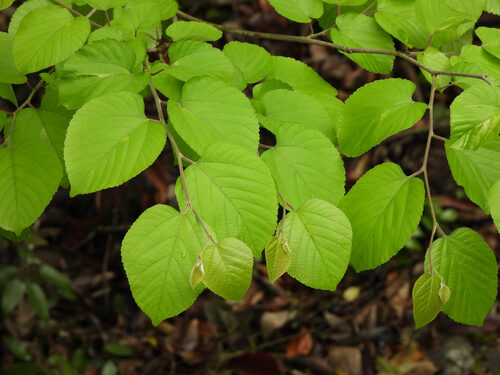
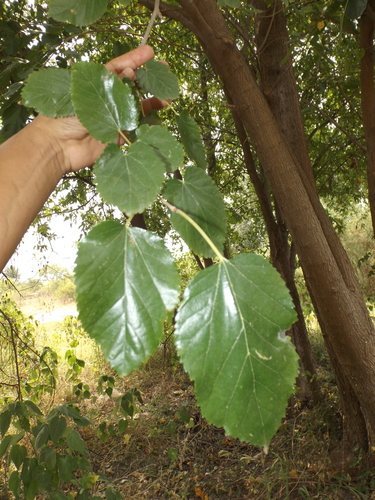
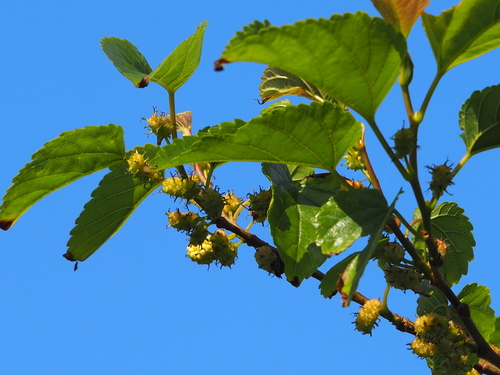
A fig. It is a tall and often very large tree. It can lose all or some of its leaves during the year. It grows 15-30 m high and spreads 15-40 m across. It is a widely spreading plant often with a rounded crown. It can have both strangling roots and aerial roots. The trunk is short and very thick. It has irregular flanges on it and buttresses. It can have a mass of prop roots. The bark is dark grey to brown. Young shoots are bright green. The leafy growth at the base of the leaf is sword shaped and 10 cm long. The leaf stalk is 2-5 cm long. The leaves are 6-15-20 cm long and 4-6 cm wide. They are oval or sword shaped and thin but leathery. They are dark green above but with pale veins and leaves are dull underneath. The male and female flowers occur in the one fig. The male flowers are few and near the opening. The fruit or figs are about 1 cm across. They are round and greenish white to brown with white or red dots. They are wrinkled on the surface. Varieties with different leaf shapes have been described.
Edible Uses
The leaves are known in Thai cuisine as phak liap (Thai: ผักเลียบ). They are eaten boiled as a vegetable in Northern Thai curries, referred to in the Northern dialect as phak hueat (ผักเฮือด).
Traditional Uses
The fruit are eaten. The young leaves are cooked and eaten. They are also used in soup. The buds or stipules are boiled to give a sour taste.
This uses section is brief — help expand it
Medicinal Uses
A decoction of the bark is used as an injection in the treatment of leucorrhoea[240. Applied externally, a bark decoction is used as a wash on ulcers and as a gargle in salivation.
Distribution
It is a tropical plant. It grows in a range of locations including rocky outcrops and rainforest. It needs well drained soil. It can grow in dry and humid regions. It is damaged by frost. In China it grows between 300-2700 m altitude in S China. Melbourne Botanical gardens. It suits hardiness zones 10-12. In XTBG Yunnan. In Townsville Queens BG.
Where It Grows
Africa, Andamans, Asia, Australia, Bhutan, Cambodia, Caroline Islands, China, Chuuk, East Timor, Egypt, Hawaii, Himalayas, India, Indochina, Indonesia, Laos, Malaysia, Myanmar, North Africa, Northeastern India, Pacific, Pakistan, Papua New Guinea, PNG, Philippines, SE Asia, Sikkim, Solomon Islands, Sri Lanka, Thailand, Timor-Leste, USA, Vanuatu, Vietnam,
Cultivation
Trees can be grown from seed or aerial layers. Cuttings from young shoots strike easily. It often naturally starts in the fork of a host tree and eventually strangles and kills the other tree.
Other Uses
The latex is used for caulking boats and waterproofing. The light coloured wood is soft and porous. The wood, including the aerial roots, is used locally in light construction, tool making etc. The wood is used for fuel. Grown as a shade tree in coffee plantations.
Production
Trees grow quickly. In Australia, fruit mature June to October.
Other Information
It is a preferred vegetable. It is sold in local markets.
Notes
There are about 800-1000 Ficus species. They are mostly in the tropics. There are 120 Ficus species in tropical America.
Synonyms
Also Known As
Aaw, Albayi, Amchar, Biguan Rong, Chakkila, Ge bpong yang, Gelong den, Hishi, Hpak-hi, Kabra, Labra, Lu huang ge shu, Neme adao, Niza bao, Nuo na zi, Nyaung-chin, Nyaung-gyin, Nyaung-shin, Pakar, Pakur, Pa luo, Payer, Pen-cap banyan, Phak lueat, Pilkhan, Putkal, Sour buds tree, Suan bao shu
References (62)
- Abdel-Hameed, E. S., 2009, Total phenolic contents and free radical scavenging activity of certain Egyptian Ficus species leaf samples. Food Chemistry 114: 1271-1277
- Ajesh, T. P., et al, 2012, Ethnobotanical Documentation of Wild Edible Fruits used by Muthuvan Tribes of Idukki, Kerala-India. International Journal of Pharma and Bio Sciences 3(3): 479-487 (As Ficus virence var. virence)
- Anderson, E. F., 1993, Plants and people of the Golden Triangle. Dioscorides Press. p 211
- Anon., 2003, Native Plants for the Fitzroy basin. Society for Growing Australian Plants Inc. (Rockhampton Branch) p 56
- Beasley, J., 2011, Plants of Tropical North Queensland - the compact guide. Footloose publications. p 97
Show all 62 references Hide references
- Brock, J., 1993, Native Plants of Northern Australia, Reed. p 190
- Calvert, G., 2010, The Burdekin Delta Tree Guide. Lower Burdekin Landcare Association., Inc., Ayr p 85
- Cancilla, D., 2018, Ethnobotanical and Ethnozoological Values Desktop Assessment - Eliwana Project. p 13
- Cao, Y., et al, 2020, Ethnobotanical study on wild edible plants used by three trans-boundary ethnic groups in Jiangcheng County, Pu’er, Southwest China. Journal of Ethnobiology and Ethnomedicine (2020) 16:66
- Cooper, W. and Cooper, W., 2004, Fruits of the Australian Tropical Rainforest. Nokomis Editions, Victoria, Australia. p 328
- Cowie, I, 2006, A Survey of Flora and vegetation of the proposed Jaco-Tutuala-Lore National Park. Timor-Lests (East Timor) www.territorystories.nt/gov.au p 51
- Cundall, P., (ed.), 2004, Gardening Australia: flora: the gardener's bible. ABC Books. p 604
- Dobriyal, M. J. R. & Dobriyal, R., 2014, Non Wood Forest Produce an Option for Ethnic Food and Nutritional Security in India. Int. J. of Usuf. Mngt. 15(1):17-37
- Elliot, W.R., & Jones, D.L., 1992, Encyclopedia of Australian Plants suitable for cultivation. Vol 4. Lothian. p 292 (Drawing)
- Etherington, K., & Imwold, D., (Eds), 2001, Botanica's Trees & Shrubs. The illustrated A-Z of over 8500 trees and shrubs. Random House, Australia. p 329
- Flora of Australia, Volume 3, Hamamelidales to Casuarinales, Australian Government Publishing Service, Canberra (1989) p 33, 34
- Flora of China.
- Flora of Pakistan. www.eFloras.org
- French, B.R., 2010, Food Plants of Solomon Islands. A Compendium. Food Plants International Inc. p 85
- GUPTA, (As Ficus infectoria)
- Hearne, D.A., & Rance, S.J., 1975, Trees for Darwin and Northern Australia. AGPS, Canberra p 71, Pl 17
- Hibbert, M., 2002, The Aussie Plant Finder 2002, Florilegium. p 102
- Hort. kew. 3:451. 1789
- Jackes, B.R., 2001, Plants of the Tropics. Rainforest to Heath. An Identification Guide. James Cook University. p 67
- Jones D, L, 1986, Ornamental Rainforest Plants in Australia, Reed Books, p 221
- Kannan, M., et al, 2015, Ethnobotanical survey on wild edible plants of Kalrayan Hills, Salem District, Tamil Nadu, India. Global J. Res. Med Plants & Indigen. med. 4(12): 236-246
- Kenneally, K.E., Edinger, D. C., and Willing T., 1996, Broome and Beyond, Plants and People of the Dampier Peninsula, Kimberley, Western Australia. Department of Conservation and Land Management. p 139
- Krishen P., 2006, Trees of Delhi, A Field Guide. DK Books. p 100
- Kunwar, R.M. & Bussmann, R. W., 2006, Ficus (Fig) species in Nepal: a review of diversity and indigenous uses. Lyonia 11(1)
- Lazarides, M. & Hince, B., 1993, Handbook of Economic Plants of Australia, CSIRO. p 114
- Lebot, V. & Sam, C., Green desert or ‘all you can eat’? How diverse and edible was the flora of Vanuatu before human introductions?. Terra australis 52 p 408
- Levitt, D., 1981, Plants and people. Aboriginal uses of plants on Groote Eylandt. Australian Institute of Aboriginal Studies, Canberra. p 104
- Lord, E.E., & Willis, J.H., 1999, Shrubs and Trees for Australian gardens. Lothian. p 16
- Low, T., 1991, Wild Food Plants of Australia. Australian Nature FieldGuide, Angus & Robertson. p 80
- Martin, F.W. & Ruberte, R.M., 1979, Edible Leaves of the Tropics. Antillian College Press, Mayaguez, Puerto Rico. p 206 (As Ficus infectoria)
- Melzer, R. & Plumb, J., 2011, Plants of Capricornia. Belgamba, Rockhampton. p 211
- Mon, A. M., 2020, The uses of fig (Ficus) by five ethnic minority communities in Southern Shan State, Myanmar. Journal of Ethnobiology and Ethnomedicine (2020) 16:55
- Mukhia, P.K., et al, 2013, Wild plants as Non Wood Forest Products used by the rural community of Dagana, a southern foothill district of Bhutan, SAARC Journal, 27 pages
- Nicholson, N & H., 1994, Australian Rainforest Plants 4, Terania Rainforest Publishing. NSW. p 35
- Paczkowska, G . & Chapman, A.R., 2000, The Western Australian Flora. A Descriptive Calatogue. Western Australian Herbarium. p 332
- Pearson, S. & A., 1992, Rainforest Plants of Eastern Australia. Kangaroo Press p 110
- Pradheep, K., et al, 2016, Wild edible plants used by Konyak tribe in Mon district of Nagaland: Survey and inventorisation. Indian Journal of Natural Products and Resources. Vol 7(1) pp 74-81
- Sharma, B.D., & Lakshminarasimhan, P., 1986, Ethnobotanical Studies on the Tribals of Nasik District (Maharashtra). J. Econ. Tax. Bot. Vol. 8 No. 2 pp 439-446
- Shi, Y. et al, 2014, An ethnobotanical study of the less known wild edible figs (genus Ficus) native to Xishuangbanna Southwest China. Journal of Ethnobiology and Ethnomedicine. 10:68
- Shin, T., et al, 2018, Traditional knowledge of wild edible plants with special emphasis on medicinal uses in Southern Shan State, Myanmar. Journal of Ethnobiology and Ethnomedicine (2018) 14:48
- Smith, M & Kalotas, A. C., 1985, Bardi Plants: An Annotated List of Plants and Their Use by the Bardi Aborigines of Dampierland, in North-western Australia. Rec. West Aust. Mus. 1985, 12(3): 317-359
- Smith, N and Wightman, G.M., 1990, Ethnobotanical Notes from Belyuen Northern Territory Australia. Northern Territory Botanical Bulletin No 10. Parks and Wildlife Commission of the Northern Territory. p 14, 15.
- Smith, N. M., 1991, Ethnobotanical Field Notes from the Northern Territory, Australia, J. Adelaide Bot. Gard. 14(1): 1-65
- Staples, G.W. and Herbst, D.R., 2005, A tropical Garden Flora. Bishop Museum Press, Honolulu, Hawaii. p 411
- Sukarya, D. G., (Ed.) 2013, 3,500 Plant Species of the Botanic Gardens of Indonesia. LIPI p 292
- Sundriyal, M., et al, 2004, Dietary Use of Wild Plant Resources in the Sikkim Himalaya, India. Economic Botany 58(4) pp 626-638
- Swaminathan, M.S., and Kochnar, S.L., 2007, An Atlas of major Flowering Trees in India. Macmillan. p 262
- Terra, G.J.A., 1973, Tropical Vegetables. Communication 54e Royal Tropical Institute, Amsterdam, p 46 (As Ficus infectoria)
- Townsend, K., 1994, Across the Top. Gardening with Australian Plants in the tropics. Society for Growing Australian Plants, Townsville Branch Inc. p 215
- Valder, P., 1999, The Garden Plants of China. Florilegium. p 286
- Vigilante, T., et al, 2013, Island country: Aboriginal connections, values and knowledge of the Western Kimberley islands in the context of an island biological survey. Records of the Western Australian Museum Supplement 81: 145-182
- Wheeler, J.R.(ed.), 1992, Flora of the Kimberley Region. CALM, Western Australian Herbarium, p 83
- Wightman, G. M. & Andrews, M.R., 1989, Plants of Northern Territory Monsoon Vine Forests (Vol 1). Conservation Commission of Northern Territory. p 44
- Williams, J.B., Harden, G.J., and McDonald, W.J.F., 1984, Trees and shrubs in rainforests of New South Wales and Southern Queensland. Univ. of New England, Armidale. p 66
- Williams, K.A.W., 1999, Native Plants of Queensland Volume 4. Keith A.W. Williams North Ipswich, Australia. p 196
- World Checklist of Useful Plant Species 2020. Royal Botanic Gardens, Kew
- Yunupinu Banjgul, Laklak Yunupinu-Marika, et al. 1995, Rirratjinu Ethnobotany: Aboriginal Plant Use from Yirrkala, Arnhem Land, Australia. Northern Territory Botanical Bulletin No 21. Parks and Wildlife Commission of the Northern Territory. p 42.