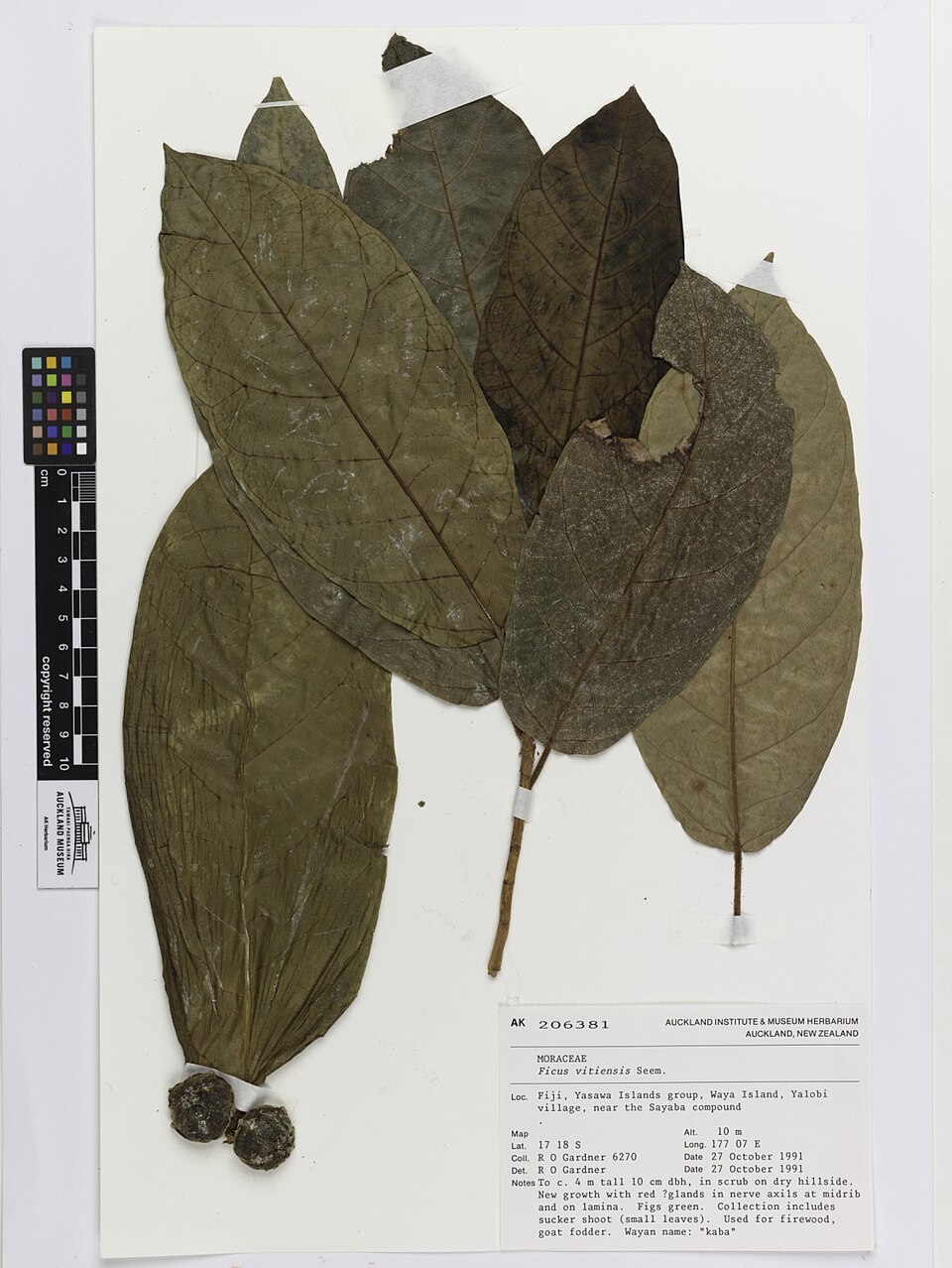
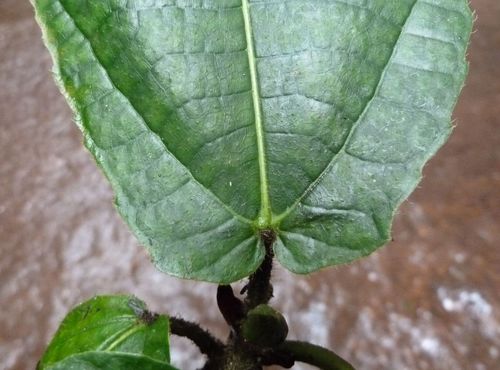
Ficus abutilifolia
(Miq.) Miq
Large-leaved rock fig
iNaturalist· cc0
no rights reserved
iNaturalist· cc-by-nc
(c) Richard Gill, some rights reserved (CC BY-NC), uploaded by Richard Gill
iNaturalist· cc-by-nc
(c) Duncan McKenzie, some rights reserved (CC BY-NC), uploaded by Duncan McKenzie
Summary
Source: WikipediaFicus abutilifolia, the large-leaved rock fig, is a species of African rock-splitting fig that occurs in two disjunct regions, one population north, and another south of the equator. The two populations are pollinated by different fig wasps, and are morphologically distinct. It is named for the similarity of its broadly ovate leaves to that of Abutilon. It is virtually restricted to cliff faces and rock outcrops, and is easily recognized from its large, glabrous leaves and smooth, pale bark.
Description
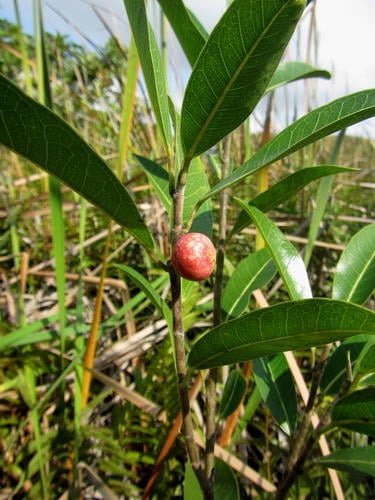
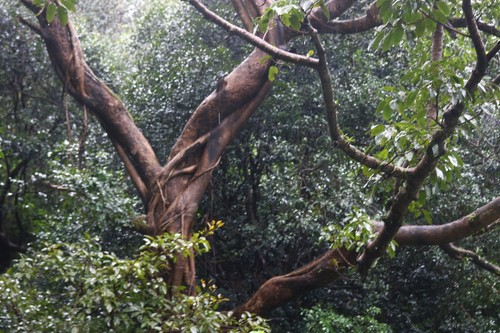
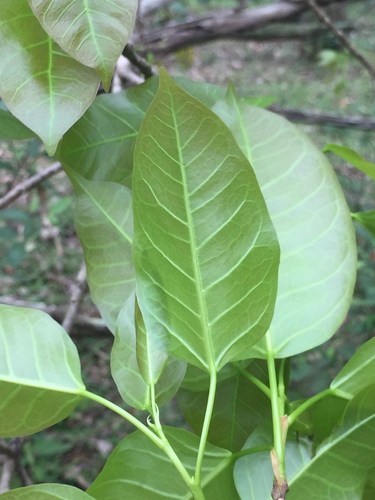
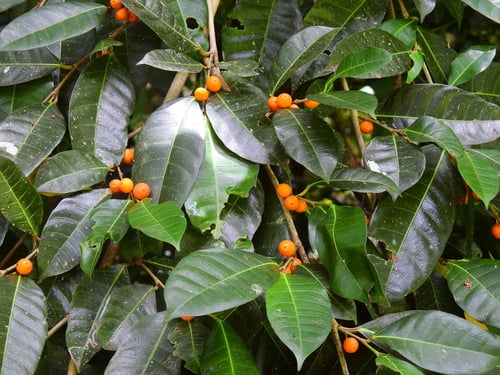
A fig. It is a shrub or medium sized tree. It loses its leaves during the year. It grows 6-10 m high and spreads 6 m wide. It can also be a bush 3-4 m high. The crown can spread widely and the bush is almost round. The bark is smooth and creamy-white. The trunk is twisted and branches low down. The branches are stout. The leaves are large and almost round. The leaves are alternate and leathery. They have a deep notch in the base. They are bright green and the veins are red. The leaves are 5-15 cm long by 5-17 cm wide. The figs are on the ends of small branches in the axils of leaves. They are 1-1.6 cm across. They are smooth or slightly hairy. The fruit are figs produced either singly or in small groups. They are green with cream spots. They are red when ripe. They have a very short stalk.
Edible Uses
Fruit - raw. Usually very palatable, but they can be somewhat sour, and insipid. They can be dried for later use. The fruits are 15 - 25mm in diameter. Leaves - cooked and eaten as a vegetable. The leaves are only eaten very occasionally.
Traditional Uses
The fruit are eaten raw. Figs can be dried and stored. Leaves are occasionally eaten. Aerial roots are eaten.
This uses section is brief — help expand it
Medicinal Uses
Decoctions prepared from the leaves are used in promoting fertility in humans. The leaves are used as a remedy against stomach aches. The milky latex derived from the plant is applied externally to remove skin warts. A decoction of the bark is taken by men as a strengthening tonic.
Distribution
It is a tropical and subtropical plant. It normally grows over rock outcrops in full sun. It is damaged by frost. It grows in dry areas. It can grow in arid places. It grows in savannah and is often on rocky sites. It grows from cracks and crevices and splits the rocks. In Zimbabwe it grows up to 1,360 m above sea level. It suits hardiness zones 9-12.
Where It Grows
Africa, Benin, Botswana, Burkina Faso, Cameroon, Central Africa, Congo DR, East Africa, Eswatini, Ethiopia, Ghana, Guinea, Guinée, Malawi, Mali, Mozambique, Nigeria, Senegal, Somalia, South Africa, Southern Africa, Sudan, Swaziland, Tanzania, Uganda, West Africa, Zambia, Zimbabwe,
Cultivation
Plants can be grown from seeds or cuttings. The seeds are small and need to be mixed with sand for sowing. Fresh seeds should be used. Seedlings transplant well. The pollinating wasps are Nigeriella fusciceps Wiebes and Elisabethiella comptoni Wiebes.
Propagation
Seed - best sown as soon as it is ripe in a lightly shaded position in a nursery seedbed. Germination can be expected within 10 - 30 days depending on temperature and the freshness of the seed - fresh seed and warm temperatures will favour more rapid germination. Seedlings should be placed in a sunny position and eventually transplanted into a well-drained sandy mix rich in organic matter. Cuttings are not as easy as many other species in this genus, but can be successful. Take softwood or semi-hardwood cuttings, around 20 - 25cm long. Remove the lower leaves from the stem. Insert into a washed river sand mix and place in a misting unit, or if this is not available, place the tray with cuttings inside a clear plastic bag to reduce the adverse effects of transpiration. These should root within a month and be ready for transplanting in a further 3 - 4 weeks into a rich, well-drained medium.
Other Uses
The wood is light and soft, yet tough. It becomes a yellow-brown when dry and works easily and polishes well but on the whole it is not of much use to people. This species belongs to the 'rock splitting' group of figs which are confined to rocky habitats, often germinating on bare rock surfaces. Their roots penetrate small cracks in the rocks and, as the roots grow larger, they can end up causing large splits in the rock. The tree can be grown as an ornamental, but because of its aggressive root system it is advisable to keep it away from buildings, paved areas and swimming pools.
Production
Seedlings grow slowly at first.
Notes
There are about 800 Ficus species. They are mostly in the tropics. There are 120 Ficus species in tropical America.
Nutrition
| Part | Moisture | kJ | kcal | Protein | Vit A | Vit C | Iron | Zinc |
|---|---|---|---|---|---|---|---|---|
| Fruit | 85.2 | 205 | 49 | 0.7 | — | 17 | 0.1 | 0.1 |
Synonyms
Also Known As
Danehi, Fatuma bidia, Foloka, Grootblaarrotsvy, Gyedua, Hobanhobata, Mfawa, Mubungu-bungu, Yandi
References (31)
- Achigan-Dako, E, et al (Eds), 2009, Catalogue of Traditional Vegetables in Benin. International Foundation for Science.
- Addis, G., Asfaw, Z & Woldu, Z., 2013, Ethnobotany of Wild and Semi-wild Edible Plants of Konso Ethnic Community, South Ethiopia. Ethnobotany Research and Applications. 11:121-141
- Ann. Mus. Bot. Lugduno-Batavum 3:288. 1867-1868 ("1867")
- Avouhou, H. T., et al, 2012, Ethnobotanical Factors Influencing the Use and Management of Wild Edible Plants in Agricultural Environments in Benin. Ethnobotany Research & Applications. Vol. 10:571-592
- Burkill, H. M., 1985, The useful plants of west tropical Africa, Vol. 4. Kew.
Show all 31 references Hide references
- Dalziel, J. M., 1937, The Useful plants of west tropical Africa. Crown Agents for the Colonies London.
- Dansi, A., et al, 2008, Traditional leafy vegetables and their use in the Benin Republic. Genet Resour Crop Evol (2008) 55:1239–1256
- Etherington, K., & Imwold, D., (Eds), 2001, Botanica's Trees & Shrubs. The illustrated A-Z of over 8500 trees and shrubs. Random House, Australia. p 325
- Fowler, D. G., 2007, Zambian Plants: Their Vernacular Names and Uses. Kew. p 48
- Fox, F. W. & Young, M. E. N., 1982, Food from the Veld. Delta Books. p 274 (As Ficus soldanella)
- Gallagher, D. E., 2010, Farming beyond the escarpment: Society, Environment, and Mobility in Precolonial Southeastern Burkina Faso. PhD University of Michigan.
- Grivetti, 1976, 1979,
- Grivetti, L. E., 1980, Agricultural development: present and potential role of edible wild plants. Part 2: Sub-Saharan Africa, Report to the Department of State Agency for International Development. p 79 (As Ficus soldanella)
- INFOODS:FAO/INFOODS Databases
- Jardin, C., 1970, List of Foods Used In Africa, FAO Nutrition Information Document Series No 2.p 136
- Joffe, P., 2007, Creative Gardening with Indigenous Plants. A South African Guide. Briza. p 67
- Long, C., 2005, Swaziland's Flora - siSwati names and Uses http://www.sntc.org.sz/flora/
- Lulekal, E., et al, 2011, Wild edible plants in Ethiopia: a review on their potential to combat food insecurity. Afrika Focus - Vol. 24, No 2. pp 71-121
- Moksia, F., et al, 2019, Diversity and Socio-Economic Value of Wild Edible Plants in the Mounts Mandara Region, Cameroon. International Journal of Sciences. Vol. 8:10
- MORTIMORE,
- Peters, C. R., O'Brien, E. M., and Drummond, R.B., 1992, Edible Wild plants of Sub-saharan Africa. Kew. p 147
- Royal Botanic Gardens, Kew (1999). Survey of Economic Plants for Arid and Semi-Arid Lands (SEPASAL) database. Published on the Internet; http://www.rbgkew.org.uk/ceb/sepasal/internet [Accessed 4th May 2011] (As Ficus soldanella)
- Ruiters-Welcome, A. K., 2019, Food plants of southern Africa. Ph.D. thesis. Univ. of Johannesburg p 79
- Swaziland's Flora Database http://www.sntc.org.sz/flora
- van Wyk, B, van Wyk, P, and van Wyk B., 2000, Photographic guide to Trees of Southern Africa. Briza. p 150
- Venter, F & J., 2009, Making the most of Indigenous Trees. Briza. p 158
- Vivien, J., & Faure, J.J., 1996, Fruitiers Sauvages d'Afrique. Especes du Cameroun. CTA p 211
- Wehmeyer, A. S, 1986, Edible Wild Plants of Southern Africa. Data on the Nutrient Contents of over 300 species
- Welcome, A. K. & Van Wyk, B.-E., 2019, An inventory and analysis of the food plants of southern Africa. South African Journal of Botany 122 (2019) 136–179
- World Checklist of Useful Plant Species 2020. Royal Botanic Gardens, Kew
- www.figweb.org