Ficus obliqua var. petiolaris
G. Forster, (Benth) Corner
Larger small-leaved fig
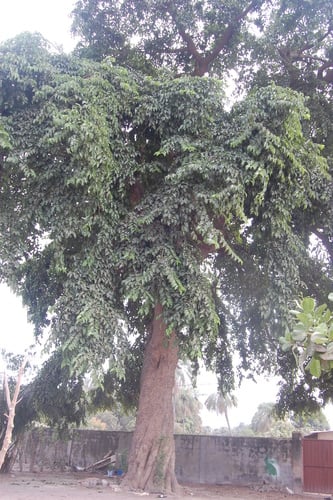
iNaturalist· cc-by-nc
(c) geoffbartram, some rights reserved (CC BY-NC)
iNaturalist· cc-by-nc
(c) Geoffrey Sinclair, some rights reserved (CC BY-NC), uploaded by Geoffrey Sinclair
Summary
Source: WikipediaFicus obliqua, commonly known as the small-leaved fig, is a tree in the family Moraceae, native to eastern Australia, New Guinea, eastern Indonesia to Sulawesi and islands in the southwestern Pacific Ocean. Previously known for many years as Ficus eugenioides, it is a banyan of the genus Ficus, which contains around 750 species worldwide in warm climates, including the edible fig (Ficus carica). Beginning life as a seedling, which grows on other plants (epiphyte) or on rocks (lithophyte), F. obliqua can grow to 60 m (200 ft) high and nearly as wide with a pale grey buttressed trunk, and glossy green leaves. The small round yellow fruit ripen and turn red at any time of year, although ripening peaks in autumn and winter (April to July). Known as a syconium, the fruit is an inverted inflorescence with the flowers lining an internal cavity. Ficus obliqua is pollinated by two species of fig wasp—Pleistodontes greenwoodi and P. xanthocephalus. Many species of bird, including pigeons, parrots and various passerines, eat the fruit. The range is along the east coast from Queensland, through New South Wales in rainforest, savanna woodland, sclerophyll forest and gallery forest. It is used as a shade tree in parks and public spaces, and is well-suited for use as an indoor plant or in bonsai. All parts of the tree have been used in traditional medicine in Fiji.
Description
A fig. It is a tree. The leaves are simple and 6-10 cm long. The young growth is hairy while the mature growth is smooth. The fruit are 10-18 mm across. They occur in pairs in the axils of leaves. The ripe figs can be cream, yellow, orange, red or pink. They have many seeds. The fruit are edible.
Edible Uses
The fruit are edible.
Medicinal Uses
Ficus obliqua is an elegant shade tree for parks or fields, and is adaptable to differing soils. A notable specimen in Mick Ryan Park, Milton on the New South Wales south coast stands 14 m (46 ft) tall and 38 m (125 ft) across, and is a local landmark. Like other fig species that grow into large trees, Ficus obliqua is not suitable for any but the largest gardens as its aggressive root system invades drains and garden beds. Fig trees also drop large quantities of fruit and leaves, leaving a mess underfoot. Although it is much less used in bonsai than F. rubiginosa, F. obliqua is well-suited for use in the medium; its small leaves and trunk's propensity to thicken give it attributes optimal for a tree 10–80 cm (3.9–31.5 in) in height. It is seen in bonsai nurseries mainly in the Brisbane area, where it is a locally common species, and is very highly regarded by at least one proponent, Bradley Barlow. Barlow entered a specimen from Brisbane to the Bonsai Clubs International competition in 2006, winning a prize. It is also suited for use as an indoor plant in low-, medium- or brightly lit indoor spaces. The timber is too soft for use in woodworking. Known as baka or baka ni viti in Fiji, Ficus obliqua has many of its parts used in Fijian traditional medicine, and was previously held to be sacred there. Its white sap has been used for painful or swollen joints and limbs or boils, or diluted with water and drunk to improve breast milk. Liquid extracted from the root bark has been used for headaches or, when diluted, to improve health after childbirth, and the leaves are applied to venereal lesions. The species has been traditionally used for boils in Samoa and Tonga.
Distribution
A subtropical plant. It grows in rainforests in Queensland and New South Wales in Australia.
Where It Grows
Australia*,
Notes
There are about 800-1000 Ficus species. They are mostly in the tropics. There are 120 Ficus species in tropical America.
References (4)
- Cooper W & Cooper W T, 1994, Fruits of the Rain Forest. RD Press p 130
- Elliot, W.R., & Jones, D.L., 1992, Encyclopedia of Australian Plants suitable for cultivation. Vol 4. Lothian. p 288
- Flora of Australia, Volume 3, Hamamelidales to Casuarinales, Australian Government Publishing Service, Canberra (1989) p 45
- Gard. Bull. Singapore 17:402. 1960