Ficus nodosa
Teysm. & Binnend.
Rocky River Fig, Cape Fig
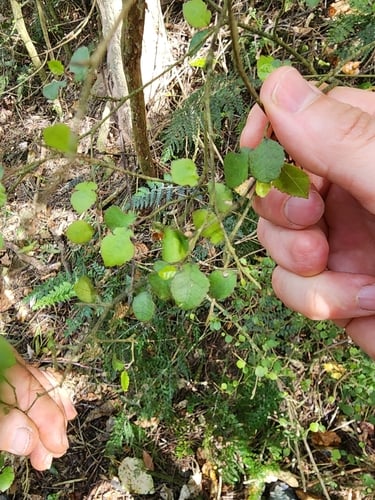
iNaturalist· cc-by-nc
(c) Aaron Bean, some rights reserved (CC BY-NC), uploaded by Aaron Bean
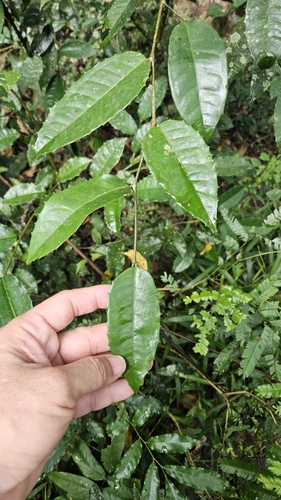
iNaturalist· cc-by-nc
(c) Aaron Bean, some rights reserved (CC BY-NC), uploaded by Aaron Bean
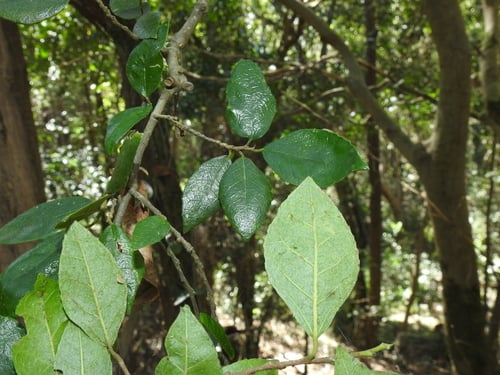
iNaturalist· cc-by-nc
(c) Aaron Bean, some rights reserved (CC BY-NC), uploaded by Aaron Bean
Description
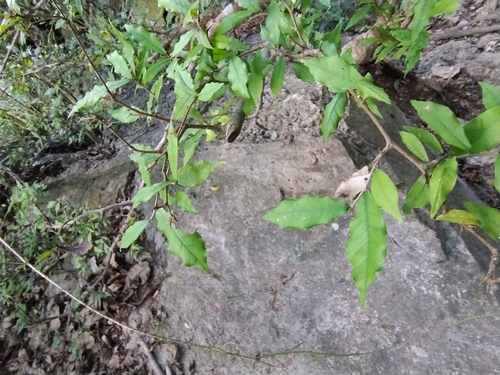
A fig. It is a small tree which grows 8-12 m high. It can be 30-40 m tall in tall forests. It spreads 6-12 m across. It has a rounded and often sparse crown. It does not have strangling nor aerial roots. The trunk is short and buttressed. The bark is reddish brown and scaly. The young shoots are pale green and covered densely with hairs. The leaves are large and heart shaped. The leaves are 12-24 cm long and 10-18 cm across. They are thin textured and have an irregular edge. They are mid green colour. The leaf stalks are 8-10 cm long. The fig fruit are 3-4 cm across. They are oval and reddish brown. They are produced in clusters on leafless shoots. These are produced on the trunk and older branches.
Edible Uses
Leaves. Fruit. The yellow to purple-brown, subglobose to almost pear-shaped fruits are 25 - 40mm in diameter.
Medicinal Uses
The leaves are applied externally as a styptic and antiseptic.
Distribution
A tropical and subtropical plant. It grows in the lowland rainforest. It can be in drier situations.
Where It Grows
Asia, Australia*, Indonesia, Pacific, Papua New Guinea, PNG, SE Asia, Solomon Islands,
Cultivation
Plants can be grown from seed or by aerial layering.
Other Uses
The fibrous bark is used to make strings and clothing. The bark is fibrous. We have no specific information for this species, but the fibre is likely to be used for making cordage, possibly cloth and maybe also to make tapa bark cloth. The fibrous branches can be used to clean the teeth. The leaves of some species are used to wrap food for cooking. The leaves of some species are quite rough and can be used as a sandpaper substitute and for scouring pots. The wood is occasionally used for timber. The wood of plants in this genus is usually of low quality, light in weight, soft and not very durable. It is sometimes used for purposes such as light construction, digging sticks, yam stakes, etc. The wood is also used for fuel and sometimes for making fire by friction.
Notes
There are about 800-1000 Ficus species. They are mostly in the tropics. There are 120 Ficus species in tropical America.
Synonyms
Also Known As
Kem kem, Laura, Paka, Pohon ara kali batu, Pohon ara sungai
References (9)
- Cooper, W. and Cooper, W., 2004, Fruits of the Australian Tropical Rainforest. Nokomis Editions, Victoria, Australia. p 325
- Elliot, W.R., & Jones, D.L., 1992, Encyclopedia of Australian Plants suitable for cultivation. Vol 4. Lothian. p 287
- Flora of Australia, Volume 3, Hamamelidales to Casuarinales, Australian Government Publishing Service, Canberra (1989) p 64
- Henderson, C. P. & Hancock, I. R., 1988,
- Peekel, P.G., 1984, (Translation E.E.Henty), Flora of the Bismarck Archipelago for Naturalists, Division of Botany, Lae, PNG. p 142, 144
Show all 9 references Hide references
- Powell, J.M., Ethnobotany. In Paijmans, K., 1976, New Guinea Vegetation. Australian National University Press. p 110
- PROSEA (Plant Resources of South East Asia) handbook, Volume 2, 1991, Edible fruits and nuts.
- Sukarya, D. G., (Ed.) 2013, 3,500 Plant Species of the Botanic Gardens of Indonesia. LIPI p 288
- Townsend, K., 1994, Across the Top. Gardening with Australian Plants in the tropics. Society for Growing Australian Plants, Townsville Branch Inc. p 213